Get email alerts on the Us 19 Transit Plan topic
No spam. Unsubscribe anytime.
Forward Pinellas authorizes US 19 regional transit service plan study with condition for midterm update
Summary
The board approved a work authorization to develop a US 19 regional transit service plan to refine station areas and service concepts; funding will use MPO transportation planning funds and the study is expected to take 12 months. The board added a condition to receive an update at roughly the 50% expenditure point.
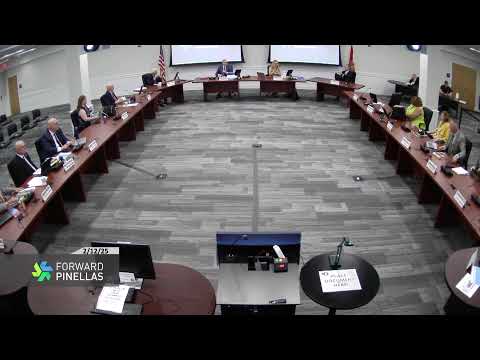
Forward Pinellas approved a work authorization to develop a US 19 regional transit service plan that will refine station-area locations, evaluate redevelopment potential, and produce recommended service concepts and cost estimates. The board approved the scope after a motion from Commissioner Flowers and a second from Commissioner Scott; Vice Chair Eggers secured a friendly amendment to require a board update at roughly the 50% midpoint of consultant expenditures.
Chelsea, presenting remotely as Forward Pinellas staff, outlined the study’s intent: to build on a 2022 TBARTA corridor study by narrowing an initial set of about 15 potential station areas, evaluating market-based redevelopment potential, producing 2-D and 3-D visualizations for up to 10 selected stations, and developing a phased implementation and cost estimate. Chelsea told the board, "This will be funded using MPO funds or our transportation funds," and said the study should be completed within 12 months.
The study will evaluate demographics and travel demand along US 19, refine service route concepts (express bus in mixed traffic versus dedicated lanes), estimate capital and operating costs, and propose public–private partnership opportunities. Presenters emphasized coordination with FDOT, PSTA, GoPasco and Pasco MPO; staff said Pasco County had offered potential funding support but internal staff and budget changes left that contribution uncertain.
Commissioner Eggers asked whether the study could be phased so the board could pause if early findings reduced the project’s merit. Eggers also referenced cost: "$300,000 is not, you know, the end of the world, but it's a lot of money, I think," a remark used by the board to justify the requested midterm update. The board agreed to the 50%-update amendment and approved the work authorization.
Board members stressed the need to examine first-mile/last-mile connections and to align potential station investments with private redevelopment to ensure public infrastructure supports market-driven outcomes. Staff said outreach will emphasize focus groups with corridor residents, workers and employers rather than broad online-only surveys.
Next steps: staff will execute the work authorization, begin outreach and return to the board with a midterm update at approximately the 50% expenditure point; any subsequent funding or service implementation decisions will require separate board and partner approvals.
AI generated
The text on this page is AI generated. Summaries, highlights, analysis, and video transcripts are all produced from the original source material.
AI can make mistakes, so if you spot one, and we will fix it for everyone.
Note: the source content is unaltered by us. Any content source we link to, be it a video, an audio recording, or a document, is presented exactly as its publisher released it. That publisher is usually a government body, sometimes an individual official or another organisation.