Lifetime Citizen Portal Access — AI Briefings, Alerts & Unlimited Follows
Senate conservation committee advances wetlands, park, PFAS and other measures; tree preservation bill sent back for more work
Loading...
Summary
The Senate Committee on Conservation, Natural Resources and Agriculture advanced measures affecting wetlands, state parks, PFAS monitoring and consumer disclosures and sent a contentious tree-preservation proposal back to stakeholders for more work.
The Senate Committee on Conservation, Natural Resources and Agriculture met in Richmond and advanced a series of environmental and land-use bills, including measures to create a state park, expand wetlands protections, require PFAS monitoring in the Occoquan Reservoir watershed and enable manufacturers to post batch-test results for toxic elements in baby and toddler foods.
Committee members voted to report or re-refer multiple bills to subsequent committees, while deferring further action on a permissive tree-preservation measure to allow stakeholders more time to negotiate.
Why it matters: The committee’s actions touch drinking-water safety, coastal and tidal wetland protection, state land acquisition and local land-use tools. Several items have fiscal implications — notably steps that could affect capital spending by Fairfax Water if PFAS sources are not reduced — and several measures were advanced to finance for budget review.
Most important actions and debate
PFAS in the Occoquan watershed: The committee advanced a bill directing industrial and certain stormwater dischargers in the Occoquan watershed to begin PFAS monitoring on a timetable set in the legislation, with DEQ authority to reopen permits if levels do not decline. Fairfax Water and local governments told the committee the reservoir is a unique, partially closed system where PFAS can accumulate and that meeting the new EPA drinking-water maximum contaminant level without source reductions could trigger large capital costs. Industry groups and airport authorities raised concerns about technical feasibility for some dischargers; supporters said the bill targets sources and permit timelines rather than demanding impossible immediate treatment.
Oak Hill State Park: Lawmakers advanced a bill that would allow the Commonwealth to acquire the roughly 1,200-acre Oak Hill property (the former Monroe homestead) without general-fund spending, using local and private funding pledged by Loudoun County and an endowment to cover operations. Supporters said the parcel has historic significance and that the owners have turned down development offers and proposed donating the property with an accompanying endowment and operating plan. Committee members asked about the state’s capacity to maintain parks; the bill was reported and referred to Finance with recorded votes and three abstentions.
Wetlands protection task force: The committee reported a bill establishing a task force to update and implement policies to protect tidal and nontidal wetlands. Advocates, including the Chesapeake Bay Foundation and Wetlands Watch, said Virginia’s existing “no net loss” goal is not being met and that a policy-focused group would help align agency programs with best available science.
Baby-food labeling for toxic elements: The committee advanced a bill requiring certain baby and toddler food packages to include a QR code linking to batch-test results for toxic elements (lead, cadmium, arsenic, mercury) and to a state-created working group. Pediatric physicians and child-health advocates testified to cases of elevated lead in young children and supported the bill as a prevention measure. The bill was reported and referred to Finance.
Blue catfish limit change: The committee approved legislation removing the one-fish-per-day limit for blue catfish in tidal rivers (excluding listed lakes and above the fall line), a step proponents called necessary to reduce the invasive species’ population; marine and recreational fishing witnesses debated whether removing the limit would help or harm fisheries and related businesses.
Tree-preservation bill sent to study: A bill creating a statewide framework to map and protect critical root zones for mature trees — a permissive option localities could adopt — drew extensive testimony from local governments, conservation groups, builders and developers. After lengthy discussion about costs, data and housing affordability, the committee voted to pass the measure by indefinitely (PBI) and send a letter asking stakeholders to continue negotiations.
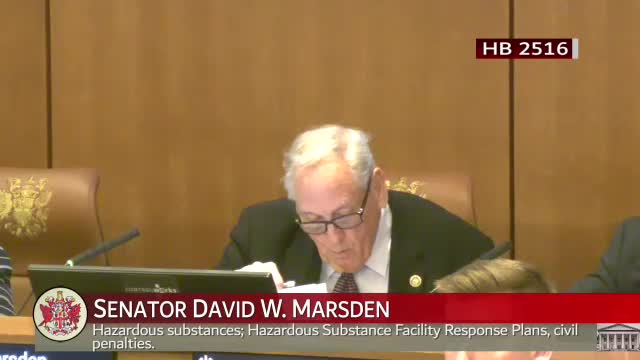
Votes at a glance (selected items) - Block: four House bills (HB 1697; HB 1798; HB 1810; HB 1968 as recorded) — motion to place in block and pass; roll call: Ayes 14, No 0. (block recorded in committee transcript) - HB 1948 (reported and re-referred to Finance): Ayes 14, No 0. - HB 2008 (reported): Ayes 8, No 6. - HB 2170 (reported and re-referred to Finance): Ayes 14, No 0. - HB ? (substitute conforming to SB 796; committee report recorded): Ayes 15, No 0. - HB 2516 (chemical storage/tank regulation, Delegate Lopez’s bill): reported and re-referred to Finance: Ayes 15, No 0. - Oak Hill State Park bill (creation/transfer; Delegate Lopez): reported and re-referred to Finance; recorded roll: Ayes 11, Nays 0, Abstentions 3. - HB 1837 (removes duplicative produce-broker license): reported; Ayes 15, No 0. - HB 1834 (move shallow-water dredging fund): reported and re-referred to Finance; Ayes 15, No 0. - HB 2238 (tree-preservation, Delegate Martinez): Passed to study (PBI) with a letter to stakeholders; Ayes 12, Nays 3. - HB 2782 (blue catfish limit removal, Delegate Simons): reported; Ayes 14, Nays 1. - HB 2517 (research on biosolids/sludge on state-owned lands, Delegate Runyon): reported; Ayes 15, No 0. - HB 2050 (PFAS / Occoquan monitoring, Delegate Bulova): reported and re-referred to Finance; Ayes 11, Nays 4. - HB 1844 (baby-food labeling, Delegate Maldonado): reported as amended and re-referred to Finance; Ayes 15, No 0.
What’s next: Several of the bills the committee reported were re-referred to Senate Finance for fiscal review; that committee’s deliberations will determine budget language or capital-plan implications. The tree-preservation proposal was put on hold so stakeholders can further negotiate details, particularly around cost and the effect on housing development.
Speakers who testified at length included Delegate Lopez, Delegate Martinez, Delegate Simons, Delegate Runyon, Delegate Bulova, Delegate Maldonado, witnesses from Fairfax Water and DEQ, multiple conservation groups (Chesapeake Bay Foundation, Wetlands Watch, James River Association), and industry groups (Virginia Manufacturers Association, Home Builders Association of Virginia).