Get AI Briefings, Transcripts & Alerts on Local & National Government Meetings — Forever.
Oregon Board of Pharmacy seeks $1.5 million for licensing system, proposes 40% fee increase
Loading...
Summary
At an Education Subcommittee public hearing Feb. 11, agency officials asked for $1.5 million to replace an aging licensing database, proposed a 40% across-the-board fee increase and described rising complaint volumes that the board says strain current staff and systems.
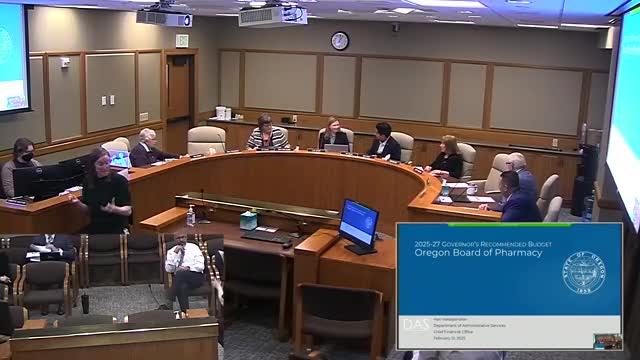
The Education Subcommittee held a public hearing on House Bill 5,028 on Tuesday, Feb. 11, to review the Oregon Board of Pharmacy’s budget request for the 2025–27 biennium. Agency and Department of Administrative Services representatives outlined a $1.5 million one-time request to modernize the board’s licensing and compliance system, a proposed 40% fee increase for all licenses and registrations, and ongoing operational pressures tied to rising complaint and inspection volumes.
The proposal matters because the board is an other-funded agency that relies on license and registration fees to support its work supervising pharmacists, pharmacy technicians and drug outlets statewide. Rosa Klein, interim executive director of the Oregon Board of Pharmacy, said the agency’s “mission today is to promote and protect public health, safety, and welfare by ensuring high standards in the practice of pharmacy and through effective regulation of the manufacture and distribution of drugs.”
Hari Valapandian, representing the Department of Administrative Services chief financial office, summarized the governor’s recommended budget for the board and said it “addresses all of these emerging issues as well as increases fees.” Valapandian told the committee the largest single proposed expenditure is a $1,500,000 one-time request to replace a licensing system whose vendor contract is ending and that lacks the compliance functionality the board needs.
Agency officials said the board currently employs 24 staff across licensing, compliance and operations and supports more than 21,000 licenses and nearly 11,000 registrations. Gary Runyon, the board’s pharmacist consultant, described a substantial increase in case workload: the board averaged about 600 complaint cases per year from 2013–2017, roughly 750 per year between 2018–2021, and about 1,100 cases annually in the past two years. “Providing compliance officers with the necessary tools, technology, and support to handle complex cases and expanding workloads effectively is paramount to fulfilling our statutory obligation,” Runyon said.
Officials said the board’s inspection cycle is biannual (July 1–June 30) and that, weather permitting, staff are on track to complete inspections for the current cycle. The board reported that only 64% of inspected pharmacies were in compliance in 2023–24, short of a stated target of 85%, and that the average time from complaint to board presentation was about 138 days in 2023, above the board’s 100-day target.
On revenue, the agency requested a 40% increase across all license and registration categories, the first broad increase since 2019 and a substantial adjustment for pharmacist licenses last raised in 2001. In a committee exchange, Representative Wright noted the 40% figure and asked what it would mean for an individual pharmacist’s renewal. Agency staff responded that a current pharmacist renewal of $200 would increase to $350 under the proposal.
CG Shelton Flores, the board’s chief financial and administrative officer, said agency revenues are “other fund” receipts generated primarily by license and registration fees and that without a fee increase the agency could not afford the proposed $1.5 million database investment or maintain a recommended six-month ending balance. Flores described cost-containment measures the agency already uses, including settlement of disciplinary cases before hearings and maximizing current software capacity, and said the $1.5 million estimate will be refined through procurement.
Committee members pressed for additional details on several topics: whether the database procurement would seek off-the-shelf solutions or bespoke development (agency staff said they have identified multiple vendors that provide licensing platforms used by other states and will pursue a competitive procurement), the expected timeline (the current system will no longer be supported after June 2026 and the agency aims for deployment by 2026), and whether the board collects structured reasons for pharmacy closures (the agency said it does not collect exit-reason data because gathering and acting on that information falls outside its statutory regulatory scope).
Representatives and senators on the committee also asked about staffing turnover and the impact on customer service and license issuance. Klein and Runyon said the board had a 33% reduction in licensing staff in recent years but had refilled positions and that licensing timeliness improved to about 74% of licenses issued within 30 days in 2024, compared with the board’s 75% target.
The subcommittee closed the public hearing after no members of the public signed up to testify. No formal vote or appropriation was taken during the hearing; the budget will be considered again in subsequent subcommittee work sessions.
The hearing included detail on two agency legislative concepts the board plans to file in the 2025 session: one would add authority to require evaluations for licensees (amend ORS 689.135) and another would fix statutory language to allow pharmacists to prescribe medication for opioid use disorder as intended by past legislation (amend ORS 475 and 689).