Get email alerts on the Criminal History Checks topic
No spam. Unsubscribe anytime.
Committee votes not to advance $5 million fingerprinting bill, cites larger process problems
Summary
Senate Bill 2194, which would have authorized up to $5 million for fingerprinting equipment and directed the Bureau of Criminal Investigation to provide four-day background results, received a unanimous "do not pass" recommendation after committee testimony said equipment is not the primary bottleneck.
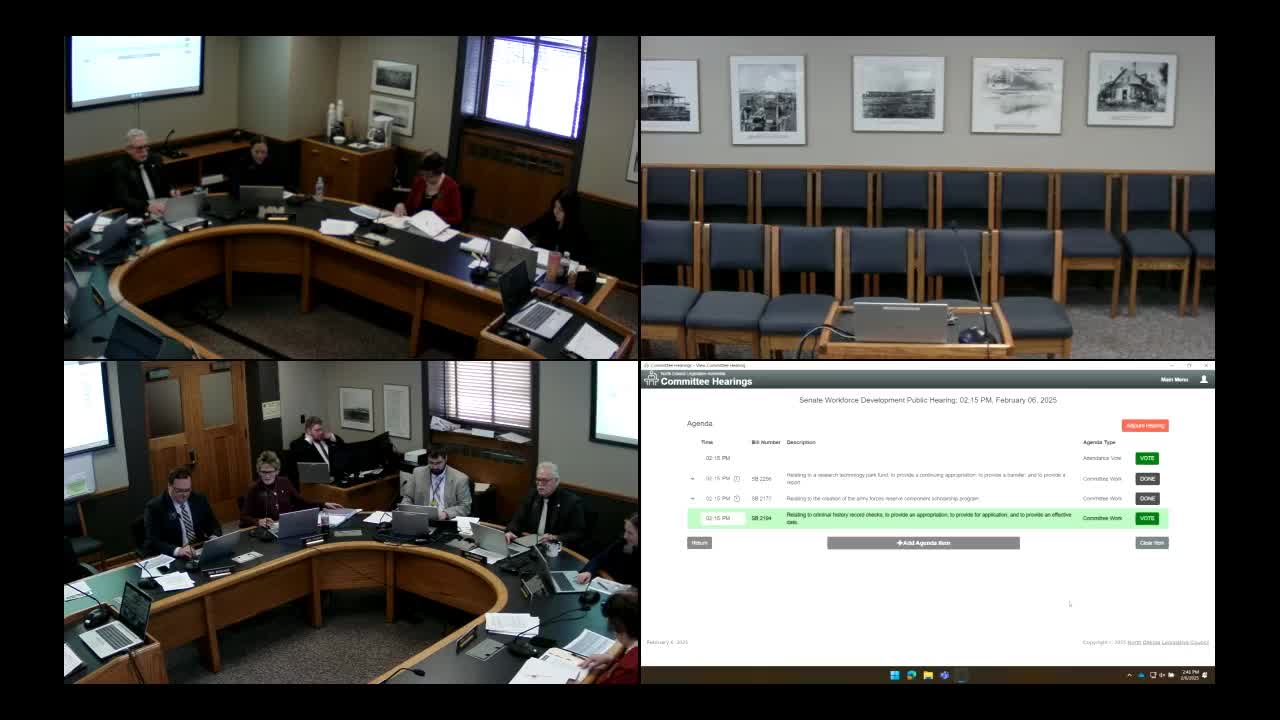
A Senate committee recommended a "do not pass" on Senate Bill 2194, a measure that would have authorized the attorney general to spend up to $5,000,000 for digital fingerprinting equipment and required the Bureau of Criminal Investigation (BCI) to provide criminal-history results within four days. The recommendation carried on a recorded vote of 5-0.
Testimony from the attorney general's ITC director and from committee members identified the technical and procedural limits that make fingerprint equipment only part of the problem. Heidi Smith, ITC director for the office of the attorney general, told the committee that BCI currently accepts digital fingerprints but that accepted submissions rely on devices configured to an approved format and on secure state network connections.
Smith said there are security and integration concerns if outside entities buy standalone "live scan" devices and attempt to submit prints over public-facing networks. "If you don't have them on the state network... there's some security concerns where if we're just allowing every entity that wants to do them to buy their own live scan," she said, explaining the need for approved vendors and secure interfaces.
Committee members and staff also emphasized that the primary delays in background checks stem from paperwork errors, incomplete registration cards, processing of ancillary documents and human factors — not the capture of fingerprints alone. Lawmakers questioned whether a $5,000,000 appropriation that appears focused on equipment would meaningfully shorten overall turnaround when other steps remain slow.
A motion to recommend "do not pass" was moved by Senator Larson and seconded; the clerk recorded a committee vote of five yes, zero no (Wabamaw: yes; Axman: yes; Larson: yes; Bosche: yes; Powers: yes). The committee discussed returning the bill to sponsors for rewriting to address broader process improvements, including coordination with Department of Human Services and consideration of changes to training/authorization that would allow provisional work under supervision while background clearances finish.
Members suggested the bill sponsor consider reworking the measure to address the whole workflow — interagency document handling, error rates, payment schedules and a potential RFP to build improved intake systems — rather than funding hardware alone.
AI generated
The text on this page is AI generated. Summaries, highlights, analysis, and video transcripts are all produced from the original source material.
AI can make mistakes, so if you spot one, and we will fix it for everyone.
Note: the source content is unaltered by us. Any content source we link to, be it a video, an audio recording, or a document, is presented exactly as its publisher released it. That publisher is usually a government body, sometimes an individual official or another organisation.