Get Full Government Meeting Transcripts, Videos, & Alerts Forever!
Get email alerts on the Fbi Director Nomination topic
No spam. Unsubscribe anytime.
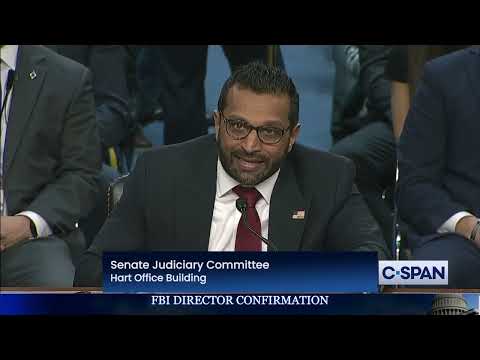
FBI nominee tells Senate Judiciary Committee he will prioritize violent crime and congressional transparency
Summary
A nominee for FBI director told the Senate Judiciary Committee he would focus on combating violent crime, restoring public trust in the FBI, and responding promptly to congressional oversight requests, citing 16 years of public service and past roles in counterterrorism and intelligence.
A nominee for FBI director told the Senate Judiciary Committee that he would prioritize combating violent crime and restoring public trust in the Federal Bureau of Investigation if confirmed.
The nominee told the panel he would “remain focused on the FBI's core mission,” stressing both criminal investigations and cooperation with the Department of Justice’s prosecutorial role. He said he would also make responding to congressional oversight requests a priority: “All appropriate requests for information will be responded to expeditiously and fully,” he said.
The nominee framed his priorities around two tracks: supporting local law enforcement to address violent crime and ensuring aggressive, constitutionally grounded oversight. He said violent crime in 2023 underscored the urgency, and he quoted figures he described as illustrating the scale of the problem: “Just in 2023 alone, there was a 100,000 rapes, a 100,000 drug overdoses, and 17,000 homicides.” He also said public trust in the FBI is low, adding that “40% of Americans have trust in the FBI.”
The witness described a career of roughly 16 years in government service, saying the first eight years after law school were spent as a public defender in Miami-Dade County and later for the Southern District of Florida. He said he later worked as a terrorism prosecutor in the Justice Department’s National Security Division, served on the National Security Council as senior director for counterterrorism, and served as a deputy director of national intelligence responsible for the presidential daily briefing.
He cited prior work on investigations into Foreign Intelligence Surveillance Act (FISA) abuses while on the House Intelligence Committee staff and said that such misconduct had eroded public trust in the FBI. He described awards he received for overseas counterterrorism work, naming a 2017 assistant attorney general’s award from then–Attorney General Loretta Lynch and an intelligence-community human intelligence award for related work.
The nominee opened his statement by acknowledging family members in the hearing room, identifying his parents, Pramod and Anjana, and his sister, Nisha, and recounting his family’s immigration history. He said those experiences shaped his commitment to due process: “If we cannot provide due process to the worst, then there can be no due process for anyone,” he said.
On the role of the FBI, the nominee said the bureau should enable “good cops [to] be cops” by providing tools and resources to tackle violent crime while preserving constitutional protections. He repeatedly emphasized cooperation with Congress and pledged transparency if confirmed.
He closed his opening remarks by thanking the committee and his family and saying he looked forward to answering questions: “I look forward to answering your questions,” he said.