Planning commission hears update on Vision Zero action plan and priority corridors
Summary
Consultants briefed the Reading Planning Commission on a draft Vision Zero action plan that reframes an earlier active-transportation plan, identifies six priority corridors for bike and pedestrian improvements and outlines steps needed to pursue federal Safe Streets for All and other grants.
Consultants presented an update on the Vision Zero action plan to the Reading Planning Commission on Jan. 21, saying the draft will be finalized in the coming weeks and could underpin future federal grant applications.
Peter Stone, consultant presenting the plan update, told commissioners the Vision Zero effort grew out of the city’s earlier active-transportation work and was revised in 2022 to align with funding opportunities. “Primarily, there’s a lot of funding available once you have a Vision 0 action plan,” Stone said, noting the city submitted a demonstration grant last August but was not awarded funding.
The nut graf: the plan identifies six priority corridors downtown and along the river to improve pedestrian and bicycle safety and to position the city for federal implementation grants through programs tied to the Bipartisan Infrastructure Law.
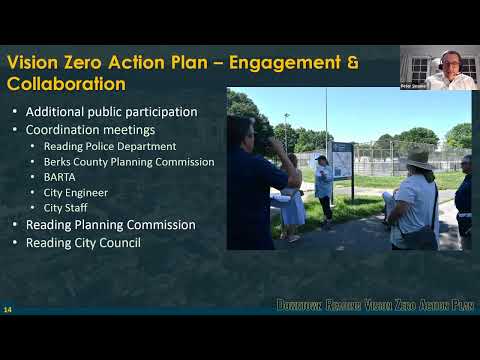
Stone summarized the plan’s scope and rationale, saying Vision Zero is “a strategy to eliminate all traffic fatalities and serious injuries while increasing safe, healthy, equitable mobility for all.” He reviewed the plan’s components: leadership commitment, a steering committee, a five‑year safety analysis, engagement and equity considerations, policy and process changes, and an inventory of project tools ranging from painted sharrows to protected bike lanes and sidewalk infill.
The consultants identified six priority corridors: Second/Canal Street, Court Street, Penn Street, Cherry Street, Seventh Street/the railroad corridor and Spruce Street/Riverfront Drive. Illustrative concepts shown to the commission included parking-protected bike lanes and buffered bike lanes that preserve most on‑street parking. Stone said the team avoided recommending changes on PennDOT-owned roads when possible to reduce permitting complexity.
Commissioners and attendees pressed on practical constraints. A commissioner asked how the plan would address winter maintenance; Stone replied that “if it become an issue, then the city would just have to wake up and have the same cleaning systems that, for example, Berlin does,” pointing to joint operational solutions such as small street and sidewalk sweepers.
Parking and implementation were recurring topics. Stone said the steering committee and city staff were clear that wholesale removal of on‑street parking would not be acceptable and that most proposed designs preserve parking except at a few intersection locations where sight lines are a safety concern. Multiple commissioners noted underused parking garages downtown and urged staff to examine incentives or agreements to shift short‑term parking off the street to enable protected bike facilities.
Stone also flagged equity as a funding advantage: the plan’s disadvantaged‑population analysis showed about 76% of Reading’s population would score as disadvantaged under the federal formula used for grant evaluations, which could strengthen future grant applications.
The consultant recommended the city consider converting the steering committee into a standing advisory body to track progress, update priorities and support grant applications. Stone said the final draft will include a color‑coded mapping system for recommended treatments by corridor and a short list of “low‑resistance” pilot projects for near‑term implementation.
Planning staff said the plan will return to the commission after staff and the consultants reconcile the draft with other ongoing initiatives. The timeline discussed at the meeting called for wrapping the action plan in the coming weeks and considering another round of grant applications in spring 2025.
Ending: The commission did not take formal action at the workshop meeting. Staff said they will bring draft materials back for additional review once the report and mapping are complete.
AI generated
The text on this page is AI generated. Summaries, highlights, analysis, and video transcripts are all produced from the original source material.
AI can make mistakes, so if you spot one, and we will fix it for everyone.
Note: the source content is unaltered by us. Any content source we link to, be it a video, an audio recording, or a document, is presented exactly as its publisher released it. That publisher is usually a government body, sometimes an individual official or another organisation.