Get AI Briefings, Transcripts & Alerts on Local & National Government Meetings — Forever.
Arizona Commerce Authority outlines trade offices, pipeline and metrics as state attracts major international investment
Loading...
Summary
The Arizona Commerce Authority told the House International Trade Committee it operates trade offices in multiple countries, has a growing pipeline of international projects—largely in manufacturing—and uses annual metrics to evaluate trade-office performance.
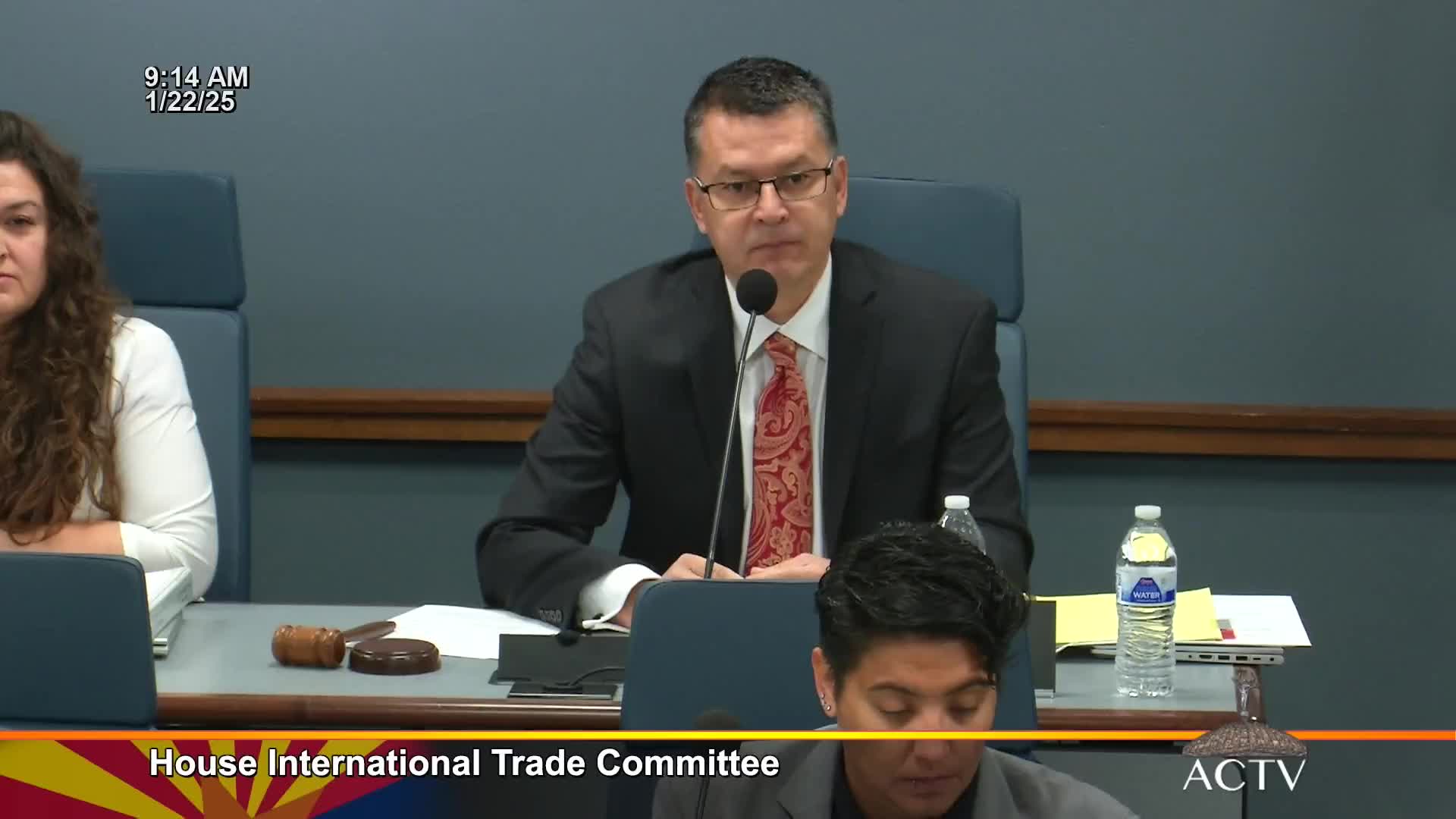
Sandra Watson, president and CEO of the Arizona Commerce Authority, told the Arizona House Committee on International Trade that the authority is expanding the state’s international presence and tracking measurable outcomes as it pursues foreign direct investment and export growth.
Watson said the ACA currently operates trade offices in Mexico, Israel, Europe, Taiwan, South Korea and Canada and runs export assistance programs including the Arizona State Trade Expansion Program (AZ STEP) and the Export Tech Program. “Arizona currently operates trade offices in Mexico, Israel, Europe, Taiwan, South Korea, and Canada,” Watson said. “Our programs include the Arizona State Trade Expansion Program, which we call AZ STEP, and the Export Tech Program.”
The agency presented statistics the committee described as evidence of rapid growth in overseas activity: from 2012 to 2020 the ACA supported 45 international projects representing nearly 5,000 jobs and roughly $1 billion in investment, while since 2020 the agency said it has landed 56 international projects representing more than 21,000 projected new jobs and about $74 billion in investment. Watson said ACA’s active pipeline totals about 478 projects today and that manufacturing accounts for more than two-thirds of opportunities and around 84% of potential new jobs in that pipeline.
Watson also told the committee Arizona recorded a record export year in 2023, with goods exports totaling about $28.75 billion, a 5.5% increase from the prior year. She named Mexico as Arizona’s largest trading partner and listed other top export destinations as Canada, the Netherlands, China and the United Kingdom. On the import side, she said Arizona received approximately $35.8 billion in imports in 2023, with Mexico again the top source.
Committee members asked how trade offices are selected, how they are funded and what metrics the ACA uses to evaluate performance. Watson said the existing offices were established with legislative appropriations and that the agency evaluates offices annually against metrics that include number of jobs, number of companies served, opportunities/engagements created, inbound delegations hosted and trade assists completed. “We do an evaluation every single year. And as all of you know, we measure everything we do,” Watson said. She added the ACA tailors metrics for each office based on market opportunity and staffing.
Members pressed Watson about the ACA’s role in addressing local impacts such as housing and infrastructure tied to large investments. Watson said the ACA coordinates with local governments and developers to provide companies data on housing permits and infrastructure needs but does not direct housing or infrastructure decisions. “We play a role, but we’re not driving those decisions,” she said, describing how the agency demonstrates demand to cities and developers when major projects arrive.
Watson described recent memorandum-of-understanding signings as a pathway to deeper collaboration. She cited MOUs signed with Gyeonggi Province (South Korea), the Taiwan USA Industrial Cooperation Promotion Office and the Netherlands, and said those agreements target areas including semiconductors, advanced manufacturing, workforce and technology. She also noted inbound and outbound trade delegations and the ACA’s role in organizing the governor’s International Diplomatic Forum.
Several members requested additional, specific data: an itemized list of international companies and their Arizona locations, a calculation of state revenue tied to exports, and the exact metrics used to evaluate trade-office performance. Watson said she would follow up with those materials.
Ending: The ACA presentation concluded with committee members requesting follow-up data on company locations, fiscal impacts and the agency’s market-selection criteria; Watson said the agency would provide the requested information.