Get Full Government Meeting Transcripts, Videos, & Alerts Forever!
Get email alerts on the Consumer Protection Act topic
No spam. Unsubscribe anytime.
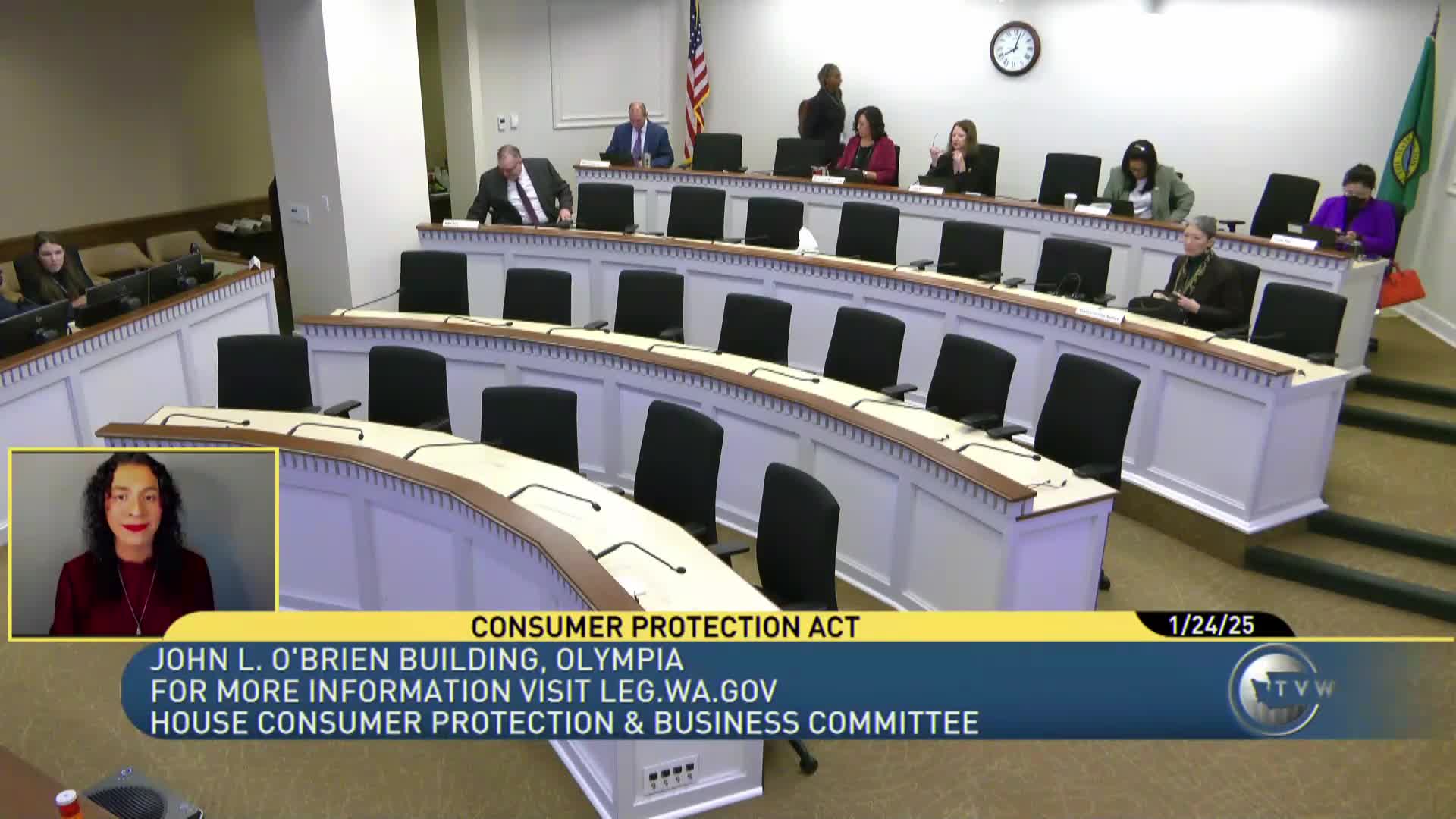
Committee staff give lawmakers refresher on state Consumer Protection Act
Summary
Committee staff reviewed the scope, enforcement paths, per se violations and remedies under Washington's Consumer Protection Act during a Jan. 24 work session, including differences between attorney general enforcement and private lawsuits and the statute's elements, limitations and penalties.
Committee staff gave the Consumer Protection & Business Committee a focused briefing Jan. 24 on the scope and mechanics of Washington's Consumer Protection Act and how citizens and the attorney general may enforce it.
The presentation, led by Megan Mulvihill, staff to the committee, and Peter Klotfelter, senior counsel with the Office of Program Research, summarized the statute's history, the elements a private plaintiff must prove, the concept of per se violations and the range of remedies and penalties available under state law.
The briefing said the Consumer Protection Act (CPA) was enacted in 1961 and was modeled after the Federal Trade Commission Act. Megan Mulvihill told the committee the CPA forbids "unfair methods of competition and unfair or deceptive acts or practices in trade or commerce" and that courts, not the statute itself, define what constitutes unfair or deceptive conduct. Mulvihill said the CPA gives both the attorney general and private citizens the right to bring civil actions.
Mulvihill summarized the elements a private plaintiff must establish under current case law: an unfair or deceptive act or practice, that the act occurred in trade or commerce, a public-interest impact, injury to the plaintiff's business or property, and causation. She cited the Hangman Ridge Training Stables v. Safeco Title Insurance decision as the case that articulated those elements and warned that the statute's elements and enforcement rules are shaped by court interpretation.
Peter Klotfelter explained "per se" violations: the legislature can designate violations of other statutes as automatically satisfying certain CPA elements (for example, demonstrating a public-interest impact). He told members there are more than 100 statutes in Washington that incorporate per se CPA violations for particular conduct and that some of those per se provisions limit enforcement to the attorney general.
On remedies, the staff explained plaintiffs may seek injunctive relief, actual monetary damages, costs and reasonable attorneys' fees. Courts may award additional (treble) damages up to three times actual damages but not exceeding $25,000, and civil penalties are prescribed for particular violations. The presenters cited a $7,500 maximum penalty for each violation of unfair methods of competition or unfair or deceptive acts or practices (with potential for multiple violations per repeated communications), a $125,000 maximum penalty for violating a CPA injunction, and an enhanced $5,000 penalty for unlawful acts that target specific communities. The presenters said penalties were increased in 2021 and partially modified in 2024 and that the attorney general must report to the Legislature every five years on whether statutory penalty amounts remain appropriate.
Mulvihill also outlined the attorney general's consumer protection division functions (investigations, informal complaint resolution, administering lemon-law and manufactured/mobile-home dispute programs, consumer education and, when appropriate, civil enforcement) and contrasted that with private enforcement, which requires the plaintiff to prove the case elements and to show injury and causation.
Committee members asked staff questions after the presentation. Representative Kloba raised concerns that private causes of action could invite frivolous claims and asked whether lawyer ethics rules or court sanctions limit frivolous filings; staff said they would follow up on relevant procedural sanctions but noted that courts and professional rules can constrain frivolous filings. Representative Barno and staff discussed the distinction between penalties and restitution: Mulvihill and staff said restitution ordered by the attorney general or a court is paid to harmed consumers, while statutory penalties collected by the attorney general typically go to the state.
Committee staff closed by noting the CPA's liberal-construction directive and its purpose to protect the public and foster honest competition, and they offered to provide follow-up materials and answers to members' technical questions.