Lifetime Citizen Portal Access — AI Briefings, Alerts & Unlimited Follows
State tells appellate panel franchise scheme "tricked" immigrants out of life savings; respondents call it a private contract dispute
Loading...
Summary
At oral argument in State v. National Maintenance Contractors, state counsel told a three‑judge panel the company sold promised "monthly income" that left many franchisees with pay below minimum wage and urged reversal of summary judgment; respondents urged the dispute is contractual and regulated under FIPA. The court took the case under advisement.
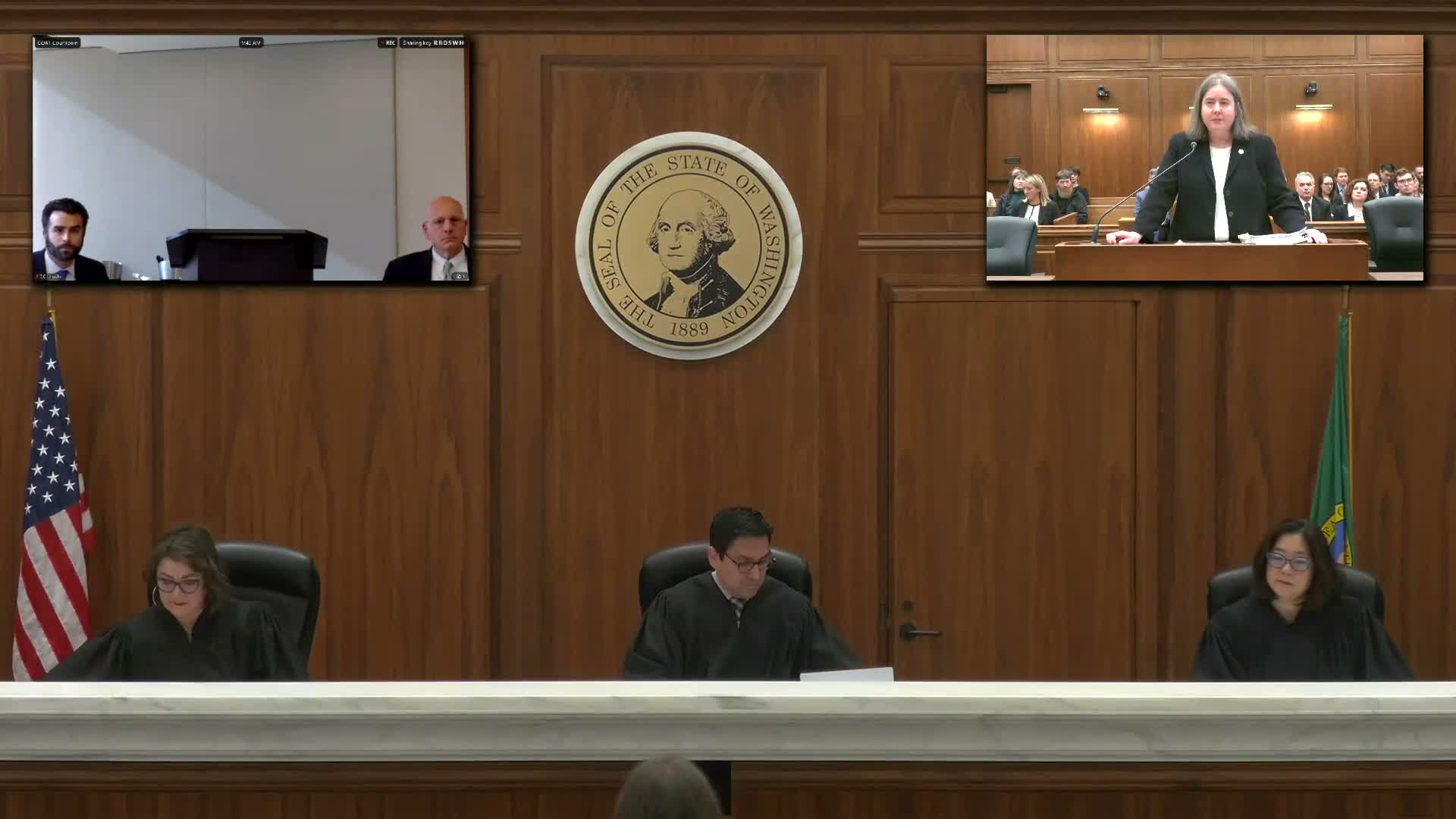
Julia Doyle, counsel for the State of Washington, told an appellate panel that the case concerns a widespread consumer‑protection failure in which "vulnerable immigrants [were] tricked out of their life savings to buy a job that paid many of them below minimum wage." Doyle asked the court to reverse a trial court order that granted summary judgment and dismissed the state's entire case.
Doyle framed four central legal questions for the panel: whether the Consumer Protection Act (CPA) has a public‑interest impact here; whether the defendants' conduct had the "capacity to deceive" a substantial portion of the public; whether the CPA's unfairness/unconscionability element is satisfied; and whether the trial court misread the Franchise Investment Protection Act (FIPA). "All four of these ... significantly compromised Washington's consumer protection framework," Doyle told the court.
Frank Sciaramomano, counsel for the respondents (National Maintenance Contractors, referred to in argument as NMC), countered that the case "is fundamentally about the boundaries of the Consumer Protection Act" and urged that the matter is a private commercial dispute between sophisticated parties and franchisees rather than a mass‑market fraud suit. He argued that franchising is a "heavily regulated" industry with a presale disclosure scheme under FIPA and that the record shows NMC provided franchise disclosure documents and that some franchisees were multiunit or sophisticated buyers.
The panel pressed both sides on whether disputed factual issues — for example, franchisees' differing levels of sophistication, how many accounts a franchisee needed to make the promised income, and whether omissions were material — require a jury determination or are pure questions of law. Doyle argued materiality is not typically a disputed issue under the CPA and said the record shows NMC was aware that the obligation to provide the promised monthly income was material. Sciaramomano emphasized that several Hangman Ridge factors (such as advertising and solicitation) weigh in respondents' favor and that repetition alone does not satisfy the public‑interest test for private‑dispute conversion.
Doyle cited precedent including Potter v. Wilbur Ellis and Nelson v. National Fundraising Consultants to show failure‑to‑disclose and marked‑up supply practices have previously met CPA standards. In rebuttal, she also relied on Panaag and a recent decision she cited as Schiff v. Liberty Mutual to contend that even in regulated fields deceptive practices can be actionable and that courts should assess the least‑sophisticated consumer when applying the CPA.
The state emphasized scale, telling the panel the conduct at issue affected "nearly 500 Washingtonians," and urged that an Attorney General enforcement action is appropriate to address systemic harm rather than limiting CPA enforcement to classic mass‑mailer cases.
The panel did not rule from the bench. After argument and a reserved rebuttal period, the court took the case under advisement and called the next matter on the calendar.