Get Full Government Meeting Transcripts, Videos, & Alerts Forever!
Get email alerts on the Workforce Development topic
No spam. Unsubscribe anytime.
State CTE director outlines programs, work‑based learning expansion and capital projects
Summary
Wade Sik, state director of the North Dakota Department of Career and Technical Education, briefed the Senate Workforce Committee on CTE enrollment, work‑based learning initiatives, capital projects funded with federal coronavirus-era dollars and program funding, noting strong graduation outcomes for CTE concentrators.
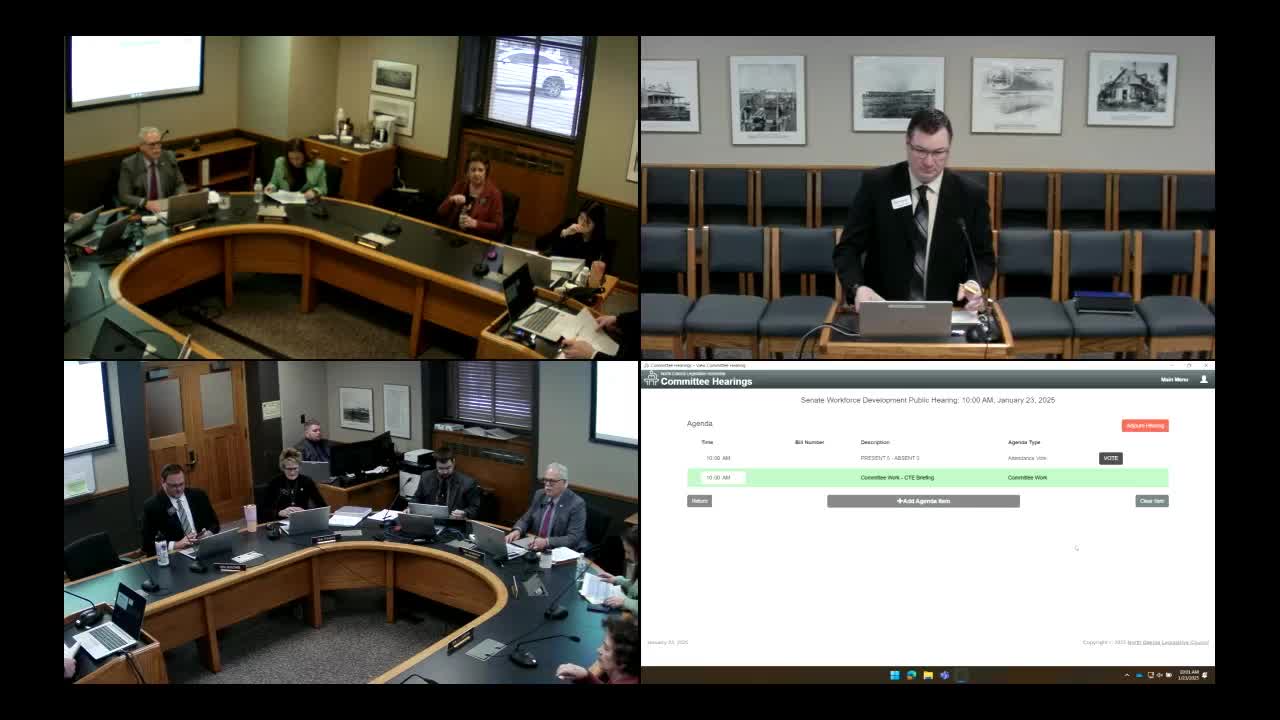
Wade Sik, state director for the North Dakota Department of Career and Technical Education, told the North Dakota Senate Workforce Committee that the agency is expanding career and technical education (CTE) access, work‑based learning and capital projects intended to boost the state workforce.
Sik said the department recorded about 26,000 unduplicated high‑school students who took at least one CTE course in 2023–24 and that CTE concentrators — students who take at least two courses in the same career pathway — graduate at a much higher rate than the statewide average. "If the only thing we cared about in CTE was graduation rates, we're knocking it out of the park," Sik said, citing an overall cohort graduation rate near 82 percent and a 98 percent graduation rate for CTE concentrators.
The briefing summarized student outcomes, workforce partnerships and recent appropriations. Sik described work‑based learning as a priority, noting the department has used a $1.5 million legislative appropriation to fund 16 full‑ or part‑time work‑based learning coordinators with flat grants (up to $50,000 for a full‑time coordinator, prorated for part time). The department reported growth in placements by funded coordinators from roughly 1,061 placements in 2023 to about 22,100 placements in 2024 and said roughly 200 employers hosted work‑based learning students in 2024.
Why it matters: Committee members pressed the department about where hands‑on training takes place, how virtual CTE centers differ from physical centers and whether funding for current programs is ongoing. Sik said the $1.5 million for coordinators is in the department’s base budget and that the agency is asking for additional funding to expand coverage in under‑served economic regions.
Details and program structure
Sik described CTE as a combination of hands‑on training, work‑based learning and industry‑recognized credentials and said the department partners with the North Dakota Department of Public Instruction, Job Service North Dakota, the University System, tribal colleges and the Workforce Development Council. He said the department is organized by program area (agriculture, business, family and consumer sciences, trade and industry, health sciences, information technology and STEM) and provides program funding, professional development and technical assistance. The department staff of about 22.5 full‑time equivalents also manages career and technical student organizations such as DECA, FBLA, FCCLA, FFA and SkillsUSA.
Sik described a multi‑year capital program using federal coronavirus capital project funds and related state match. He said the total set of capital projects tied to CTE expansion amounts to about $121 million and that the agency received initial federal appropriations in 2021 but gained access to spend the funds in 2023 after negotiations with the U.S. Treasury. Sik said 13 projects were funded; seven are complete and others are in various stages of closeout or construction.
Data, placements and equity
Sik told the committee the department tracks post‑program placement and that about 90 percent of CTE concentrators can be matched to higher education, employment, AmeriCorps or other next steps using the state longitudinal data system and wage matches. He said placement figures may undercount military service and some part‑time employment because of thresholds used in the data. Sik highlighted outcomes for Native American students: statewide graduation for Native American students was about 63 percent, while Native American CTE concentrators had a 93 percent graduation rate.
Work‑based learning and tools
The department has defined work‑based learning to include cooperative work experience courses, supervised agricultural experiences, internships, pre‑apprenticeships and employer placements; it excludes one‑day tours or career expos. Sik described Compass, a module embedded in R U Ready ND (the state’s career exploration platform), that matches student profiles and local employer opportunities, and CareerView XR, a virtual‑reality career exploration product the department integrated into the platform. Sik also described a Marketplace for Kids program for elementary students and a state‑funded ND STEM Ecosystem grant to support regional STEM events.
Questions from committee members
Committee members asked where hands‑on training occurs and whether students at schools such as Fargo South would use the Fargo career center for advanced manufacturing. Sik replied that hands‑on training occurs in local labs, at CTE centers and through employer placements, and that the Fargo career center project includes advanced manufacturing labs. Senator Powers said, "To be honest, I've never heard of this organization," after reviewing the department’s website; Sik and committee members responded with examples of local programming and centers.
Sik also described an ongoing data challenge: PowerSchool limits which facility a student can be attached to for reporting, which undercounts enrollments for students who take courses at multiple facilities. He said the department expects better attribution after the state’s planned transition to Infinite Campus.
Budget and next steps
Sik outlined funding: a roughly $41.5 million biennial operating budget for 2023–25, authority over about $12 million in federal Perkins funds for postsecondary and secondary CTE, and approximately $121 million in capital project funds for new and expanded CTE centers. He said the $1.5 million appropriation to fund work‑based learning coordinators was placed in the department’s base budget and that the agency has requested additional funds in subsequent budget cycles to add 10–12 more coordinators targeted to regional gaps.
Sik said the department reports monthly to its state board on three student outcome goals — increasing the number of CTE concentrators, increasing the percentage of students who graduate workforce‑ready, and increasing rural student enrollment in CTE centers — and that the agency is pursuing policy changes to ease CTE teacher certification for industry professionals.
"CTE changes lives. It really does and that's where I saw it," Sik told the committee, describing his experience at the Burdick Job Corps Center and examples of students who entered welding and nursing pathways and gained employment. The director closed by offering to answer further questions and committee staff moved on to scheduling and other business.