Get Full Government Meeting Transcripts, Videos, & Alerts Forever!
Get email alerts on the Committee Rules topic
No spam. Unsubscribe anytime.
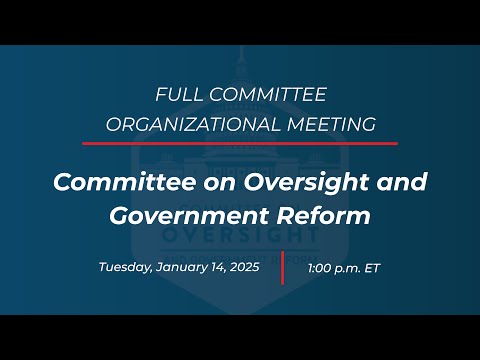
House Oversight Committee adopts rules for 119th Congress after fights over subpoenas, subcommittees and conflicts
Summary
The House Committee on Oversight and Government Reform adopted its rules for the 119th Congress after rejecting Democratic amendments that would have required subpoena consultation with the ranking member, merged two subcommittees, and barred people with financial conflicts from advising the committee.
The House Committee on Oversight and Government Reform adopted its rules for the 119th Congress after rejecting a series of Democratic amendments that sought to change subpoena procedures, subcommittee structure and conflict-of-interest standards.
The rules package, described by the chair as largely unchanged from last Congress, passed on a recorded vote of 25–16. Democrats on the panel pressed several changes they said would protect minority rights, guard against secret subpoenas and prevent private financial interests from influencing committee work. Committee Republicans said the rules preserve the majority's ability to conduct oversight and create subcommittees to pursue a broad oversight agenda.
The chair, Representative James Comer, noted the package was “substantially the same as last congress with only a few changes,” and highlighted rules on subcommittee jurisdictions, the use of electronic voting, and transcript procedures. The rules include a new subcommittee structure (rule 6), accommodations for continued electronic voting (rule 5), and changes to the transcription of witness testimony (rule 15(j)).
Nut graf: The votes set the operating framework for one of the House’s most politically charged panels. The contested amendments reflected longstanding disputes over subpoena power and transparency, the scope of oversight subcommittees, and whether outside advisers with financial ties to matters before the federal government should be restricted from advising the committee.
Key amendments and debate
• Subpoena consultation (Connolly amendment): Representative Gerry Connolly of Virginia offered an amendment that would have required the chair to consult the ranking member and provide a draft subpoena at least 24 hours before authorizing and issuing it, with a narrow waiver for emergencies. Connolly argued the change would “lend further credibility to the reputation of this committee, and take away from the harmful practice of issuing secret subpoenas.” The amendment was rejected on the electronic vote, 16–24.
• Subcommittee merger (Mfume amendment): Representative Kweisi Mfume of Maryland proposed merging the committee’s Government Operations and Federal Workforce jurisdiction with the newly formed Delivering on Government Efficiency subcommittee. Mfume said the merger would preserve longstanding jurisdictional authority and avoid duplicative bureaucracy. The amendment failed, 16–25.
• Conflict-of-interest / recusal (Stansbury amendment): Representative Melanie Stansbury of New Mexico offered an amendment that would have barred a person with a personal financial interest impacted by committee decisions from advising the committee or interacting with it in any matter that would benefit that person financially. Stansbury read into the record the amendment’s language and framed it as bringing “standard ethics language into the committee process.” Opponents called the text overly broad and said it risked restricting the public’s ability to petition government; the amendment failed, 16–25.
• Amendments addressing alleged presidential and outside influence (Garcia amendment): Representative Robert Garcia proposed an amendment aimed at preventing the committee from advancing legislation that would enrich President Trump or his businesses; he cited previous Oversight Committee findings about payments to the former president. The amendment was defeated, 16–25.
• Restoring a civil rights subcommittee (Crockett amendment): Representative Jasmine Crockett proposed reestablishing a subcommittee on Civil Rights and Civil Liberties. Crockett framed the amendment as a return to focused oversight of voting rights and other civil protections; opponents raised objections and the amendment failed, 16–25.
Discussion and context
Debate repeatedly returned to the committee’s role in policing the executive branch and how majority control should exercise subpoena power. Representative Connolly emphasized precedent and prior practice, saying the committee was “silent on whether or not the chair consults with the ranking member” and urging a return to advance notice of subpoenas. Chairman Comer said he was “sympathetic” to consultation but opposed the amendment’s change in rule, noting he’d pledge to use subpoena power responsibly.
Democrats criticized the creation of a new Delivering on Government Efficiency subcommittee (often referred to in the hearing as the “Doge” subcommittee) as a vehicle that could be influenced by private advisers with business before the government. Representative Stansbury pointed to recent press reporting and said the amendment was meant to prevent “using the committee as a personal piggy bank.” Republicans said establishing specialized subcommittees would let more members participate in oversight and that staff levels and budgets were unchanged by the reorganization.
Several members raised concerns about outside advisers and potential conflicts tied to private companies with federal contracts, citing SpaceX and other corporate relationships. In questioning, members referenced executive-branch disclosure practices and the need for public ethics rules; opponents said the Stansbury language could be read to bar citizens and taxpayers with any financial interest from advising lawmakers.
Votes at a glance
- Connolly (VA) — require 24-hour notice and draft subpoena provided to ranking member before issuing subpoena (with waiver for emergencies): Failed, 16–24. - Mfume (MD) — merge Government Operations & Federal Workforce jurisdiction with Delivering on Government Efficiency subcommittee: Failed, 16–25. - Stansbury (NM) — bar persons with a personal financial interest impacted by committee decisions from advising or interacting with the committee on matters that would benefit them financially: Failed, 16–25. - Garcia (CA) — bar committee actions that would advance legislation enriching President Trump or his businesses (as described by sponsor): Failed, 16–25. - Crockett (TX) — reestablish a subcommittee on Civil Rights and Civil Liberties: Failed, 16–25. - Adoption of committee rules for the 119th Congress (final motion to adopt rules package described by the chair): Approved, 25–16.
What the rules do and next steps
The adopted rules formalize the committee’s subcommittee structure and continued use of electronic voting for recorded votes and amendments. The chair said the panel will continue to use the electronic system for recorded votes and that, if technical issues arise, the committee will revert to traditional roll calls. Members can expect the committee to begin work under the new subcommittee jurisdictions immediately, and several speakers signaled a heavy oversight agenda in the coming weeks, including hearings scheduled by subcommittees.
Ending: The committee’s adoption of rules sets the operational guardrails for the next two years and leaves standing key partisan disputes about subpoenas, the proper scope of oversight subcommittees, and how to handle potential outside financial conflicts. Members on both sides said they expect continued engagement and oversight in the coming months.