Get Full Government Meeting Transcripts, Videos, & Alerts Forever!
Get email alerts on the School Schedule topic
No spam. Unsubscribe anytime.
Joint committee reports data-driven case for returning comprehensive high schools to semester scheduling
Summary
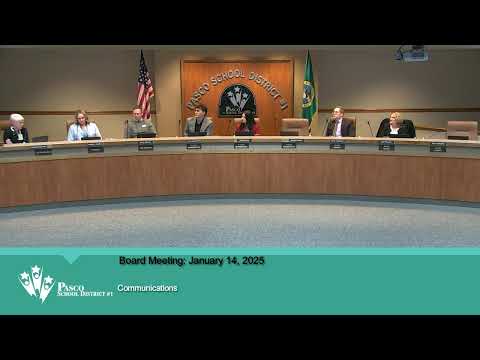
Ms. Miragopal, chair of the joint committee formed under the district–PAE bargaining charge, presented a data-rich summary and said the committee will present its formal recommendation to the bargaining team on Jan. 21.
Ms. Miragopal, chair of the joint committee formed under the district–PAE bargaining charge, presented a data-rich summary and said the committee will present its formal recommendation to the bargaining team on Jan. 21.
The committee compared Pasco’s comprehensive high school data from two prior years when schools used a semester system (2016–17 and 2017–18) with trimester-era data (2020–2023 and 2023–24), excluding the COVID years. Miragopal said the review found notable differences in full-time-equivalent (FTE) counts and credit accumulation: under the semester system seniors averaged about 24.5 cumulative credits even when the state graduation requirement was 20 credits; under the trimester model upperclassmen FTEs dropped to roughly 0.9 in some cohorts as students left early or carried open periods.
Why it matters: The committee concluded semester scheduling can make it easier for students to carry fuller course loads, increase steady credit accumulation and strengthen teacher–student relationships by having teachers and students together for longer spans. Advocates said semester alignments also simplify college and Running Start scheduling and may improve outcomes for students requiring specialized instruction.
Findings and trade-offs: The trimester system offers a broader range of electives, earlier grading periods for intervention and built-in options for credit recovery during the school day; those were listed as continuing strengths. The committee emphasized implementation considerations if the bargaining team negotiates a semester change: a planning year (2025–26) and full implementation in 2026–27, middle-school alignment, course scope-and-sequence work, supports for special education and newcomers, and a comprehensive communications plan.
Student representatives and board members spoke during discussion: student reps said semester schedules can reinforce the idea that "every class counts," while others highlighted the trimester benefit of letting students try more electives. Miragopal said the committee produced a seven-page condensed report and that the bargaining team — not the board — will make the final scheduling decision.
What was not decided: No formal board action was taken; the committee will present its recommendation to the bargaining team as scheduled.