Get Full Government Meeting Transcripts, Videos, & Alerts Forever!
Get email alerts on the Homicide Probable Cause topic
No spam. Unsubscribe anytime.
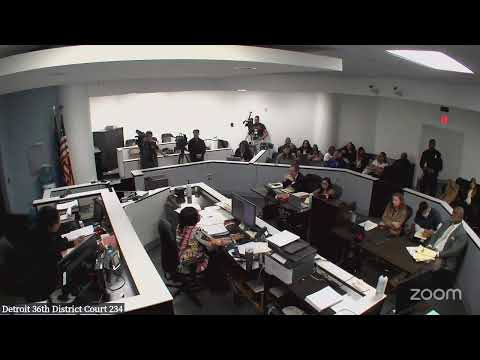
Judge finds probable cause in death of Neziah Harris, amends sexual-conduct allegation and schedules next court date
Summary
The presiding judge in 36th District Court on Jan. 9 found probable cause to proceed on a first-degree premeditated murder charge against defendant Jarvis Butts and granted the prosecutor—s request to amend a sexual-conduct count; the judge set additional court dates.
Detroit — The presiding judge in 36th District Court on Thursday found probable cause to proceed on a first-degree, premeditated murder charge against Jarvis Butts and granted the prosecutor's request to amend a related sexual-conduct allegation, the court record shows.
Prosecutors told the court that evidence presented during a multi-day hearing — including hundreds of text-message entries between the victim and Butts, Google searches for at-home abortion methods, a black hoodie recovered near 7 Mile and Bird that tested positive for human blood and contained both the victim—s and Butts— DNA, and other physical items recovered at the scene — together met the probable-cause standard. The judge set a next court date and ordered further proceedings on the case.
Why it matters: The hearing resolved whether the case should proceed to trial on the most serious charges. Prosecutors argued the timeline, the physical evidence and search activity showed motive and opportunity; defense counsel urged the judge to deny bind-over on the murder count as conjectural and insufficient for probable cause.
Prosecutors summarized phone and messaging evidence as showing repeated contact between the young victim and the defendant through late 2023 and up to Jan. 9, 2024, the day officers say the victim was last seen on camera. Investigators described a total cessation of the victim—s social-media and phone activity after that date. Prosecutors also pointed to return trips and location data that placed the defendant in areas where relevant evidence was later recovered.
Forensic evidence described in court included a black hooded sweatshirt recovered in the wooded area along the Rouge River near 7 Mile and Bird; a forensic analyst testified the garment contained multiple phenol-positive stains (the analyst referenced 15 such markings) and that swabs yielded human blood and the victim—s DNA, and that a separate swab produced a DNA profile that included the defendant. Prosecutors played and read large portions of text-message logs that they said showed intimate contact and a later gap in communication. Prosecutors also noted that investigators recovered a pair of eyeglasses and shoes near where other clothing was located and that one vehicle tied to the defendant was searched; investigators reported knives and at least one firearm were recovered and that selected items were submitted for laboratory testing.
Defense counsel argued at length that the prosecution—s case was circumstantial and that the pieces of evidence did not connect to show an act by the defendant that caused the victim—s death. Defense counsel said there was no eyewitness testimony showing the defendant killed the victim, no admission by the defendant, and no murder weapon definitively tied to him. The defense asked the court to deny bind-over on the premeditated murder charge and emphasized that some physical evidence tested negative or produced inconclusive results for attribution to the defendant.
The judge addressed both sides' arguments in a detailed oral ruling. The judge said the absence of a recovered body did not preclude a finding of probable cause and emphasized the combination of a sudden end to the victim—s communications, the physical evidence discovered at 7 Mile and Bird, and other investigative findings. The judge also granted the prosecution's request to amend the sexual-conduct count to reflect the victim—s age as 12, rather than 13 as earlier charged.
The presiding judge concluded the hearing by admonishing the defendant directly: "Do the right thing. Tell us where she's at, please. Just do it, Jarvis." The judge scheduled further proceedings and set a forthcoming court date related to the case.
Courtroom details: The hearing included testimony from the lead investigator and a forensic analyst, presentation of message logs and digital evidence, and argument from prosecutors and defense counsel. The record shows prosecutors asked to upgrade one sexual-conduct count to reflect the victim—s age and sought bind-over on the murder charge; the court granted the amendment and found sufficient cause to proceed on the homicide charge under Michigan law.
What the record does not show: The hearing transcript and testimony did not include a confession by the defendant, nor did it identify a single weapon that a witness testified was used in the victim—s death. Several items seized were described as tested for DNA; in some instances the analyst reported that samples were too small for further confirmatory testing. Prosecutors argued that the defendant likely concealed evidence and the victim's body; defense counsel disputed that the record supported such an inference and urged the matter be left for the jury.
Next steps: The court set a further proceeding and a trial-related date; prosecution indicated it would proceed on amended charges including first-degree murder and updated sexual-conduct allegations. The case remains pending and the defendant continues to be represented in court.