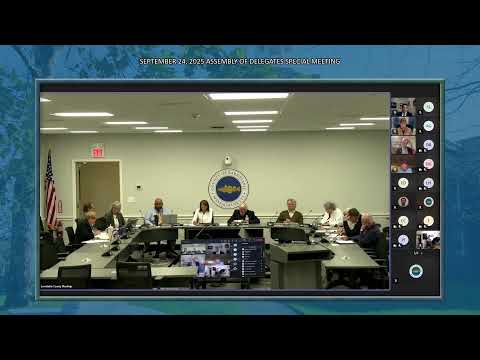
Barnstable County delegates hold hearing on regional luxury transfer fee; drafting group named
Summary
The Barnstable County Assembly of Delegates on Sept. 24 held a public hearing on a proposed regional luxury real estate transfer fee intended to raise funds for year‑round and affordable housing across Cape Cod, and named a five‑member drafting group to prepare petition language.
BARNSTABLE, Mass. — The Barnstable County Assembly of Delegates on Sept. 24 held a public hearing on a proposed regional luxury real estate transfer fee intended to raise money for year‑round and affordable housing across Cape Cod. Delegates heard invited testimony from municipal officials, nonprofits, business groups and residents and directed a five‑member drafting group to prepare a petition for further committee consideration.
Delegate Susan (Doug) Warner, who opened the hearing, said the committee was still shaping details but was seeking input before filing a regional petition to the state legislature. "We're very interested in hearing what you have to say," Warner told the room and remote participants.
The hearing focused on how a local option transfer fee might be structured, who would administer it and how proceeds would be distributed. Supporters and some municipal officials argued a fee targeted at high‑value transactions could produce a steady revenue stream for housing programs; critics and several town officials said the concept needs specific drafting on thresholds, exemptions and local allocations before they could endorse it.
Why it matters: Cape Cod officials and advocates called the housing shortage a crisis that is pricing out workers, seniors and other year‑round residents. Several witnesses said limited municipal subsidy funds and development constraints make new revenue sources necessary to preserve and create affordable housing.
Key details discussed
- Scope and administration: Delegates described a regional approach in which towns could opt in or opt out; administration was discussed as likely to occur through the registry of deeds at the time of transfer. Exact administration, opt‑in rules and any county set‑aside were not finalized.
- Thresholds and rates: Witnesses and delegates discussed possible thresholds ranging from about $1 million to multi‑million levels and illustrative rates between roughly 0.5 percent and 4 percent. Several speakers urged graduated rates and exemptions for family transfers, deed‑restricted properties and certain court‑ordered transfers. No threshold or rate had been adopted.
- Revenue estimates and likely uses: Paul Niedzwiecki, president and CEO of the Cape Cod Chamber of Commerce, presented regional estimates—saying a transfer fee applied to properties over $1 million could generate roughly $14 million to $16 million annually depending on the final rate and thresholds. He recommended prioritizing deed restrictions and other strategies that can preserve existing housing stock in year‑round use.
- Target populations and program examples: Barbara Clarkson, chief of inmate services and programs at the Barnstable County Sheriff’s Office, argued funding should support permanent, supportive and "low‑threshold" housing to help people released from custody and others who face barriers to stable housing. Clarkson said about "40 to 50 individuals are released each month from the Barnstable County Correctional Facility," and cited a recent month in which 76 people were released countywide.
Positions and concerns expressed
Supporters - Municipal officials and housing advocates said a regional fee could provide flexible dollars for town housing trusts, deed‑restriction purchases and supportive services. Jack Richardson, a Falmouth select board member, urged an ambitious regional approach and suggested graduated rates that increase with property price. - Several town officials including Brewster’s assistant town manager Donna Kalanick and Falmouth affordable housing representatives described how current town subsidy streams fall short of housing production goals—Falmouth cited an annual housing production target of about 80 units but said existing local funds generally support far fewer units (one town representative said current revenue supports roughly 16 units annually under local subsidy caps).
Skeptics and requests for specifics - Numerous speakers including Andrew Gottlieb of the Association to Preserve Cape Cod, town managers and select board members said they could not endorse an approach without clear written language on exemptions, governance, and how funds would be allocated. Gottlieb emphasized protecting priority habitats and directing subsidies toward previously disturbed or sewered village centers rather than new sprawl. - Several residents and market observers warned about potential market effects, distribution fairness and the need for a sunset or reauthorization mechanism. Some called for higher thresholds to ensure the fee targets only the upper end of the market.
Administrative and next steps
- Delegates announced a drafting subgroup charged with preparing detailed language: Delegates Susan Warner (Yarmouth), Daniel Gessen (Falmouth), Elizabeth Harder, Wayne Sampson and Delegate Jack Richardson will draft the county petition and submit it to the assembly’s economic development committee in October. The assembly said additional public hearings will follow once draft language is available.
- The assembly did not vote to adopt any transfer fee policy at the hearing. Delegates did approve routine procedural motions earlier in the meeting, including adopting the order of business and moving into the committee of the whole.
What was not decided or specified
- Final rates, thresholds, formulas for returning revenue to towns, precise exemptions and the county share for administration were left unspecified. Several town officials asked that the bulk of funds be returned to originating towns with a modest county set‑aside for administration and regional projects; others suggested the county could collect and remit proceeds to towns to lower local administrative costs.
Quotes - "We're very interested in hearing what you have to say," Delegate Doug Warner said in opening the hearing. - "As a representative of the Barnstable County Sheriff's Office, I submit this testimony in support of the proposed luxury tax initiative," Barbara Clarkson said, urging funding for low‑threshold and supportive housing for people reentering the community. - "This tool alone won't solve our housing crisis, but can be an essential part of the solution if done thoughtfully, regionally, and with a clear plan," Paul Niedzwiecki said.
Next steps and calendar
The drafting subgroup will prepare proposed petition language in October for the economic development committee. Delegates said the assembly plans further public hearings and committee review before any vote to adopt a home‑rule petition or other county action.
For now, the hearing produced public comment, a list of frequently raised options (graduated thresholds, local opt‑in/opt‑out, registry administration, deed‑restriction purchases) and a commitment from delegates to return with a written proposal for additional public review and votes.
AI generated
The text on this page is AI generated. Summaries, highlights, analysis, and video transcripts are all produced from the original source material.
AI can make mistakes, so if you spot one, and we will fix it for everyone.
Note: the source content is unaltered by us. Any content source we link to, be it a video, an audio recording, or a document, is presented exactly as its publisher released it. That publisher is usually a government body, sometimes an individual official or another organisation.