Get Full Government Meeting Transcripts, Videos, & Alerts Forever!
Get email alerts on the Animal Welfare topic
No spam. Unsubscribe anytime.
Puerto Rico House panel hears calls to study funding for animal-abandonment response in District 20
Summary
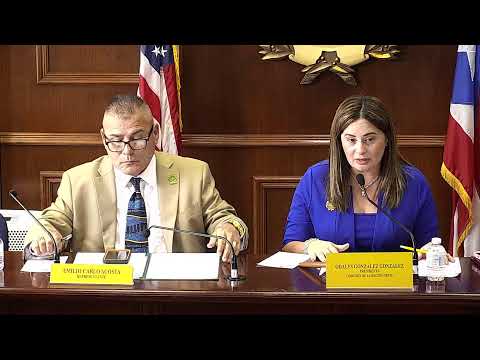
The House of Representatives’ Comisión Oeste on Oct. 23 held a public hearing on Resolution Cámara 216, a measure introduced by Representative Emilio Carlos Acosta directing the House Committee on Social Welfare to study ways to secure funding and strengthen programs to combat animal abandonment and support rescuers in District 20 (Cabo Rojo, Hormigueros and San Germán).
The House of Representatives’ Comisión Oeste on Oct. 23 held a public hearing on Resolution Cámara 216, a measure introduced by Representative Emilio Carlos Acosta directing the House Committee on Social Welfare to study ways to secure funding and strengthen programs to combat animal abandonment and support rescuers in District 20 (Cabo Rojo, Hormigueros and San Germán).
The resolution’s sponsor, Representative Emilio Carlos Acosta, said the measure “responde a una preocupación genuina y urgente” among residents of the three municipalities and asked the panel to identify mechanisms so rescuers, municipalities and nonprofits can get needed support. “Queremos identificar qué mecanismos existen y cuáles se pueden crear para que los rescatistas, los municipios y las organizaciones sin fines de lucro puedan contar con el apoyo necesario para continuar su labor,” Acosta said.
The hearing assembled testimony from the Puerto Rico Police, the Oficina de Gerencia y Presupuesto (OGP) and the Department of Agriculture. Police testimony emphasized existing legal authority and operational limits under Law 154 of 2008 (Ley para el Bienestar y Protección de los Animales), while OGP described the measure as investigatory and without an immediate fiscal effect; the Department of Agriculture said it lacks centralized data and enforcement capacity for companion-animal abandonment.
Lic. Amneris Alvarado, representing the Puerto Rico Police, read the force’s statement that Law 154 of 2008 gives police and animal-control officers authority to intervene, take custody and seek protective orders for animals and that the police maintain an institutional policy of zero tolerance for abandonment and abuse. She also said the agency’s internal guidance is contained in an order it identified as "Orden General 606-41 (6 de julio de 2020)." The police delegation told the commission it lacks veterinary contracts, shelter capacity and dedicated budget authority to house and care for animals removed in abuse or abandonment investigations, and that much of the care depends on voluntary contributions from private veterinarians and nonprofit shelters.
Agent José Flores Soto, coordinator for enforcement in the Mayagüez area, told the panel that a formal training program was developed and delivered to state police through the academy but that municipal police do not yet receive that training routinely. He said municipal participation can be arranged when municipalities formally request the training. Teniente Zulaida Martínez, coordinator for central animal-welfare investigations, said a contract renewal with a training provider (identified in testimony as Mossba) aims to shift future courses from general orientation to investigation-focused instruction and to involve prosecutors and veterinary and other local partners.
The OGP’s Carmen María Guillén González said the measure is investigatory and therefore does not itself authorize new spending. Guillén said the certified budget does not include a dedicated line for animal-welfare or rescue programs but noted a $30,000,000 allocation identified in the certified budget for “services essential” that could, at municipal discretion and subject to each municipality’s priorities and the certification process, be applied to those services. OGP staff provided proposed municipality allocations under the current distribution proposal: Cabo Rojo $250,000 and Hormigueros $378,254, both labeled for services-essential use; OGP and its municipal management staff said how those amounts are used is a municipal decision.
Alejandro Pérez, director auxiliary of the Department of Agriculture’s veterinary diagnostic laboratory, said the department does not maintain islandwide statistics on abandoned companion animals and does not have an office or dedicated inspectors for animal-welfare enforcement. He described existing cooperative agreements with federal partners for specific animal or wildlife incidents and recommended a study that includes a census (for example, microchipping) and mapping of shelters, rescuers and capacity.
Committee members made several requests and received confirmations from witnesses: the Puerto Rico Police agreed to provide a copy of the internal order and protocol the commission requested within five days; OGP said it would provide the commission with the formal letters or distribution documents it has sent to municipalities about the services-essential allocations; and police representatives said they will coordinate training for municipal police upon formal municipal request. Representative Acosta asked OGP to send municipalities a request recommending they dedicate part of their services-essential allocation to address animal abandonment; OGP staff said such recommendations are possible but that any programmatic commitments requiring recurring funds must go through the ordinary budget process and the certified budget overseen by the Financial Oversight and Management Board (PROMESA).
Witnesses and members also noted operational and statutory gaps that may require legislative change. Police representatives said abandonment complaints are infrequently filed as formal police reports, with many community reports instead appearing on social media, and that prosecutors sometimes decline to file charges where the facts do not clearly meet the statutory standard in Article 1 of Ley 154. Police and members suggested the commission consider whether statutory language should be clarified to address situations such as leaving animals at full shelters.
The hearing concluded with committee members reiterating the need for a multisectoral study, improved interagency coordination and a public-data baseline to inform budget requests. No formal vote was taken during the hearing; the committee closed the session at 10:29 a.m.
Follow-up actions identified during the hearing include the police provision of the internal order within five days, OGP transmission of municipal distribution documents for record, and an interagency study and proposed metrics (shelter capacity, number of sterilizations, reduction targets) to inform future budget planning.