Lifetime Citizen Portal Access — AI Briefings, Alerts & Unlimited Follows
Zoning Commission hears Montana Triangle PUD; commissioners set closed meeting and grant ANC party status amid community concern
Loading...
Summary
The Zoning Commission held a public hearing Oct. 20 on a consolidated PUD and a map amendment to rezone about 4.2 acres of Montana Triangle frontage from MU‑5B to PDR‑1 for a proposed 180,000‑square‑foot flex building. Office of Planning and DDOT recommended approval with conditions; nearby residents and ANCs raised concerns about industrial uses,
The Zoning Commission of the District of Columbia on Oct. 20 held a virtual public hearing on a consolidated planned unit development (PUD) and related map amendment for the Montana Triangle site, where Jamal Shaffer LLC and Jamal’s Bumper George LLC (affiliates of Douglas Development Corporation) seek to rezone roughly 4.2 acres of New York Avenue frontage from MU‑5B to PDR‑1 and to build a roughly 180,000‑square‑foot, two‑level flex/warehouse building.
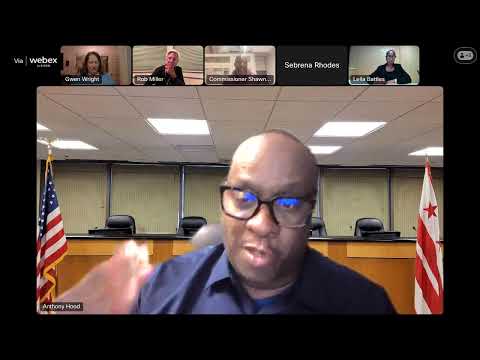
The hearing, chaired by Anthony Hood, also produced two formal procedural actions: the commission voted to hold a closed meeting on Oct. 23 “to seek legal advice from our counsel and deliberate upon the contested cases” and granted party status in the case to ANC 5D. Hood announced the closed meeting proposal and moved for it, and the commission’s roll call recorded three votes in favor (Hood, Commissioner Wright and Vice Chair Miller); two commissioners were not present and did not vote.
Why it matters: The proposal sits on a 9.13‑acre PUD site on New York Avenue Northeast where the District’s 2021 Comprehensive Plan added a PDR stripe along the corridor. The applicant says the project will bring jobs, multimodal streetscape improvements and environmental measures to a long‑dormant site; opponents say rezoning the frontage to PDR‑1 will lock in industrial uses that could preclude future housing and worsen air and truck impacts for nearby neighborhoods.
Most important developments presented at the hearing
Applicant presentation: Lila Batiste of Holland & Knight led the applicant team. Paul Milstein of Douglas Development described the property’s development history since Douglas acquired it in 2014 and the company’s shift from a larger mixed‑use scheme to a “flex” building concept after public financing (TIF and HUD 108) proved unavailable. Architect Reynaldo Venancio (Powers Brown Architecture) described a two‑level, 180,000‑square‑foot building with about 20,000 square feet of ground‑floor office/showroom/retail, roughly 126 parking spaces on one side of the office area and roughly 198 parking spaces overall in the current design. The building elevations show a 48‑foot overall height and a 36‑foot clear interior height suitable for a range of light industrial, maker, commissary, showroom or fitness/entertainment uses; the team emphasized façade articulation and landscaping along New York Avenue and Montana Avenue.
Transportation and public‑realm commitments: Daniel Solomon (Grove Slade) testified that DDOT had scoped and reviewed the applicant’s transportation study and provided a no‑objection report with conditions. The project proposes to eliminate 16 existing curb cuts, provide head‑in/head‑out loading, install traffic signals at selected site drive intersections, upgrade sidewalks and provide a dual sidewalk/shared‑use path on New York Avenue frontages, and implement a TDM plan. Solomon and DDOT staff said they expect trucks to use DDOT‑designated truck routes (New York Avenue, West Virginia Avenue and Bladensburg Road) and not to route through local residential streets; the applicant agreed to work with DDOT in public‑space permitting to finalize signal and sidewalk/trail designs.
Office of Planning recommendation: Brandice Elliott and Crystal Myers for the Office of Planning (OP) recommended approval in their Oct. 16 hearing report (entered into the record) because, OP said, the narrow rezoning along the 200‑foot frontage implements the Comprehensive Plan’s PDR stripe and the PUD secures public benefits (streetscape, architectural mitigation, stormwater management, job creation) while not requesting additional height or density. OP noted potential policy tensions with housing and mixed‑use goals but concluded, after balancing the Comprehensive Plan maps and policies and the New York Avenue Vision Framework, that the proposal is not inconsistent with the Comprehensive Plan on balance.
Community concerns: Residents, ANC commissioners and neighborhood groups expressed opposition or strong skepticism, citing three broad areas: (1) the scale and character of the proposed building — several commissioners and residents noted the building’s roughly 800‑foot linear frontage along New York Avenue and warned a long, largely blank façade could discourage pedestrian activity; (2) land‑use permanence and housing loss — ANC 5C and others argued rezoning and a large single‑building footprint could foreclose thousands of potential residential units on the larger Montana Triangle site and urged a new zoning typology that would allow PDR while protecting housing capacity; and (3) transportation, noise and air quality — neighbors warned that heavy truck activity, idling and diesel exhaust are already problems in the corridor and asked for enforceable truck‑routing, loading and parking limits, and for stronger buffers between industrial operations and nearby residences.
Applicant use restrictions and conditions: In response to community concerns, the applicant provided a list of industrial uses it would voluntarily prohibit in the PUD; the team also offered an elevated, landscaped buffer of roughly 45 feet between the New York Avenue frontage and the remaining developable land to the south, committed to a binding TDM plan, and agreed to DDOT‑requested public‑realm upgrades that will be finalized in public‑space permitting. The applicant said the proposed flex building is intended for multiple potential tenants (flex/light manufacturing, commissary, showroom, indoor recreation) and that a future tenant‑driven change would return to the commission if a change required modification to the approved PUD plan.
Parking, loading and scale: DDOT and the applicant clarified differing parking calculations: PDR parking rates and warehouse rates differ under the zoning rules (for general PDR the applicant used 1 space per 1,000 sq. ft.; for a warehouse rate the requirement is lower), and DDOT’s preferred parking guidance is expressed as a percent above the zoning minimum (DDOT favors up to 150% of the zoning requirement depending on transit access). The applicant currently shows roughly 198 parking spaces and up to 19 loading docks; DDOT noted this loading count and parking layout are unusually large and asked for continued coordination as designs and public‑space conditions are refined.
Procedural results and next steps: During preliminary matters the commission accepted the proffered transportation and planning experts, admitted the applicant’s LEHI scorecard (waiver), and resolved preliminary disputes about ANC involvement: ANC 5C’s earlier record submissions were preserved but ANC 5D (which is adjacent but not technically “affected” under the zoning rule) was granted party status under the broader party‑status standard. The commission took a roll‑call vote to hold a closed meeting on Oct. 23 at 3:15 p.m. to receive legal advice and deliberate on the contested cases; Chair Hood made the motion and the roll call was 3‑0‑2 (three yes, two not present/not voting).
What the record shows is unresolved: The hearing did not produce a final commission decision on the PUD or the map amendment. Commissioners asked for supplemental information before a later hearing: (a) DDOT/OP to clarify parking assumptions and, if possible, cite comparable projects with similar numbers of loading bays; (b) applicant to provide final, binding language on the proposed use restrictions, the proposed 45‑foot landscaped buffer, and any additional enforceable conditions tying truck routing, loading hours and parking access to the PUD; and (c) parties and agencies to file responsive comments. The commission set a schedule for supplemental filings and responses and signaled the case will return for further review and deliberation.
Ending: The commission left the record open for further submissions from OP, DDOT, the applicant and affected ANCs and set a timeline for supplemental filings. No final vote on the PUD or map amendment occurred on Oct. 20; the closed meeting Oct. 23 and subsequent written submissions will shape the next public deliberations.
Speakers quoted in this article include Chair Anthony Hood; Lila Batiste, counsel for the applicant; Paul Milstein, vice president for Douglas Development; Reynaldo Venancio, Powers Brown Architecture; Daniel Solomon, Grove Slade (transportation); Brandice Elliott and Crystal Myers (Office of Planning); Noah Hagen (DDOT); and several ANC commissioners and residents. Direct quotes are taken from the hearing transcript at the times noted in the provenance.