Lifetime Citizen Portal Access — AI Briefings, Alerts & Unlimited Follows
City of East Point holds ‘Business License 101’ workshop explaining when licenses and certificates of occupancy are required
Loading...
Summary
City of East Point planning staff led a public workshop explaining business-license rules, certificate-of-occupancy inspections, required documents and renewal deadlines for home-based, commercial and short-term lodging operations.
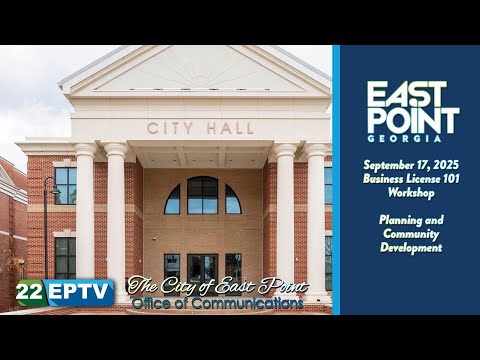
City of East Point Planning & Community Development staff held a public “Business License 101” workshop to explain when a city business license is required, what supporting documents are needed and how the commercial certificate of occupancy (CO) and annual renewals work.
At the session, Planning & Community Development presenter Terrence (PCD) walked attendees through the city’s business-license classifications — home based, commercial and short-term lodging — and when each requires a license. He explained that the city issues a business occupational tax certificate (commonly called a business license) through the Business License Division and that the license must conform to the city’s zoning ordinance and business license ordinance. “The East Point business license legally authorizes your business, whether it’s home based or commercial, to operate within the city of East Point,” Terrence said.
The workshop emphasized three common paths to compliance: confirm that the proposed use is allowed under zoning, obtain any required permits and inspections and, for commercial spaces, obtain a commercial certificate of occupancy before applying for the business license. Terrence described the CO as a safety and zoning check signed by the chief building official and the fire marshal: the CO confirms the space is “used according to our zoning ordinance, it’s been inspected and it complies with all of the requirements for you to operate and be at that location.”
Why it matters: The city treats the business license as an occupational tax tied to revenue generated in East Point. Staff repeatedly told attendees that operating and generating income inside the city — whether from a commercial storefront, a leased studio or a whole-house short-term rental — generally requires both a CO (for commercial locations) and a City of East Point business license. Code enforcement may check compliance beginning April 1 each year and can issue citations for businesses operating without required approvals.
Key details from the workshop
- When a license is required: Terrence said the city’s ordinance (section 5.223) generally requires a license for any person, firm or corporation “doing business” in the city and liable for the occupational tax. Exemptions cited in the workshop included certain government and military facilities and places of worship, but staff noted those entities may still need a CO or special-use permit.
- Home-based businesses: The presenters said East Point’s home-occupation rules typically limit allowable activities to administrative or low-impact operations and that certified family day-care providers or state-authorized “cottage” operations (for example, small food producers) can qualify under specific rules. Terrence advised residents to consult the home-occupation ordinance before assuming a home-based business is permitted.
- Commercial businesses and CO inspections: The CO inspection checks life-safety items such as exit doors and hardware, exit and emergency lighting, fire extinguishers and sprinkler or alarm systems where required. Terrence described the inspection and the CO fee: attendees were told the CO application fee is $115 and that submitting the CO application triggers scheduling of the fire marshal and building official inspections.
- Documents required with a business-license application: Staff listed required items that include the completed application form, proof of applicant ID, federal tax ID (or Social Security number for sole proprietors), state registration where applicable, and any industry-specific permits (for example, Fulton County health department reports for food-service businesses or Department of Agriculture approvals for certain markets). Nonprofits must provide their 501(c)(3) documentation to establish fee exemptions or reductions.
- Fee calculation and minimum charges: Presenters explained the occupational tax is calculated from multiple pieces: a base administrative charge (as stated in the workshop, $75), a flat tax (as stated, $50) and additional components based on gross receipts and the number of employees. Staff said the minimum total amount most new businesses will pay is $155 (presenters referenced this as the base minimum). Terrence and Tanya Miller, the business-license coordinator, emphasized the calculation uses gross receipts (not net profit) and that the city may request tax returns if reported figures appear inconsistent.
- Professional fee option and E-Verify: Certain licensed professionals may elect a per-professional flat fee option (presenters said the ordinance lists eligible professions and that fee is $400 per professional). The application also contains an E-Verify section; Georgia requires E-Verify for employers over certain thresholds and the presenters noted businesses with 10 or more employees must provide E-Verify authorization numbers.
- Renewals and deadlines: Staff said the city mails courtesy renewal notices between October and December but that renewals are due by March 31 each year. The presenters warned that code enforcement begins compliance checks on April 1 and late renewals may lead to late fees and potential citations enforced through the municipal court process.
Q&A highlights
- Renting commercial space: Resident Harper Cooper asked whether renting a studio for crocheting would require a license; staff answered that a commercial rental used for business would need a CO and a business license and that zoning must allow the use. “Yes, ma’am. Because you are still doing that type of business in the city, it will require … a certificate of occupancy” (Terrence).
- Home-based crocheting: Tanya Miller and Terrence explained that small-scale home-based ecommerce or administrative activity is often allowed under the home-occupation rules, but significant activity (on-site customers, noticeable storage or heavy traffic) can trigger the need for a business license and zoning review. Tanya Miller stated in the session that if an owner is generating revenue while living in East Point, “you are most definitely required to have a business license, because, basically, what your business license is is an occupational tax.”
- Fees and annual calculation: Attendee Ophrey Franklin asked about fees. Staff reiterated the CO application fee (stated as $115) and described the occupational tax calculation based on gross receipts and number of employees; they said the minimum starting charge is $155 and that the license must be renewed annually with gross receipts reported for the prior calendar year.
- Landlord vs. tenant responsibilities: Presenters said landlords of commercial properties must hold their own business licenses and COs and that each tenant is also responsible for obtaining a CO and business license for their specific tenant space. Terrence explained the safety rationale: a tenant’s interior configuration (shelving, storage) can affect exits and fire-code compliance, so each new business receives its own inspection and CO.
What staff asked of attendees and next steps
Staff encouraged attendees to confirm zoning before leasing or making buildouts, to contact the city’s permitting division for CO questions and to work with the Business License Division to prepare the application and supporting documents. Project manager Yasmin will collect participant feedback via a survey, and Tanya Miller invited organizers and attendees to contact her at tmiller@eastpointcity.org or bl@eastpointcity.org and to visit the PCD office Monday–Friday beginning at 9 a.m. for assistance.
Ending
The workshop provided a step-by-step overview of East Point’s licensing and CO process and answered attendee questions on rentals, home-based operations, fees and renewal timing. Staff stressed that operating and generating income inside city limits generally triggers licensing and that beginning the zoning and permitting conversation early reduces delays when a business builds out a commercial space.