Get Full Government Meeting Transcripts, Videos, & Alerts Forever!
Get email alerts on the Library Security topic
No spam. Unsubscribe anytime.
Library director says more analysis needed before installing weapons detectors at Central Library
Summary
After reviewing security data, staff surveys and equity impacts, Multnomah County Library Director Annie Lewis recommended against moving forward immediately with weapons detection at Central Library and proposed additional engagement, a closer look at vapor sensors and updates to exclusion and weapons policies.
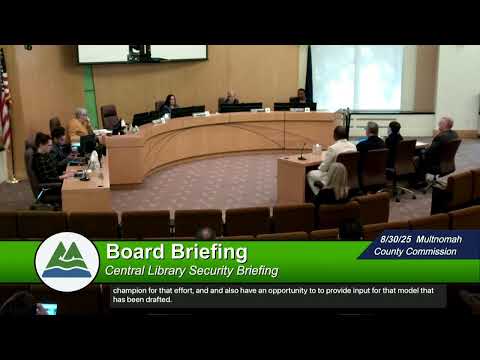
Multnomah County Library Director Annie Lewis told the Board of Commissioners on Thursday that the library will not yet move forward with weapons detection systems at Central Library, citing incomplete operational analysis, equity concerns and the need for further community engagement.
"The safety and security of library staff, patrons, and our neighbors is our absolute number 1 priority," Lewis said during a briefing that reviewed security investments, incident data, vendor demonstrations and staff input. "I do not feel we have enough conclusive information to support moving forward with weapons detection systems."
Lewis outlined security investments and recent operational changes: the library’s security spending has risen to about $3,900,000 in fiscal year 2026, up from roughly $2,100,000 in fiscal year 2019; Cascadia Behavioral Health and contracted peer specialists provide behavioral health support; Intercon Security provides on‑site contracted officers; and the county security operations center monitors cameras 24/7. Lewis said Central Library averages about 1,400 visitors per day and that incident reports have declined since July.
The briefing summarized an evaluation of weapons‑detection technologies, including a demonstration of an Evolv system. Library staff presented estimated costs and operational impacts: leasing the Evolv system could cost roughly $43,700 a year plus an estimated $10,500 installation fee, but the principal expense would be additional security personnel. Library staff estimated up to 10.2 additional security officers per open hour could be required to run screening and maintain interior and exterior security, raising annual security costs from an estimated $300,000 to as much as $1,000,000.
Lewis and county staff described legal constraints and operational considerations. Under Oregon law, administrative searches for non‑law‑enforcement purposes require careful policy definitions and consistent, nondiscriminatory application. Lewis said any screening regime would require clear rules about what counts as a weapon, updated procedures for what to do if a weapon is detected, and consistent application to all patrons, including tourists, children and older adults. She noted that the county cannot currently restrict firearms possessed by concealed‑handgun‑license holders except where an ordinance and administrative rules expressly allow it.
The library’s equity analysis highlighted a risk that weapons detection systems could disproportionately affect people of color, people experiencing houselessness, neurodivergent patrons, and others who might feel targeted or deterred from library use. A survey of Central Library staff drew notable opposition to walk‑through metal detectors: 76% of responding staff opposed walk‑through detectors, 62% said such systems would decrease their physical safety, and 70% said their psychological safety would decrease.
Lewis said the library would pursue several measures short of full weapons screening. The library is evaluating vapor sensors for restrooms, has improved signage and exclusion procedures, plans to revise the library’s weapons rule (rule 7) for clarity, and intends to review exclusion lengths (which currently range up to three years for repeated violations). The library also plans additional training and communication for on‑site security staff and intercom officers, ongoing outreach with Portland Police Bureau and workplace security, and a community engagement effort to solicit patron input — including from patrons who stopped using Central because of safety concerns — with results due in about a month.
Commander Brian Hughes of the Portland Police Bureau said police response times near the library have improved in recent months and that the bureau responds to criminal activity both inside and within 200 feet of the library. Workplace security and Intercon managers said they are focusing on consistent staffing, cross‑training and closer collaboration with library staff.
Lewis said the library will not impose access restrictions that require a membership or card to enter, and county leadership declined at this time to reinstate Multnomah County Sheriff facility security officers. The library also decided to leave benches on Tenth Avenue open during an upcoming balustrade restoration project to preserve limited outdoor seating and to concentrate monitoring in a focused area.
Lewis closed by urging continued county and city collaboration on underlying causes of security problems, including housing, mental‑health services and outreach. "The underlying causes of security that the library faces are a result of greater systemic issues," she said. "I respectfully request that the board continues to advocate for measures and enact policy that will enhance community safety, improve housing affordability, access to mental health care, and programs that meet basic needs."