Get Full Government Meeting Transcripts, Videos, & Alerts Forever!
Get email alerts on the Budget Allocation Ocofund topic
No spam. Unsubscribe anytime.
Oversight committee reviews final OCO spending plan; members press for timelines and clarity on RV-focused rapid rehousing
Summary
HSH presented the adopted Our City, Our Home budget for FY 2025–26 and FY 2026–27, detailing $104 million in new programming over two years and trailing legislation that reallocates one-time OCO funds.
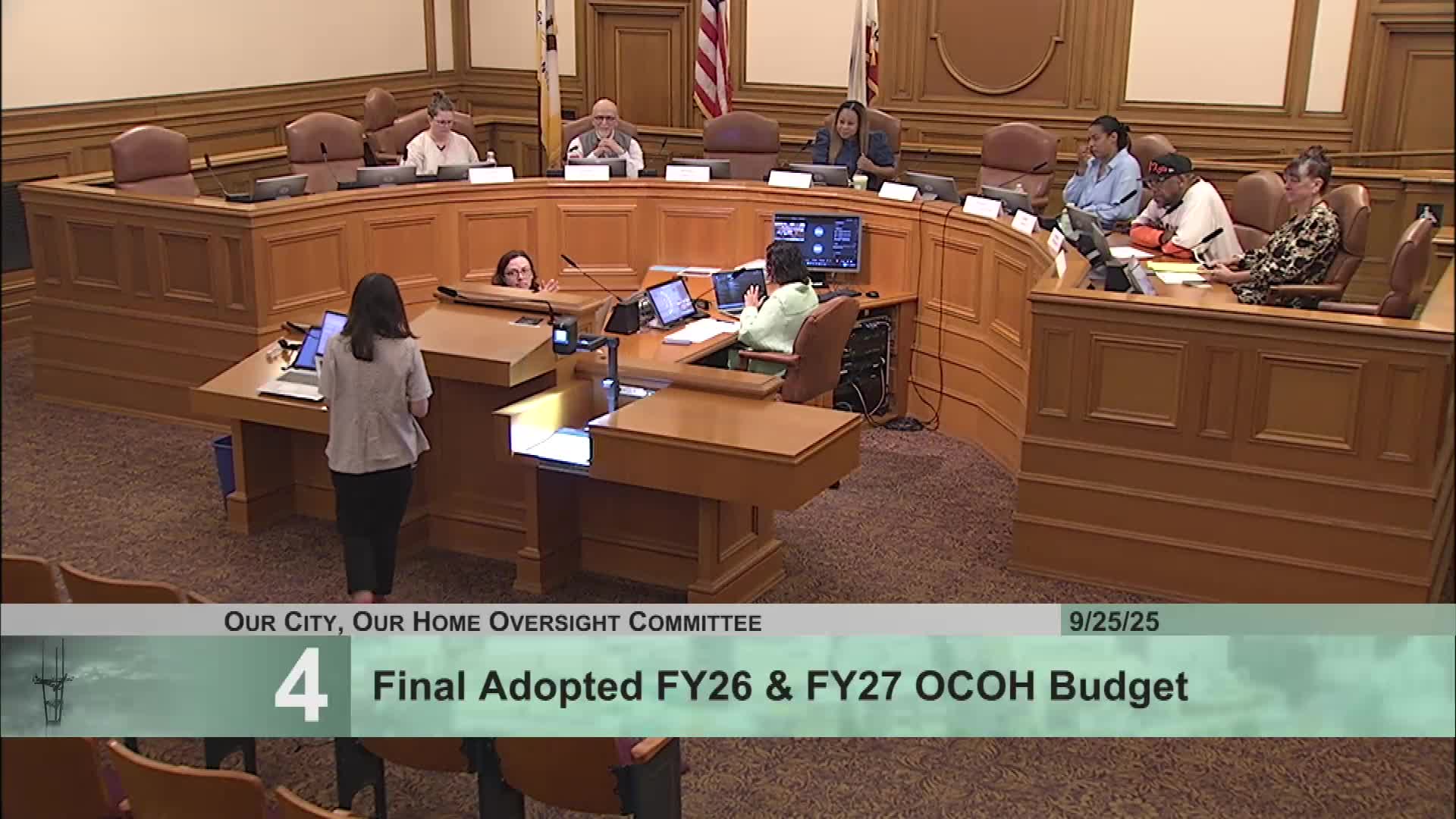
The Our City, Our Home (OCO) budget for the Department of Homelessness and Supportive Housing (HSH) was presented Sept. 25 to the oversight committee, with HSH staff detailing a two-year spending plan and line-item additions approved during the Board of Supervisors’ phase of the budget.
“My name is Reina McKinnon. I’m the Our City Our Home budget manager for HSH, and today I’ll be presenting on the final approved OCO budget for FY '25-'26 and FY '26-'27,” HSH budget manager Reina McKinnon said as she opened the department’s presentation. McKinnon said the adopted HSH portion of the OCO fund totals $463,000,000 for FY 2025–26 and $320,000,000 for FY 2026–27, and that the package includes $104,000,000 in new programming over the two-year window.
The presentation enumerated major new investments added during Board phase: roughly $46.9 million for new rapid-rehousing and shallow subsidy programs across populations (including 130 family rapid-rehousing slots and allocations to support family and adult rapid rehousing), $31.8 million to fund up to 120 beds for the Rapid Engagement Shelter and Treatment for Opioid Recovery (RESTORE) program, $3.4 million for 50 new adult hotel vouchers tied to the mayor’s Large Vehicle Strategy, and $4.7 million for outreach, case management and a vehicle buyback program to support individuals living in vehicles. McKinnon said the budget also continues funding for 130 family hotel vouchers put into service in FY 2024–25 and extends that support for 18 months.
Committee members focused most of their questioning on whether certain adult rapid-rehousing slots were being set aside to support the RV (vehicle-living) initiative and how that would affect prioritization through the city’s coordinated entry process. Member Friedenbach pressed staff for clarity, saying, “If you’re homeless, living in an RV, you’re homeless. If you’re living on the street, you’re homeless,” and asked whether people in RVs would receive preference over unsheltered people without vehicles.
McKinnon and HSH staff responded that the 100 adult rapid-rehousing slots identified in the budget were intended to add capacity to support the RV intervention strategy — not to remove slots from the baseline coordinated entry system — and that she could not answer how coordinated entry prioritization rules would be applied at the case-management level. “I can’t speak to the coordinated entry process. We’re really here to just talk about the budget,” McKinnon said. Committee members requested follow-up from HSH and the controller’s office about the implementation timeline and how the slots will be administered.
McKinnon also reviewed trailing Board of Supervisors legislation that accompanied the budget. She said the final legislation included a one-time reallocation of $34,700,000 in unencumbered OCO funds and unappropriated earned interest to support the Breaking the Cycle initiative; a suspension of the 12% cap on short-term rental subsidies; and authorization for the city to allocate up to $19,100,000 of future OCO fund revenue through FY 2026–27 to eligible programs without following the tax-code expenditure percentages — though any reallocation beyond that would still require the annual appropriations ordinance and, for larger reallocations, a supermajority of the Board of Supervisors.
Several members asked about the legal review of those Board actions and whether the city attorney had provided an opinion. Committee staff said the city attorney participated in board proceedings, but cautioned that some advice to departments and the board is privileged and might not be publicly distributable; the committee asked staff to inquire whether non-privileged guidance could be shared.
Committee members also requested an itemized comparison showing the committee’s recommended investments versus the final adopted budget and asked for a timeline for rollout and eligibility information for new subsidies and slots. HSH staff committed to providing additional detail after the meeting.
No committee vote was taken on the budget during the Sept. 25 meeting; the presentation and questions were recorded as part of the committee’s oversight and implementation review.