Lifetime Citizen Portal Access — AI Briefings, Alerts & Unlimited Follows
House commission questions LUMA on repeated outages in District 21; officials point to aging equipment, vegetation and funding gaps
Loading...
Summary
A Sept. 25 public hearing before the House of Representatives’ South‑Region commission reviewed LUMA Energy testimony, Negociado de Energía data and consumer‑protection input as lawmakers pressed for details on vegetation management, funding and response times after repeated outages in Guánica, Yauco and other District 21 municipalities.
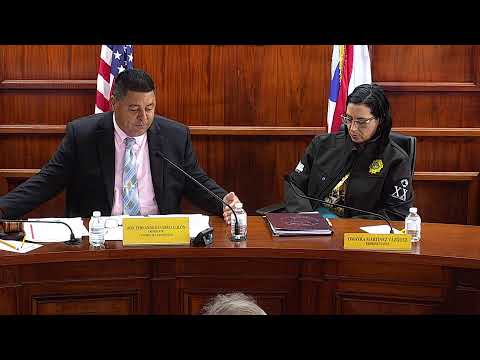
The House of Representatives’ Commission of the South Region held a public hearing Sept. 25 to examine “constant interruptions” of electric service in District 21 (Guánica, Lajas, Las Marías, Maricao, Sabana Grande and Yauco), focusing on infrastructure failures, vegetation management and funding shortfalls.
LUMA Energy’s government‑affairs director, Rebeca Maldonado, told the panel the island’s transmission and distribution system “sigue deteriorándose y su confiabilidad se ve afectada” and listed equipment currently out of service and planned stabilization work. She said, as part of a fiscal‑year plan, there are dozens of critical components needing repair or replacement, and warned recent delivery delays in global supply chains and shortages of skilled technicians have slowed restoration work.
The commission’s investigation is based on House Resolution No. 77, filed by Representative Omaira Martínez Vázquez. Martínez, the resolution’s sponsor, described chronic outages in her district and pressed LUMA and regulators for faster responses. “Desde anoche, bajo voltaje. Maricao, pueblo, sin servicio eléctrico,” she said during the hearing, noting frequent constituent calls seeking help.
Why this matters: witnesses and lawmakers said outages affect residents’ safety, homes and local development, and that reversing years of deferred investment will take time and money.
What LUMA reported LUMA’s written and oral testimony to the commission described an aging, fragile network and provided itemized counts of critical equipment it described as out of service islandwide and targeted for stabilization work. Among the figures presented to the commission were 24 substation transformers with combined nominal capacity cited in testimony and a list of distribution and transmission devices included in the current stabilization plan. LUMA also provided a municipality‑level table showing work already completed and planned improvements — a tally the testimony described as a “gran total de 467 mejoras” in the municipalities named in the resolution through the close of the fiscal year.
LUMA officials said repairs sometimes do not keep pace with new failures: in the cited fiscal year they reported restoring service to eight transformers while 10 failed, restoring 83 distribution switches against 89 failures, and repairing 38 transmission switches against 39 failures. The company emphasized that without a “considerable” increase in non‑federal capital funding and faster execution of federally funded projects the network’s reliability could continue to decline.
Negociado de Energía and consumer protection The Negociado de Energía de Puerto Rico (NEPR) and the Oficina Independiente de Protección al Consumidor (OIPC) also testified. NEPR officials explained the agency’s role in regulating and overseeing compliance with energy policy under the Law of Transformation and Energy Relief (Law 57 of 2014, as amended) and said NEPR has opened island‑level inquiries into large outage events but did not have, in its files, open investigations specifically tied to outages in Guánica and Yauco at the time of the hearing. NEPR said it publishes final resolutions and related public documents on its website and that it analyzes outages both by event and by district to prioritize work.
OIPC attorney Beatriz González told the commission that, in the current year, the office had directly assisted 10 consumers from the municipalities in the affected district with matters related to outages, billing or reconnection. She outlined OIPC’s function as a consumer advocate that can provide procedural assistance, representation before NEPR in some cases, and customer guidance about filing complaints.
Vegetation management and response time disputes A major focus of questioning was vegetation management — tree trimming and right‑of‑way clearance — and whether rules or limits exist on how much vegetation LUMA may trim. Representative Odaly González said constituents reported crews could only prune “30 percent” of vegetation and asked whether any statute or regulation sets such a limit.
NEPR Commissioner Antonio Torres Miranda responded that in NEPR’s record and in proceedings tied to the vegetation‑management plan no minimum percentage cap had been established: “si nos pueden decir de dónde sale ese 30 por 100, ahora mismo tenemos que decir que no hay ningún mínimo,” he said, adding that the vegetation plan and quarterly progress reports are filed with NEPR and can be shared with legislators.
NEPR staff and LUMA also described a two‑part vegetation program: an initial clearing (“despeje”) funded in part by federal dollars followed by ongoing maintenance. Commissioners and LUMA officials told lawmakers some federally funded projects paused temporarily for environmental‑impact reviews and that federal disbursement schedules (including initial 25% advances and subsequent reconciliation) can delay on‑the‑ground work.
Complaint counts, priorities and emergency response Lawmakers pressed officials on the apparent discrepancy between few formal complaints recorded at NEPR for outages in specific municipalities and the many constituent reports representatives say they receive. NEPR clarified that the number of complaints filed with the regulator differed from the number of customer contacts LUMA receives: the regulator sees only cases elevated to its docket after a consumer seeks redress beyond the utility’s response.
NEPR and LUMA officials acknowledged “events” (single outage incidents affecting many customers) are typically fewer than the total number of individual complaints; they also said outages can stem from causes across three operators that make up the integrated system — generation, transmission/distribution and the resource operator — and that consumers do not always distinguish among them when reporting problems.
Officials said emergency situations (fallen poles, exposed live wires, clear safety risks) should be prioritized and that customers who feel a complaint is not being handled may file directly with NEPR or seek OIPC assistance. NEPR also described cases in which it has conducted administrative hearings away from its San Juan office to accommodate complainants.
Funding and federal projects NEPR and LUMA described multiple funding streams and constraints. Witnesses said LUMA requested roughly $50 million in operating or program funds for fiscal 2026 and had sought an additional $24 million specifically for vegetation work; NEPR said it approved that $24 million in the provisional tariff proceeding. LUMA and NEPR also discussed larger federal programs and a federal‑funds package referenced repeatedly in testimony (described in the hearing record as “1.2 [billion]” for vegetation work), noting that federal project approvals, environmental reviews and phased disbursements slow implementation.
Officials said the provisional tariff adjustment that took effect in September included a partial increase to restore funds that had not been updated since 2017; NEPR described the tariff review process as public and noted it reduced the consolidated increase requested by the three system operators in its provisional decision.
Voltage fluctuations and distributed generation NEPR staff and LUMA officials also addressed voltage and frequency fluctuations, which they said are sometimes linked to the increasing penetration of distributed generation (rooftop solar) and to interconnection practices and inverter settings. NEPR said it is updating technical rules and inverter standards to reduce voltage instability, and LUMA noted that deployment of distribution automation equipment and smart meters is intended to improve fault isolation and decrease customer impact when outages occur.
What the commission asked for next Lawmakers asked for follow‑up documentation, including LUMA’s municipality‑level vegetation reports and NEPR’s list of federally funded projects, disbursement amounts and schedules. The commission chair ordered LUMA to deliver specified information within five business days.
The hearing underscored the interacting causes lawmakers and regulators cited for outages — aging equipment, constrained funding, supply‑chain delays, vegetation encroachments and rising distributed generation — and lawmakers pressed both utility and regulators for clearer timetables and better constituent communication.
Ending Representatives scheduled follow‑up and requested written submissions of the testimonies and supporting tables. The commission closed the hearing after lawmakers reiterated that restoring reliability in District 21 will require coordination among LUMA, NEPR, OIPC and federal agencies as well as clearer public‑facing complaint processes and accelerated execution of approved projects.