Lifetime Citizen Portal Access — AI Briefings, Alerts & Unlimited Follows
Michigan committee hears proposed rewrite of adult foster‑care licensing rules
Loading...
Summary
The Joint Committee on Administrative Rules heard testimony from Department of Licensing and Regulatory Affairs staff on a consolidated rule package (JCAR rule sets 25‑51 through 25‑58) that would replace six existing adult foster care rule sets with a single, shorter rule set; committee lacked a quorum so no formal action was taken.
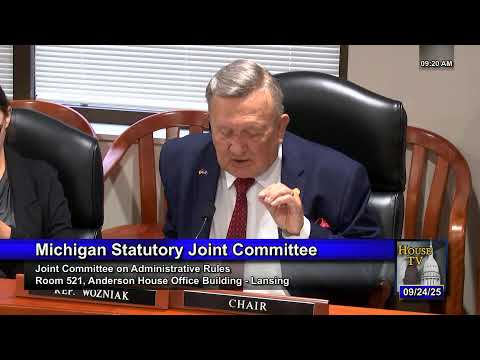
LANSING — The Joint Committee on Administrative Rules on Oct. 25 heard testimony from Department of Licensing and Regulatory Affairs (LARA) officials proposing a consolidated adult foster‑care licensing rule set, described as a rewrite of six existing rule packages into one streamlined regulation covering adult foster care (AFC) facilities.
Paige Fultz, director of the Office of Policy and Legislative Affairs at LARA, introduced the proposal and turned the presentation over to Jay Kallawertz, division director for adult foster‑care licensing in LARA’s Bureau of Community and Health Systems (BCHS). Kallawertz said the new rule set would replace six existing AFC rule sets and reduce the number of rules “from 206 to 73” and cut the rule pages from about 120 to roughly 37, a consolidation intended to simplify compliance across family homes, group homes and other AFC provider types.
The proposal would update licensing standards used to oversee roughly 3,900 licensed AFC homes in Michigan, expand and clarify certain record‑keeping and resident‑protection standards, and make a number of substantive changes to current requirements. Kallawertz said the licensing consultants who oversee AFCs number about 55 and handle roughly 2,400 complaint investigations a year; he described AFCs as serving adults with mental illness, developmental disabilities or physical disabilities and noted a wide range of acuity across residents.
Among the more significant changes described by LARA staff: - Elimination of routine tuberculosis (TB) testing for direct care staff, consistent with Centers for Disease Control guidance the department cited as applying to health‑care‑setting monitoring; - A uniform record‑retention standard of two years for licensing documentation (with certain items such as staff schedules and menus retained for 90 days); - Raising the ceiling for resident cash a licensee may hold from $200 to $400, and increasing the required on‑hand cash to return immediately to a resident from $20 to $40; the threshold for what qualifies as a “resident valuable” would rise from $25 to $100; - Authorization for issuance of a temporary special license — up to one year — following fire or other disaster to allow residents to move temporarily to another licensed home; - New written standards for facility cooling measures (not all AFCs would be required to install air conditioning, but providers must have an approved plan to cool residents during hot weather); - Allowing trained minors age 16–17 to perform certain direct‑care duties under supervision, with explicit prohibitions on medication administration and transportation by those minors; - Clarifying that a facility may use non‑department forms for resident funds and valuables if the alternate form captures the same information; and - Expanding the list of clinicians that may be recognized in facility records from “physicians” to any health‑care professional practicing within their scope (for example, physician assistants and nurse practitioners).
Kallawertz characterized the rewrite as an effort to modernize and harmonize rules that in some cases had not been substantially updated for decades. “This language is clear, more concise while continuing to ensure resident safety and protection,” he said.
Committee members questioned LARA officials about restraints and elopement prevention devices, the role of recipient‑rights and fire‑safety standards, and the interaction of licensing with payment and program rules administered by the Michigan Department of Health and Human Services (DHHS). LARA staff said use of restraints and other movement restrictions must be reflected in an individual resident’s care plan and that chemical restraints and unnecessary overmedication are prohibited under their standards; they said questions about what restrictions are permissible often require coordination with recipient‑rights authorities and DHHS because federal funding rules and program requirements can limit or specify permissible restrictions.
On door egress and delayed‑egress devices, LARA staff and committee members described a complex web of overlapping standards. LARA said the Bureau of Fire Services follows National Fire Protection Association (NFPA) guidance on delayed egress devices and the department defers to recipient‑rights rules and DHHS when restrictions affect a funded recipient’s freedom of movement. Committee members noted this can leave facilities and families uncertain about when alarmed or delayed‑egress doors are allowed; LARA staff described that area as “tricky” and said use of such devices depends on individual circumstances and other statutory or program requirements.
Committee members also pressed on staffing and payment: LARA staff said AFCs do not provide continuous nursing care and most direct‑care staff do not have advanced degrees; many direct‑care workers are paid near minimum wage. Questions about Medicaid, waiver payments and the availability of in‑home paid care were repeatedly referred to DHHS because payment policies and program eligibility fall outside LARA’s licensing authority.
LARA described the process used to draft the rule set: an internal AFC advisory council and multiple provider and advocacy stakeholders participated in drafting and review; a Zoom town hall on Oct. 2, 2024, drew about 500 attendees and yielded roughly 90 questions; a public hearing on July 8 drew three attendees and no oral comments; written comments were accepted during a public comment window and — according to LARA’s presentation — no post‑hearing modifications were made because no additional comments were received.
Public comment cards filed with the committee included support statements from the Health Care Association of Michigan and the Michigan Assisted Living Association. No formal committee action was taken on the proposed rules because the committee did not have a quorum; at the end of the meeting Representative Johnson moved to excuse absent members, and the motion was approved by unanimous consent.
The rule package still requires review and any required legislative procedures before it could take effect; LARA staff said they stand ready to respond to legislation and to work with the AFC advisory council and other stakeholders on specific questions that arise.
Ending — Questions and concerns that the committee flagged during the hearing include the practical application of movement restrictions and delayed‑egress measures, the adequacy of staffing and pay in AFCs, the boundaries between licensing and DHHS payment and program rules, and whether the consolidated rule language will produce expected efficiencies for providers and better clarity for residents and guardians. LARA officials said renewal inspections occur every other year under the licensing act and that complaint investigations occur as needed; committee members asked the department to follow up on individual enforcement inquiries when constituent complaints had been routed to adult protective services or local police.