Lifetime Citizen Portal Access — AI Briefings, Alerts & Unlimited Follows
Council hearing spotlights trauma children face in Kensington, calls for coordinated prevention and school-based care
Loading...
Summary
Philadelphia council convened a special Committee on Kensington hearing (Resolution 250502) where providers, school officials and students described daily exposure to open drug use and urged city, schools and behavioral-health agencies to coordinate funds, expand prevention and put clinicians in neighborhood schools.
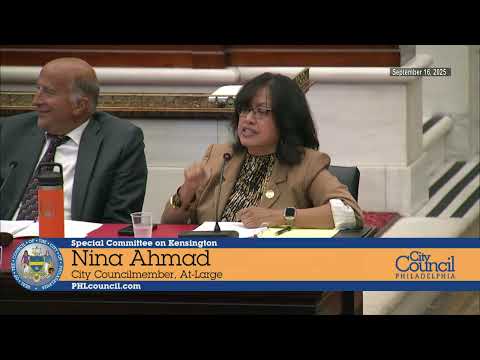
Philadelphia’s Special Committee on Kensington held a public hearing on Resolution 250502 to examine how chronic trauma from exposure to the opioid crisis affects children’s emotional, mental and behavioral health in the Kensington neighborhood and to explore tools and services to support youth. Councilwoman Ketsi Lozada, chair of the Special Committee on Kensington, opened the hearing and framed the issue as “protecting our children,” saying the committee would focus on barriers to care and possible city responses.
The hearing brought together community providers, city behavioral-health officials, School District staff and students. Providers described daily realities in Kensington — open drug markets, discarded needles near schools, and families coping with loss and instability — and urged a mix of immediate and upstream actions: safe community spaces, school-based clinicians, family-centered recovery programs, and better coordination of existing funding streams. “The opioid crisis is not just about addiction and overdoses. It’s a children’s health emergency,” said Hector Ayala, president and CEO of Hispanic Community Counseling Services.
Why it matters: witnesses said many children in the neighborhood carry trauma that impedes learning and development. Providers and School District representatives told the committee that treatment dollars tied to Medicaid reach children who meet clinical thresholds, but prevention and early-intervention services that would reach children before a formal diagnosis lack a stable funding mechanism. That gap means schools and community organizations must cobble together short-term grants and private funds to run after-school hubs, trauma-informed coaching and mobile therapy.
Provider testimony and local examples: Tony Valdez, chief executive officer of Children’s Crisis Treatment Center, emphasized “protective factors” — stable housing, accessible health care, safe after-school programs and adult mentors — as the best long-term investment against trauma. Cora Services’ CEO Anne Marie McDowell described operating braided programs across schools and community sites serving 19,000 children citywide and said the most effective work happens when multiple contracts and funds are combined to keep services in one place for families.
Smaller nonprofit providers described the day-to-day gaps. Lauren Dolan, executive director of Cade Kids, said transportation, short-term funding and safety en route to programs limit participation; she cited the 2023 Youth Risk Behavior Survey showing 16.6% of Philadelphia high school students reported missing school because they did not feel safe getting to or from school. Liam Connolly of Safe Hub Philadelphia described a new indoor sports campus in Harrogate that pairs sport-based programming with access to counseling and workforce pathways, but said his organization needs multiyear funding and fewer bureaucratic barriers to scale.
School District and city systems: Philadelphia School District officials described the STEP (Support Team for Educational Partnership) model and intensive behavioral health services (IBHS) embedded in schools. The district reported STEP teams operate in 42 district schools (some funded through CBH/DHS and some through school budgets) with roles including clinical coordinator, school behavioral consultant, case manager and family peer. District staff said STEP and IBHS aim to provide tiered supports (schoolwide prevention, small-group and individual therapy, and intensive services) and that they are beginning to measure outcomes in partnership with the University of Pennsylvania.
City behavioral-health agencies outlined constraints: Community Behavioral Health (CBH) and the Department of Behavioral Health and Intellectual disAbility Services (DBHIDS) described a broad continuum of reimbursable services (crisis teams, outpatient and residential care, IBHS) and said Medicaid-funded care requires medical necessity—meaning many children do not qualify for Medicaid-paid services until they meet clinical thresholds. CBH reported its network includes roughly 250 providers at more than 800 locations citywide; in the Kensington footprint the agencies reported 35 providers at 57 locations, with seven providers focused specifically on children at 34 treatment locations. DBHIDS/CBH officials told the committee that preserving Medicaid funding and pursuing supplemental prevention funding are central to sustaining and expanding services.
Voices of children and schools: More than a dozen students from Kensington elementary and middle schools testified. Eighth-grader Lilacoda said, “Drug usage has gotten so bad that it affects all of our lives every day,” and Noah Ortiz described walking to school past “people using drugs, people sleeping on the sidewalk, putting needles on the ground.” Students urged more safe recreation spaces, reliable after-school clubs and unlocked playgrounds, and several asked the city to convert empty lots into gardens and sports facilities.
Funding and accountability questions: Council members repeatedly pressed for clearer accounting and oversight: how many clinicians are present in each school, what hours they cover, the caseloads they carry, and whether existing city, school and Medicaid dollars are coordinated effectively. Providers urged better coordination of city, school, philanthropic and Medicaid funds (“braiding” funding) and called for multi-year, flexible grants to sustain community hubs and trauma-informed school placements rather than short-term contracts.
Requests made to the committee: witnesses and council members prioritized several near-term steps the committee might pursue: directing opioid settlement funds to child- and family-centered interventions in Kensington (school-based wellness hubs, grief groups, safe-hub transportation), piloting prevention dollars for upstream services, and convening a cross-agency summit—DBHIDS/CBH, School District, Department of Human Services, Department of Public Health, and city departments—to map programs, eliminate duplicate contracts and match providers to school and neighborhood needs.
The hearing closed with a pledge to continue work and follow up. Chair Lozada thanked the students for testifying and said the committee intends to maintain oversight so the community sees measurable improvements. The committee did not vote on policy or appropriations during the hearing; the session served as a fact-finding hearing and public record of community needs and provider recommendations.