Lifetime Citizen Portal Access — AI Briefings, Alerts & Unlimited Follows
Senate committee clears bill to speed small State Parks land acquisitions
Loading...
Summary
The Senate Natural Resources and Water Committee voted 4-1 to concur in Assembly amendments to SB 630, a bill by Senator Allen that removes duplicative Department of General Services review for certain small State Parks property acquisitions and creates a seven-year sunset and reporting requirement.
The Senate Natural Resources and Water Committee voted 4-1 to concur in Assembly amendments to SB 630, a bill by Sen. Allen intended to speed small land transfers to California State Parks by removing duplicative Department of General Services review for certain acquisitions.
Supporters said the change aims to clear a backlog of straightforward donations and small purchases that have stalled under current review requirements. "This bill would streamline State Parks' real property transactions by removing duplicative reviews for simple acquisitions, allowing the parks to be more responsive," Sen. Allen said during the hearing.
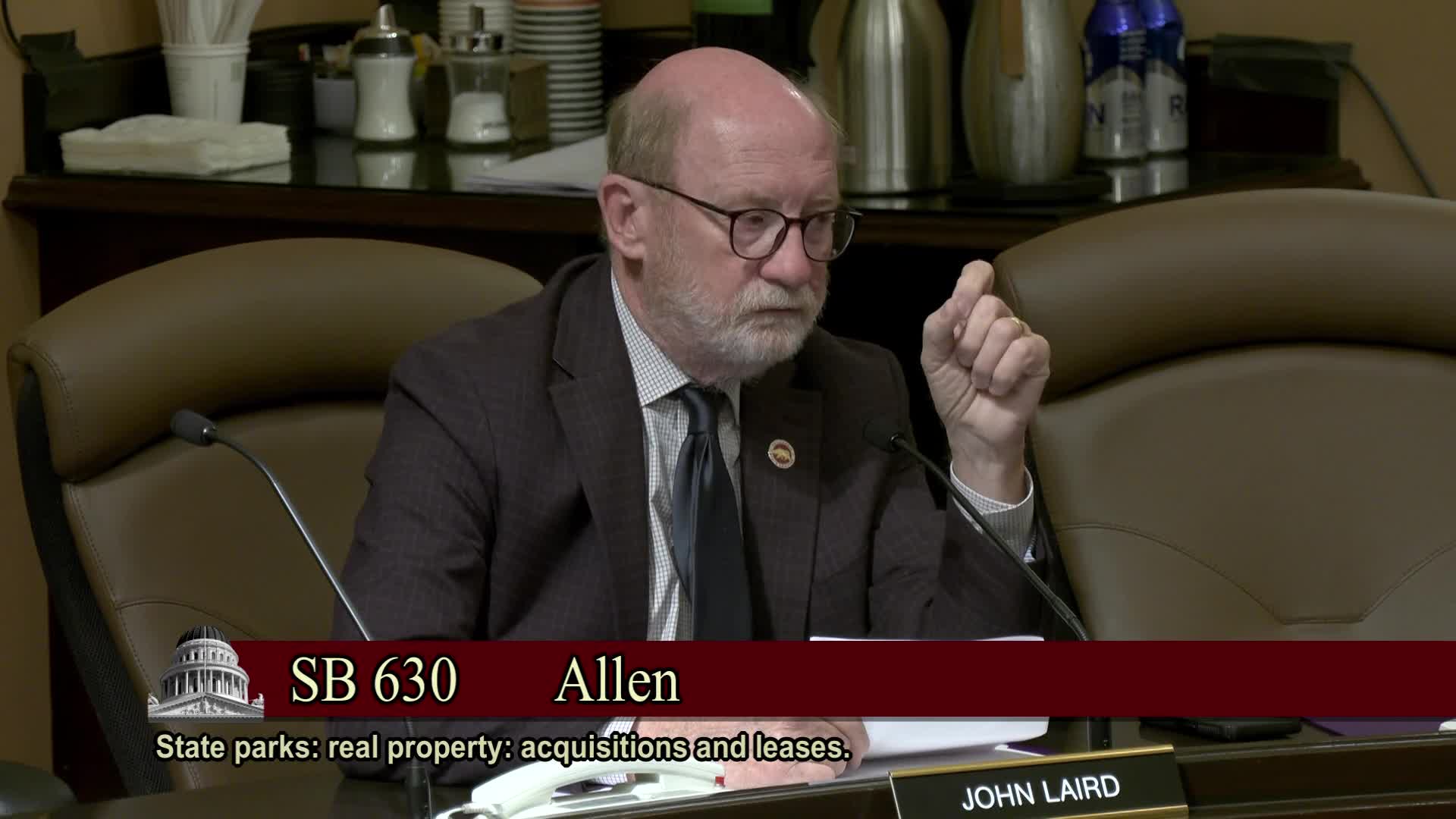
The bill, which the committee approved on a motion by Sen. Laird, raises the dollar threshold at which DGS must review and approve real estate transactions and includes a seven-year sunset requiring State Parks to report to the Legislature on progress. Supporters told the committee the measure is narrowly tailored to small acquisitions and is not intended to substitute for the department's review of larger, more complex purchases.
Reid Addis, principal of environmental and energy consulting, testified on behalf of the California State Parks Foundation, Save the Redwoods League and Sempervirens Fund, saying the issue "has been a major challenge for us, not only for years, but in some cases, decades." He and other witnesses said dozens of donated properties have been unable to move into State Parks' stewardship because of processing delays.
Jake Schultz, speaking for MidPeninsula Regional Open Space District, the California Association of Local Conservation Corps, Save Mount Diablo and Save the Redwoods League, also expressed support.
Committee members acknowledged support for streamlining but raised concerns about public process and park maintenance capacity. Sen. Laird asked where public participation would occur; the author and staff said public process would remain through the parks' existing procedures and the measure is intended to avoid duplicative public processes. "There's public process associated with these other processes that have to be in place for this bill to kick in," an author representative said.
Vice Chair Seardo expressed concern about oversight and the state's larger park maintenance backlog, noting the committee record referenced roughly $1,200,000,000 in deferred maintenance needs. Another member questioned whether adding more land would increase pressure on limited operation and maintenance funding. Allen and witnesses said the bill targets small purchases (discussed in the hearing as typically no more than $1,000,000) and contains provisions intended to limit acquisitions that would require new infrastructure.
Senators also discussed coordination with related legislation. The bill is "double joined" in the record with an Assembly measure authored by Assemblymember Pellerin addressing similar issues in the Santa Cruz Mountains; committee staff said the bills were drafted to avoid chaptering conflicts but did not require simultaneous signatures.
The committee recorded a roll-call vote on a motion "that the Assembly amendments be concurred in." The final tally, after a short recess and reconvening, was Lamone — aye; Seardo — no; Allen — aye; Laird — aye; Stern — aye, for a 4-1 vote. The bill was reported out of committee.
Supporters urged quick enactment, with Reid Addis saying they were "excited that the governor will sign this at the end of the day." The committee did not report any formal opposition during the hearing.
SB 630 now proceeds from the Senate Natural Resources and Water Committee after the committee's concurrence in the Assembly amendments; the committee record indicates the authors and staff will continue coordinating with the administration and Assembly counterparts on public-process language and implementation details.