Get email alerts on the Comprehensive Plan Amendments topic
No spam. Unsubscribe anytime.
Marion County panel debates transmitting comprehensive plan amendments amid state law concerns
Summary
County planners reported broad public support for proposed comprehensive-plan amendments but flagged Senate Bill 180 as a risk that could lead the state to return (or declare null) parts of the document; commissioners split on whether to submit the draft as written or pare back language before transmittal.
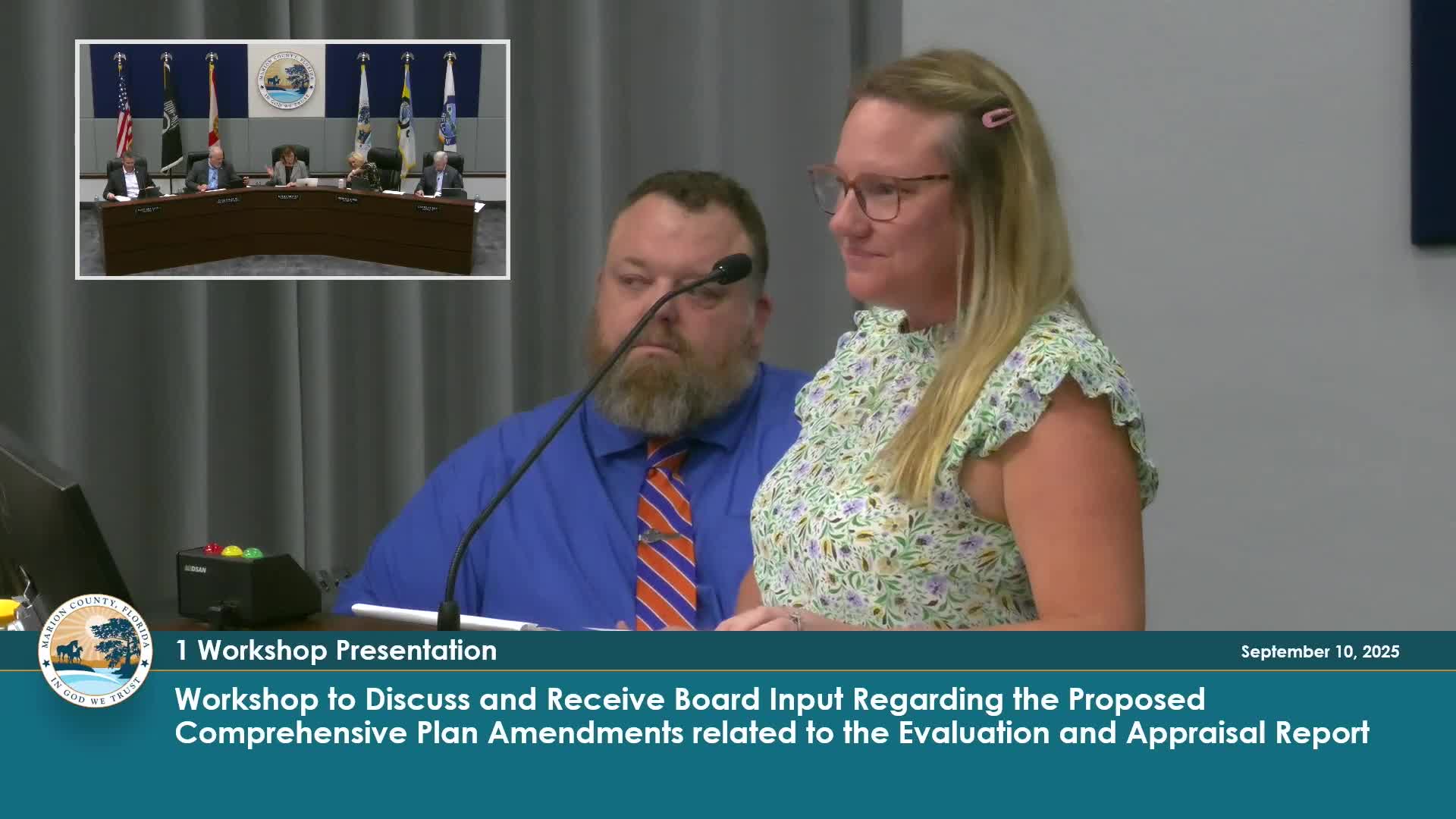
Blair Knight, county planning staff, told the Marion County Board of County Commissioners at a Oct. 2 workshop that public engagement on the proposed evaluation-and-appraisal-based amendments produced mostly favorable responses but that a new state law—Senate Bill 180—required careful line-by-line review before transmittal to Tallahassee.
"That bill basically states municipalities cannot make their land development regulations more restrictive or more burdensome," Knight said, describing why staff recommended removing or softening several newly drafted policies to reduce the chance the state finds the plan "more restrictive."
The board heard staff summaries of outreach: two online surveys and multiple community workshops in Marion Oaks and Silver Spring Shores, where planners said the record and open-space and conservation changes drew strong positive feedback. Knight said transportation and future land-use revisions produced more mixed views and some confusion about proposed neighborhood-commercial changes and form-based code (PSA) ideas.
Why it matters: commissioners must transmit a county comprehensive plan update under Chapter 163, Florida Statutes, by Jan. 28, 2026. If the state rejects the transmittal under the standard staff described, the county may have to revert to its adopted plan and negotiate with state reviewers — a process staff characterized as "uncharted territory" since recent state review outcomes have varied among counties.
Board members split on approach. Vice Chairman Zalick urged transmitting the draft as prepared to put the county's policy preferences on record. "If it gets rejected, then let them—that's fine," Zalick said. Several commissioners, including Commissioner McLean, urged caution to avoid a full nullification; McLean said he was "not willing to risk" transmitting changes that could be declared void and left the county without the adopted updates.
Staff described the approach they used: redlines in the packet identifying new language and a recommended conservative set of edits to reduce the likelihood of being found more burdensome. Examples discussed included removing a new policy that would have required step-down buffering between urban and rural lands (staff recommended striking that policy), softening wording that could be read to require new sanitary sewer availability, and reverting certain conservation and sanitary-sewer phrases that might appear more prescriptive.
Commissioners and staff agreed to keep moving toward the public hearing schedule while retaining flexibility: the planning staff proposed public hearings before transmittal to satisfy procedural requirements and to collect more public feedback before the Jan. 28 deadline. Blair Knight said staff will prepare a transmittal memo explaining where and why changes were made and how staff believe the overall package is not more burdensome.
The meeting closed with direction to schedule the public hearings that will lead to transmittal and to continue revising items staff flagged under Senate Bill 180. The board asked staff to monitor outcomes from other Florida counties that have already transmitted updates to anticipate the state's likely review approach.
The meeting record does not show a formal vote; commissioners gave staff direction and consensus guidance on next steps.
AI generated
The text on this page is AI generated. Summaries, highlights, analysis, and video transcripts are all produced from the original source material.
AI can make mistakes, so if you spot one, and we will fix it for everyone.
Note: the source content is unaltered by us. Any content source we link to, be it a video, an audio recording, or a document, is presented exactly as its publisher released it. That publisher is usually a government body, sometimes an individual official or another organisation.