Lifetime Citizen Portal Access — AI Briefings, Alerts & Unlimited Follows
Carson launches comprehensive development fee study to fund infrastructure and affordable housing
Loading...
Summary
City staff and consultants described a study to update interim development impact fees, craft an optional community benefits program and draft an inclusionary housing ordinance and commercial/industrial linkage fee; consultants said the effort aims to align developer contributions with the Carson 2040 general plan and state requirements.
City of Carson staff and outside consultants on a public virtual meeting outlined a comprehensive community development fee study that will reassess the city’s interim development impact fees, create a citywide community benefits program, and draft an inclusionary housing ordinance and commercial/industrial linkage fee to support affordable housing and infrastructure funding.
The study’s stated goal is to align developer contributions with projected growth under the Carson 2040 General Plan, meet legal requirements such as the California Mitigation Fee Act, and support the city’s Regional Housing Needs Allocation (RHNA) and housing-element goals, city staff said.
Consultants and staff described three core pieces of the study. Thomas Gonzales, vice president at EPS, framed development impact fees (DIFs) as a legal mechanism that charges new development for capital facilities needed to serve new residents and workers: “development impact fees or diffs are like a specific term within California law,” Gonzales said. He said those fees may fund capital projects — for example parks, roads and sewer capacity or vehicles and equipment that expand service capacity — but may not be used to remedy existing service shortfalls or to fund ongoing operations such as salaries.
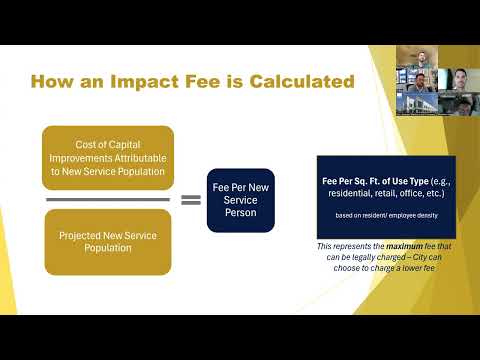
Gonzales and James Wynne, Special Projects Manager in the Community Development Department, said Carson currently has an interim DIF program with seven fee areas and that more than $14,000,000 has been collected to date under that interim program. Gonzales described the typical legal and technical approach: fees are calculated on a per-service-person or per-square-foot basis, dividing the cost of improvements needed for new growth by the number of future residents or workers the improvements will serve. The study will calculate maximum legally defensible fee amounts; city council may adopt fees up to but not exceeding those amounts.
Consultants described a separate, optional community benefits program that would operate as “value capture.” Gonzales said the community benefits program differs from DIFs because participation would be voluntary: developers who agree to provide benefits defined by the city could receive zoning or land-use concessions. He said the study will assess which zones are appropriate for the program and test whether zoning concessions provide sufficient value to incentivize developers to provide the benefits.
Brandon Fender of RSG summarized the planned inclusionary housing ordinance and the commercial/industrial linkage fee as tools specifically aimed at producing affordable units to meet Carson’s RHNA obligations. Fender said inclusionary requirements commonly range from about 5 to 15 percent of new units and that state law requires jurisdictions to offer alternative means of compliance such as in-lieu fees, off-site production, land donation or acquisition and rehabilitation. He said in-lieu fees can be pooled and leveraged with state and federal funds to produce more affordable units than on-site requirements alone.
On linkage fees, Fender said the policy links new commercial and industrial square footage to the demand for housing produced by new jobs: “as new commercial development and industrial development occurs, there’s demand for new housing,” he said. He said linkage fees would typically be charged at building permit or predevelopment stage and would scale with building square footage.
Consultants and staff outlined next steps and public outreach. The team (EPS, RSG and Webb Municipal Finance) will run financial feasibility analyses, draft policy recommendations, present findings to commissions and stakeholders, and hold a second virtual town hall likely in October. Consultants said council consideration is expected in 2026; at an earlier point in the presentation staff also said they were anticipating policy direction and adoption “next spring,” a difference the presentation did not resolve.
Residents and stakeholders raised distribution and engagement concerns. A Watson Land Company representative, Trini Jimenez, offered the firm as a stakeholder contact and asked the city to share the slide deck. Resident Brandon Fields questioned how the programs would benefit long-standing neighborhoods that are largely built out — particularly District 3 on Carson’s east side — when fees are charged citywide rather than tied to a redevelopment district. Wynne and Thomas replied that the DIF funds are citywide and not earmarked by location but may be used for eligible projects anywhere in the city; Wynne cited a current development agreement on Perry Street that includes a $250,000 community-benefit provision to improve storefronts on East Carson Street between Harborview and Santa Fe as an example of benefits targeted to District 3.
Staff said the outreach will include the online survey shown during the meeting (QR code shared) and in-person outreach at community events; consultants encouraged stakeholders to complete the survey and noted a likely additional town-hall meeting. Staff also announced an August 18 zoning-code update meeting at Carson Dominguez Hall.
No formal motions, votes or council actions were taken at the meeting; the session was a public informational and outreach presentation. The study team said it will refine recommendations after public feedback and commission input and return policy recommendations to council for later consideration.
For more information or to provide input, James Wynne, Special Projects Manager, is the city contact listed in the presentation and the city posted a survey link and said it will make the recorded presentation available on the city website.