Lifetime Citizen Portal Access — AI Briefings, Alerts & Unlimited Follows
House appropriations hearing draws wide slate of funding requests for hospitals, mental‑health services, workforce training and youth programs
Loading...
Summary
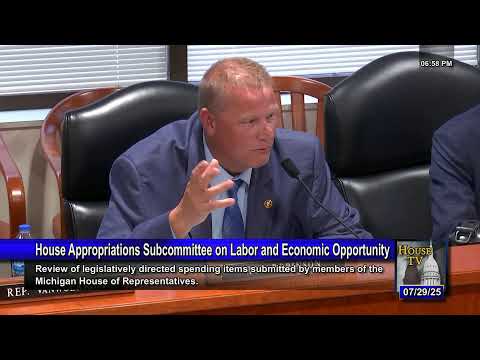
Lansing — Lawmakers on the House Appropriations Subcommittee on Labor and Economic Opportunity heard a daylong slate of funding proposals July 24 from hospitals, workforce trainers, mental‑health and recovery providers and community nonprofits seeking state support for capital projects and programs.
Lansing — Michigan lawmakers on the House Appropriations Subcommittee on Labor and Economic Opportunity heard a long docket of state funding requests July 24 from hospitals, nonprofit health providers, workforce training organizations and community groups seeking capital or operating support for the coming fiscal year.
The hearing lasted much of the day and included requests that ranged from six‑figure operating grants for specialized programs — such as sexual assault nurse examiner teams and recovery community organizations — up to multi‑million dollar capital requests for hospital renovations and new housing for people in recovery. No formal votes were held; presenters described program results, community need and funding gaps.
Why it matters: Many presenters asked the state to match federal or philanthropic dollars so “shovel ready” projects can go forward, or to provide stopgap operating funds while organizations pursue Medicaid certification or other reimbursement streams. Lawmakers repeatedly framed their questions around sustainability and whether a one‑time appropriation would be a bridge to longer‑term, self‑sustaining funding.
What lawmakers heard (high‑level): - Hospitals and capital projects: Small rural and independent hospitals testified about aging facilities and rising capital needs. Sheridan Community Hospital (Montcalm County) and Hillsdale Hospital both outlined requests to modernize buildings and equipment and said state matching funds would unlock federal USDA or other matching grants. Ferris State University and Michigan Technological University presented larger higher‑education capital requests tied to allied health training and research facilities; Ferris asked to modernize an Allied Health building used by thousands of students.
- Rural maternal care and maternity safety bundles: Wayne State University’s statewide perinatal initiative (SOS Maternity) described a coordinated “pregnancy care bundle” and sought funding to expand services and patient navigation into rural maternity deserts, where patients travel long distances for prenatal care.
- Behavioral health, crisis response and victim services: Multiple organizations requested funds for behavioral‑health work and crisis response. The Center for Behavioral Health and Justice described a pilot to train 911 dispatchers in behavioral‑health triage and to link dispatch to mobile crisis teams. Common Ground and other victim assistance groups described resiliency centers that support victims and first responders after mass‑violence events. Several counties’ sexual‑assault nurse examiner (SANE) programs also requested operating support to maintain 24/7 coverage.
- Recovery and housing: Organizations operating recovery housing — Andy’s Place, Blue Water Recovery outreach, and others — described life‑recovery and recovery‑housing models and asked the committee to approve state support that would help cover operating subsidies and expand capacity. Those projects emphasized long‑term outcomes: lower recidivism, reduced homelessness, and fewer emergency room visits.
- Workforce training and education programs: Representatives of trade schools, community colleges and nonprofit training organizations asked for funds for new simulators, facility expansions and apprenticeship programs. Kirtland Community College asked for a timber‑harvesting simulator; the Sam Buford Woodworking Institute sought capital for a large expansion. The Southeast Michigan Construction Academy described a $10 million renovation to open a permanent campus for construction trades. Michigan Virtual and the Michigan Learning Channel explained requests to expand digital instructional and professional‑development services used statewide.
- Youth and family services, prevention and literacy: Nonprofits including Brilliant Detroit (Brilliant Cities), Big Brothers Big Sisters, Junior Achievement and DAPCEP requested grants for early‑literacy programs, child success neighborhoods and tutoring hubs. Organizations that provide prevention education and services — such as Bronson Hospital’s sexual‑assault services and Families and Children Together (FACT) — testified on the need for sustained prevention funding to reduce future child‑welfare and criminal justice costs.
Nut‑graf: The hearing was a status report on the many community‑level programs that counties, hospitals and nonprofit providers rely on. Presenters universally stressed two themes: (1) demand for services is rising — particularly for behavioral health, maternal care and workforce training — and (2) the current mix of short‑term grants, philanthropic support and fee‑for‑service revenue often leaves programs unstable. Several organizations presented concrete metrics — e.g., reductions in suspensions after school‑based resilience interventions, or numbers of clients served by recovery centers — to show return on investment.
Notable individual requests (select highlights): - Gideon Boxing Gym (Saginaw) requested a $100,000 legislative directed appropriation to buy a van and underwrite travel and USA Boxing fees to broaden access for 60+ youth. - Kirtland Community College sought $100,000 for a timber‑harvester virtual reality simulator to launch a 10‑month certificate program training logging equipment operators. - Alpena Community College requested $1,250,000 toward a $4.7 million student housing project to add 34 beds; college leaders argued housing increases access to occupational programs and recruits students statewide. - Cloverland Electric Cooperative sought $3,000,000 toward a $10–15 million technology and training center in the Upper Peninsula for utility, broadband and clean‑energy workforce training. - Brilliant Detroit requested $2,500,000 to scale its neighborhood tutoring and child success hubs across Michigan; officials cited third‑grade literacy gaps. - Southeast Michigan Construction Academy described a $10 million campus build‑out and asked for state support to minimize student tuition and accelerate program expansion. - Recovery and housing groups — Andy’s Place and others — requested operating and capital support (requests varied) to expand recovery housing and long‑term recovery residences; presenters noted exceptionally low relapse and strong employment outcomes for program graduates. - Multiple independent and rural hospitals (Sheridan, Hillsdale, Memorial, Ferris‑affiliated allied health project) requested capital grants to replace aging boilers/HVAC, modernize operating suites, add allied‑health instructional space, or to match federal grants that require state funding as a condition.
Quotes: (selected verbatim excerpts from the hearing) - “We need the state to step in and make a smart, high‑impact investment.” — Representative Joe Outman, introducing Sheridan Community Hospital’s request. - “We are the place people go when they are done with treatment.” — Patrick Patterson, Michigan Association of Recovery Community Organizations, describing recovery community centers. - “This is not just about 1 building — this is about preserving access to essential care in rural Michigan.” — Representative Joe Outman on Sheridan Community Hospital’s capital ask.
Ending / next steps: Lawmakers did not take votes at the hearing. Committee members repeatedly asked presenters whether one‑time funds would be a bridge to sustainable revenue (Medicaid billing, federal grants, private philanthropy, or local cost‑sharing with school districts). Many presenters said they were pursuing certification or billing pathways to reduce future reliance on state appropriations but that an interim, targeted state investment would preserve capacity while longer‑term funding plans are implemented.
If you want to follow up: Several organizations provided contact details at the hearing; for summaries of specific asks (amount requested, sponsor, and short justification), see the provenance and clarifying details below. The subcommittee will consider all requests as it develops the FY‑26 appropriation package; staffers and presenters said they would return with more detailed budget and sustainability plans if the committee wants further analysis.