Lifetime Citizen Portal Access — AI Briefings, Alerts & Unlimited Follows
North Port leaders approve budget framework, confront $500M CIP shortfall and hiring debate
Loading...
Summary
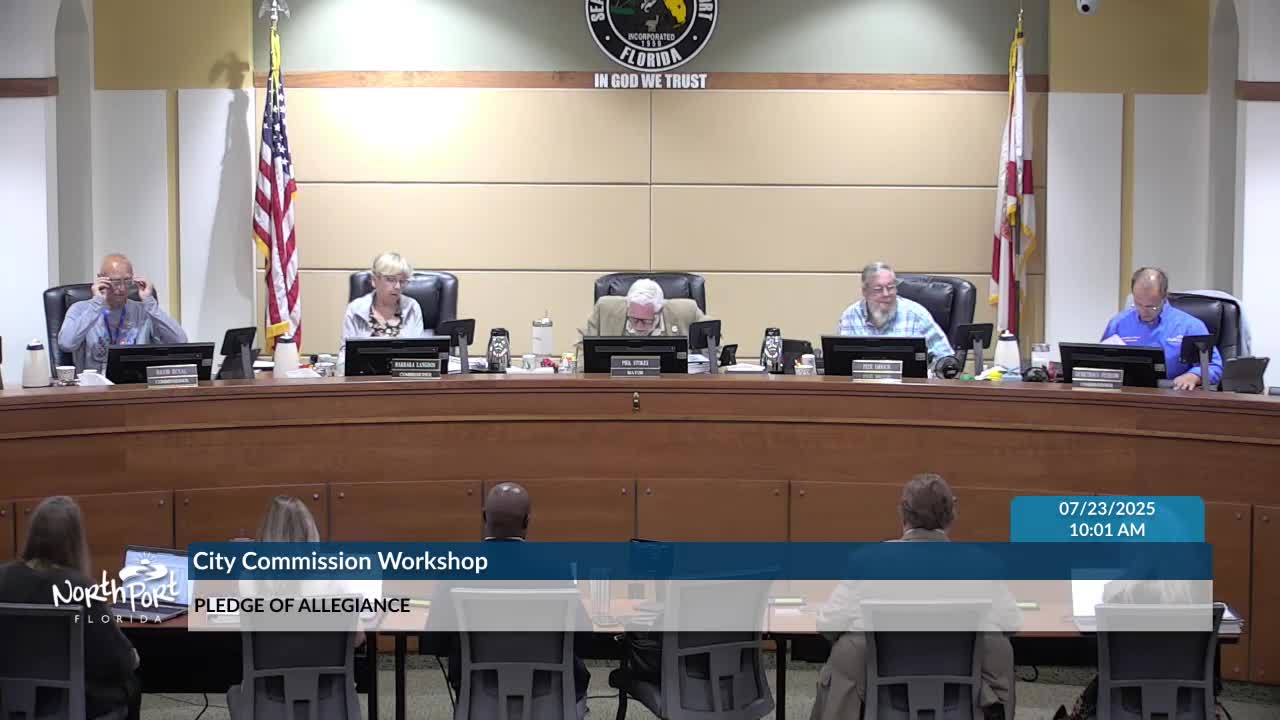
City officials reviewed the City Manager's proposed fiscal 2026 budget and a 10-year capital improvement plan during a July 23 workshop, approving guidance on several next steps while leaving major capital funding gaps unresolved.
The North Port City Commission on July 23 continued work on the City Manager's proposed fiscal 2026 budget and reviewed a 10-year capital improvement plan that shows roughly $581 million in five-year projects and nearly $1.5 billion across 10 years, with roughly half of the longer-term plan unfunded.
City Manager Fletcher told the commission the administration had presented "a balanced budget" and reviewed recent changes, including a $500,000 restoration to the police operating budget and $654,000 for a first phase of downtown linear parking. Fletcher said the city's general fund balance remains above the commission's 20% reserve policy and flagged an increased Florida Retirement System (FRS) employer contribution that required an additional $478,000 in FY2026 planning.
Why it matters: Commission members said the draft keeps the city operating while forcing difficult choices on how to pay for deferred maintenance, new facilities and growth-driven needs. Commissioners split over whether to add 26 new positions proposed for 2026 or pursue a hiring freeze pending greater revenue certainty. The commission directed staff to return in September with tighter options on capital priorities and other follow-up reports.
City Manager Fletcher opened the workshop with a line-by-line review and said the city's strategic pillars ' community, quality of life, economic development and growth management, environmental resiliency, infrastructure integrity and good governance ' drove the proposed allocations. He told the commission, "We have presented you a balanced budget," while noting several outside developments since the June workshop that forced adjustments.
Key budget items and context - Police: Fletcher said the commission's June direction restored $500,000 for police to cover prioritized operating or small capital needs; the department also plans to purchase two temporary trailers for personnel overflow at a project cost of about $900,000 funded from impact fees. Police Chief Garrison, who participated in the workshop, told commissioners the department will bring quarterly staffing updates. - Facilities maintenance: The manager said commissioners added $500,000 for a facilities maintenance fund to address an aging asset base and reduce reliance on deferring repairs. - FRS and compensation: The budget includes a mid-year swing to accommodate a higher FRS contribution, which city staff said was not finalized in June. Fletcher noted commission salary adjustments adopted since last year contributed modestly to the commission office increase. - Parks and recreation: The proposed FY2026 capital budget includes $4.1 million in parks capital with projects cited by Fletcher such as Boca Chica Park ($1,000,000), Dallas White Park ($1,100,000) and a dog park east of Toledo Blade ($400,000). Parks staff described an ongoing master-plan process and recent public open houses. - Warm Mineral Springs: Commissioners discussed a gap of about $5.5 million for mineral springs improvements. Fletcher and staff said the springs are tracked as an enterprise fund; some proposed rate and fee changes would reduce the city subsidy but the fund still faces a shortfall to finish previously approved improvements.
Hiring and the spending trade-offs A central thread of the workshop was whether to approve roughly 26 net new positions proposed in the FY2026 package. City Manager Fletcher said 12 of the 26 are not general-fund positions (they are funded by utilities, road/drainage or solid waste). He detailed the remaining general-fund requests: an assistant city attorney, a grants compliance specialist, a planning coordinator, two code inspectors, an accountant position and a mix of fire and emergency positions.
Commissioner Demetrius Petro pressed for a conservative approach, urging the commission to "go on a diet" for city spending and to consider a hiring freeze to avoid layoffs if revenues falter. Petro said he was "genuinely concerned" about the economy and the potential for state-level changes to property tax policy.
Vice Mayor Emmerich and Mayor Stokes opposed a broad hiring freeze. Emmerich said a targeted freeze would risk service degradation and hamper the city's ability to grow its commercial tax base; Stokes called the proposed budget "the most austere, the tightest, the most restrictive budget I've seen" but said he worried the wrong cuts would make North Port less attractive for private-sector investment.
Commissioner Langdon and others urged surgical review rather than an across-the-board pause. Langdon pressed staff for clarity on where the police's restored $500,000 would be spent; Fletcher said it was targeted to small CIP items and priority equipment identified by the department.
10-year CIP: a funding picture and options The manager and finance staff summarized a universe of capital projects identified in a consultant's 20-year vision and narrowed into a 10-year CIP. The shortfall is sizable: the five-year snapshot showed roughly $581 million in needs, and the broader 10-year tally approached $1.5 billion with hundreds of millions unfunded.
Fletcher and consultants grouped projects by priority (high, medium, low) and by funding bucket. Key buckets discussed were: - Dedicated enterprise and district funds (utilities, fire/rescue district, road and drainage) supported by rate and assessment studies; - Voter-approved surtax proceeds that have funded several projects but were described by Fletcher and commissioners as a limited, politically sensitive resource; - Impact fees, grants, developer contributions and potential financing such as certificates of participation (COPs) or other debt instruments; - New revenue options under study, including a vacant-lot registration program and an independent special district to finance infrastructure in growing eastern parts of the city.
Fletcher said many high-priority needs remain unfunded and recommended a targeted September follow-up to identify which funded or partially funded projects could be reprioritized. "When you look at this," he said, "the high category has $326 million unfunded. That's a red flag."
Solid-waste transfer station and other targeted proposals Commissioner Duvall proposed a three-year special residential charge of $100 per household to accelerate funding for a long-discussed solid-waste transfer station. Duvall outlined a conceptual cash-flow plan: charging $100 for three years to produce roughly $4 million per year and apply the receipts toward construction, then reduce the fee once the asset was repaid.
Several commissioners cautioned that delaying a capital project can raise total cost if construction pricing inflates. Vice Mayor Emmerich and others suggested financing options such as certificates of participation (COPs) or pursuing grants as alternatives that would spread cost and preserve timing.
Public safety training complex and facilities The commission discussed a proposed public-safety training complex as a high-priority, but unfunded, project. Fire Chief Titus said the department has a "very, very young workforce" and increasingly must send personnel to facilities outside the county for required training, adding overtime and travel cost and limiting course access.
Chief Titus and other staff noted that regional partnerships had been explored but that neighboring entities were pursuing their own training investments. Commissioners asked staff to continue outreach to potential partners and return with options; several commissioners said they favored exploring multiple funding paths, including developer contributions or phased builds, rather than waiting indefinitely.
Other directions and next steps - Communications and Mullins Center: The commission gave staff consensus direction to bring back a formal item to convert the communications division to a department and to study repurposing the George Mullins Activity Center or other city properties, including preliminary retrofit costs and potential alternative locations for existing programs. Commissioners stressed that any repurposing must avoid displacing existing youth and childcare services without suitable relocation plans. - Special district exploration: Commissioners asked staff to return before year-end with a path forward and milestones to evaluate formation of an independent special district for eastern North Port to fund infrastructure supporting commercial and industrial development.
What the commission did not do: The workshop produced no final budget vote. The commission asked staff for more detail and clear trade-off options and directed multiple follow-ups for the September budget workshop and for a longer CIP conversation.
Ending: The commission scheduled follow-up work during its August recess and a deeper CIP conversation in September. In closing remarks Mayor Stokes praised staff for the budget work, calling it one of the best he had seen, while commissioners acknowledged the difficult trade-offs ahead and the need to balance fiscal restraint with preserving the city's growth and service levels.