Get AI Briefings, Transcripts & Alerts on Local & National Government Meetings — Forever.
Milwaukee police seek facial‑recognition licenses; community groups and oversight bodies raise privacy and bias concerns
Loading...
Summary
The Milwaukee Police Department on Wednesday asked the City of Milwaukee Equal Rights Commission to consider acquiring two facial‑recognition licenses to help generate investigative leads in violent‑crime cases, and public testimony sharply contested that request, focusing on bias, privacy and vendor data access.
The Milwaukee Police Department on Wednesday asked the City of Milwaukee Equal Rights Commission to consider allowing the department to obtain two facial‑recognition software licenses, saying the tool would be limited to generating investigative leads in serious violent crimes.
The request drew more than two hours of public comment and pushback from civil‑rights groups, neighborhood advocates and members of the Fire and Police Commission, who warned that the technology is biased, invasive and likely to be misused. Speakers also criticized a vendor proposal discussed by MPD that would give the company access to the department’s historical booking photographs.
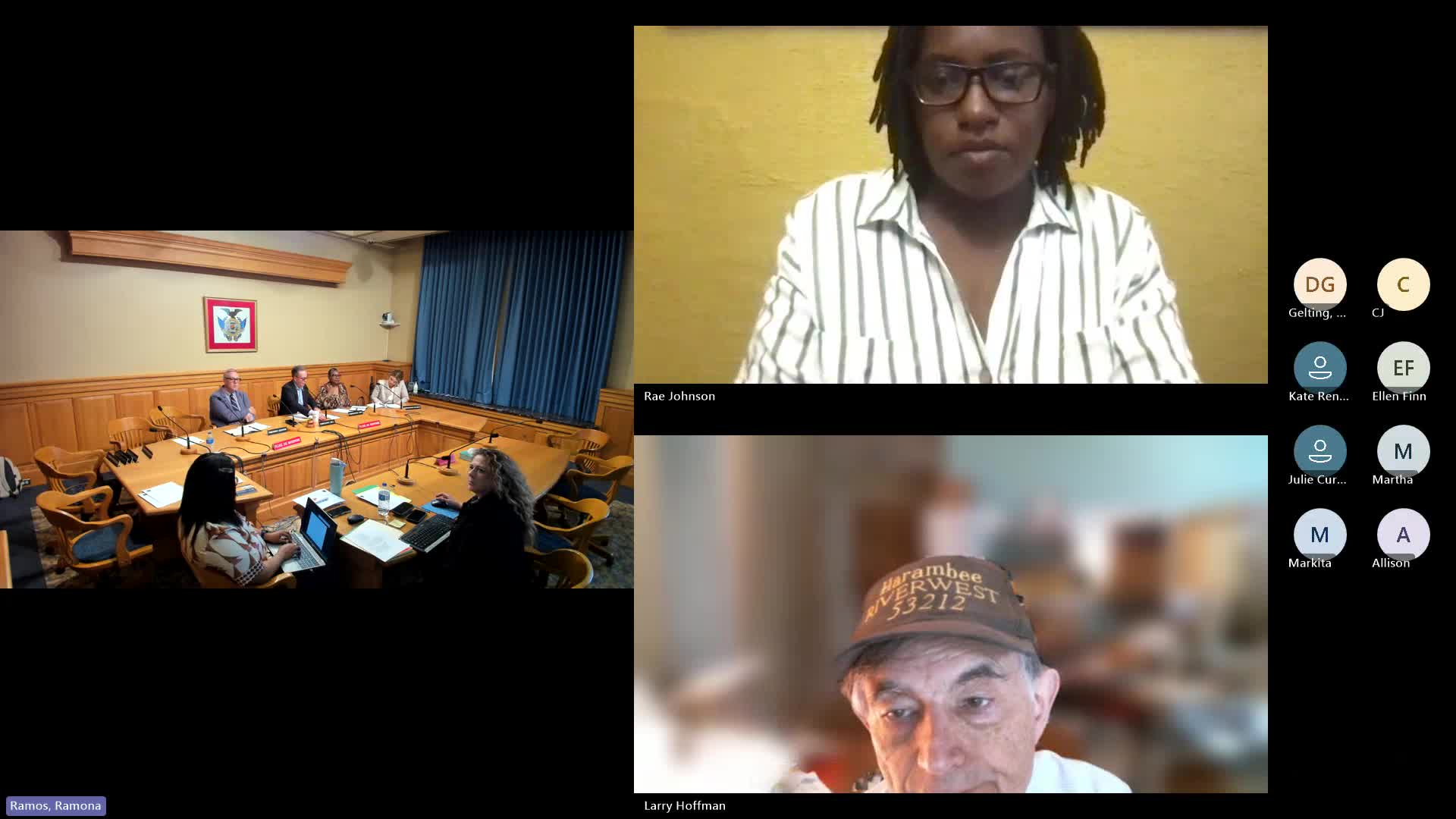
Tony Snell Rodriguez, chair of the City of Milwaukee Equal Rights Commission, opened the meeting by framing the discussion as a community listening process into the “potential use of facial recognition technology by the Milwaukee Police Department.” He said the commission had requested research from the city’s Legislative Reference Bureau to compare peer cities and identify guardrails and oversight practices.
Heather Huff, chief of staff for the Milwaukee Police Department, told commissioners MPD seeks two user licenses to run searches against lawfully possessed arrest photos when detectives need a lead on a violent crime. "It is a lead generator," Huff said, adding that, in MPD’s practice, matches would prompt traditional investigation, not arrests. Huff said MPD had previously relied on neighboring jurisdictions’ systems, but those arrangements had become limited and the department is seeking its own contract. She also said MPD intends to craft a policy with community input and supervisors in the chain of command to restrict access and punish misuse.
MPD detectives described cases they say were solved with help from facial‑recognition‑generated leads, including a March 2024 homicide and a March 2024 sexual assault. Capt. James Hutchinson, commander of the homicide division, described how a partner jurisdiction’s search produced a potential identity that led detectives to corroborating evidence and arrests. David Anderson, of MPD’s major crimes division, described a string of taco‑truck robberies on the South Side in which a brief surveillance image returned multiple leads that detectives pursued.
MPD said the vendor it is discussing, Biometrica, offered two free licenses in exchange for access to Milwaukee booking photographs. Phil Simmerton, commander of the fusion division, described the vendor as a "data company" that, he said, would run submitted surveillance images through a private matching process the company calls a "black box." Simmerton said Biometrica claims NIST approval for parts of its process and that the vendor told MPD it would not retain or publicly republish the images it receives for a search. MPD said the vendor would compare submitted surveillance stills to the department’s jail booking photos.
Those vendor details became a central focus of criticism from speakers and commissioners. Bree Spencer, a Fire and Police Commission member, called the technology unacceptable for police use: "FRT has too high a misidentification rate for it to be used by law enforcement, period." Spencer and other FPC commissioners noted that Wisconsin Act 12 transferred policy‑making authority for department standard operating procedures from the Fire and Police Commission to chiefs, but also requires the department to provide notice of new or changed SOPs and allows the Common Council to suspend or amend policies by two‑thirds vote.
Civil‑rights and privacy speakers stressed racial bias, privacy risks and potential federal or commercial reuse of biometric data. Amanda Merkway, advocacy director for the ACLU of Wisconsin, said MPD’s vendor proposal would amount to "exchanging 2,500,000 jail records for 2 free Biometrica licenses, 1 for MPD and 1 for the fusion center," and warned those booking photos include many people who were never convicted. Multiple speakers said Biometrica’s product umbrella (described in public testimony as "Umbra" on the vendor website) appeared designed to aggregate multi‑jurisdictional booking records and could feed other commercial products.
Residents, community groups and civic organizations were nearly unanimous in public testimony against MPD acquiring the technology. Speakers who testified in opposition included representatives of the ACLU of Wisconsin, League of Women Voters of Milwaukee County, the Asian American and Pacific Islander Coalition of Wisconsin, Milwaukee for Palestine and the Milwaukee Turners; several individual residents recounted distrust of MPD based on past practices. Heba Mohammed of Milwaukee for Palestine presented a petition with more than 600 signatures opposing facial recognition.
Commissioners described next steps rather than taking a formal vote. The Equal Rights Commission requested the Legislative Reference Bureau research and intends to continue public meetings and coordinate with the Fire and Police Commission before making a formal recommendation to the mayor and Common Council. Commissioners said they will compile written testimony, available public records and the LRB report before determining the commission’s formal position.
No new policy or licensing agreement was adopted at the meeting. The Equal Rights Commission approved routine minutes at the start of the meeting, and adjourned after public testimony and commissioner comments. The record contains numerous public submissions and MPD agreed to provide the presentation to the public file.
The exchange at Wednesday’s meeting makes clear the core points at issue: MPD says the tool would be limited, used only as an investigative lead and overseen internally; community groups and many commissioners say the risk of bias, data misuse and lack of third‑party oversight outweighs the benefits and that handing a private vendor an archive of booking photographs is unacceptable without stronger legal and policy protections.
The Equal Rights Commission said it will continue outreach, gather the legislative research and forward its findings to the Common Council and the mayor’s office. Commissioners also discussed coordinating community hearings in neighborhoods where residents are less likely to attend City Hall meetings so the process is not limited to downtown testimony.
Proponents and opponents both asked the public to submit written testimony to ercmilwaukee@milwaukee.gov for the public record; MPD said it will also answer chat questions and provide its presentation for the record.