Clark County outlines 2026–2031 Transportation Improvement Program, seeks planning commission endorsement
Summary
Clark County Planning Commission Chairman Carl Johnson opened the Aug. 7 work session as county transportation staff presented the draft 2026–2031 Transportation Improvement Program, a six‑year construction schedule derived from the county’s 20‑year Capital Facilities Plan and subject to later council adoption.
Clark County Planning Commission Chairman Carl Johnson called the Aug. 7 work session to order and county transportation staff presented the draft 2026–2031 Transportation Improvement Program (TIP), the six‑year construction schedule and how it ties to the county’s 20‑year Capital Facilities Plan (CFP).
The presentation, led by transportation staff referred to in the meeting as Chris and John, described the TIP as the six‑year implementation of projects scored and prioritized from the CFP and noted that the first year of the TIP becomes the county’s annual construction program. “This is the 2026–2031 transportation improvement program,” Chris said while opening the presentation.
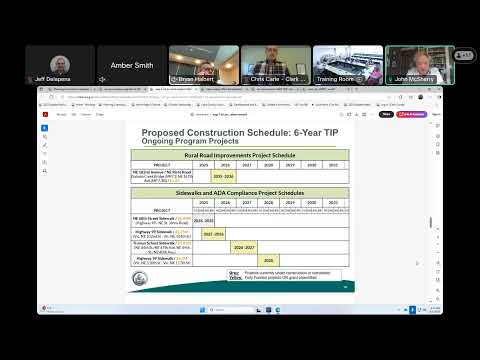
The TIP maps large capital projects carried from the CFP (shown as red lettered and blue numbered items) and overlays ongoing program projects (green). Staff explained red lettered projects are “obligated” (defined in the presentation as projects that either have realized roughly 30% of their project budgets or have been deemed important by county council), while blue items are earlier‑stage CFP projects. John reviewed a multi‑year schedule of large projects (including the 170th Street corridor series) and ongoing programs: bridge/culvert replacement, road preservation, rural road improvements, sidewalk ADA upgrades and safety improvements such as roundabouts. He said one 170th Street project is under construction and scheduled through 2027, other segments push into the late 2020s and early 2030s, and certain projects (for example a segment on 70 Second Avenue) were recently delayed to 2030.
Why it matters: The TIP allocates capital road budgets, sequences construction and identifies where the county will seek grant funding, so the program affects which corridors are built or improved in coming years, how county staff will prioritize design and right‑of‑way work, and which projects the council will be asked to adopt before the county’s budget is finalized.
Key details and funding: Staff noted that projects listed on the CFP include design, right‑of‑way and construction budgets and sometimes include partnership dollars from cities or state agencies. Transportation staff said the county received about $10.3 million in additional federal funds this year across three projects, and that federal and state grants often have per‑project caps (for some programs roughly $4–5 million per eligible phase, with variation by program). Staff said larger corridor projects therefore require multiple funding sources and that costs frequently rise as design uncovers additional needs (for example adding bridge work or expensive utility relocations).
Commissioner questions and staff answers: Commissioners asked about material‑price impacts, contingency and escalation, and coordination with cities on annexation and standards. Transportation staff said material prices have relaxed since COVID spikes but that utility coordination and federal procurement rules add schedule and cost risk. Staff said many farther‑out projects include a typical contingency (staff noted a commonly applied contingency of roughly 30% on early estimates) and cautioned that incomplete designs make long‑range estimates uncertain. On interjurisdictional coordination, staff said there was not yet direct coordination on specific annexation conversion standards but that city standards (for example for lighting) could affect future upgrades when properties are annexed.
Next steps: Staff said the presentation is a prequel to a formal request for planning commission support at a public hearing scheduled to return before the commission on Aug. 21; staff also described upcoming advisory and council steps (Development Engineering Advisory Board, a council work session in October and a council hearing in November, with adoption needed before the county budget in December).
Ending note: Staff asked the commission for comments to refine the TIP before the Aug. 21 hearing and said they will supply a CFP list and updated materials in the coming two weeks.
AI generated
The text on this page is AI generated. Summaries, highlights, analysis, and video transcripts are all produced from the original source material.
AI can make mistakes, so if you spot one, and we will fix it for everyone.
Note: the source content is unaltered by us. Any content source we link to, be it a video, an audio recording, or a document, is presented exactly as its publisher released it. That publisher is usually a government body, sometimes an individual official or another organisation.