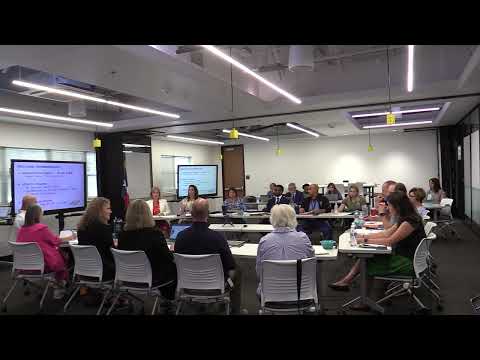
Georgetown ISD trustees approve 2025–26 compensation plan, authorize retroactive pay
Summary
The Georgetown Independent School District Board of Trustees voted to approve the 2025–26 compensation plan and a resolution to pay eligible employees retroactively, funded in part by new state allotments from House Bill 2 and lower recapture projections.
The Georgetown Independent School District Board of Trustees on Aug. 4 approved the district's 2025'26 compensation plan and a companion resolution authorizing retroactive pay for employees whose contracts already began this fiscal year.
The plan directs $3.9 million in teacher retention allotment funds from the Texas Education Agency to qualifying teachers, raises starting pay for early-career teachers, and recommends market-based increases and targeted minimum-pay bumps for other staff categories. Trustees voted by voice vote; the record shows the motion carried.
Why it matters: Trustees and district leaders said the plan was possible because of new state funding changes from House Bill 2 (HB2) and a substantial drop in the district's projected recapture payment to the state. District staff said those shifts, combined with enrollment and attendance projections, create a modest surplus that allows pay increases while keeping the budget balanced.
Key elements of the compensation package presented by district staff Jennifer Hanna and Amanda Johnson include: teacher retention allotment pass-through of about $3,900,000 designated by TEA for qualifying teachers; a support-staff retention allotment estimated at roughly $45 per ADA (about $500,000); and a basic allotment increase to $62.15 per ADA. The staff recommended a $1,000 additional increase for teachers in years one and two of service, step increases for all teachers, and an updated teacher pay scale to reflect HB2 eligibility rules.
Several non-teacher items were detailed: a 2% increase at midpoint for administrative, professional/technical, instructional aide, office/technical and auxiliary pay grades (100'500); a $1 minimum hourly increase for instructional aides in high-need assignments (pay grades 302'303) and bus drivers; a $0.50 minimum increase for office/technical and auxiliary minimums (with some auxiliary exceptions); and a proposal to move most campus administrative support positions from a 7.5-hour day to 8 hours to eliminate comp-time accrual.
District leaders said instructional coaches and librarians will be moved off the teacher pay scale because HB2'eligibility depends on PEIMS coding and time-in-classroom rules; instructional coaches were shown receiving $1,200'$1,400 increases (about 2%), and librarians average about a 3.4% increase depending on years of experience. The district will also equalize stipends for some special education and dyslexia assignments (bringing dyslexia teachers'previously paid $1,000 for certification up toward parity with inclusion teachers'$2,000), and adjust selected athletic stipends to align with surrounding districts.
Leaders reviewed staffing restorations funded within the current-year budget: an interventionist at Williams, two special-education paraprofessionals, an instructional coach at Forbes (in addition to an existing coach), a receptionist reinstated at McCoy, and retention of a second assistant principal at Mitchell. Staff said funds for those positions are in the current budget and benefits costs were included in the plan estimate.
On insurance, the district proposed moving to Blue Cross Blue Shield with Higginbotham as third-party administrator for 2025'26 and increasing the district contribution to $450 per month; staff estimated the additional employer cost at $512,400 and said the increase would not fully cover 100% of any benefit tier.
Budget and state law impacts: presenters said GISD is using a demographer's projection of 14,131 students (a 1.2% increase), an ADA projection of 13,011 (93% of enrollment, adjusted for pre-K), and revised property-value projections after HB2. District staff reported a projected recapture payment drop from $18.6 million (old projection) to $8.6 million under the new law, and a net forecasted surplus of roughly $176,008 after the recommended compensation and related costs are applied. Staff emphasized that some HB2 details (TEA coding/classification clarifications) were still pending and could require future amendments to the compensation plan.
Retroactive pay and timing: trustees also approved a resolution authorizing retroactive pay for employees whose pay period began before the amended plan takes effect; district staff said retroactive payments would be made no later than September and that teachers on the September'August calendar will see increases starting in September per standard teacher-pay timing.
Board action and next steps: Superintendent-level staff moved the plan forward and a trustee motion to approve the 2025'26 compensation plan passed by voice vote. Trustees later approved the retroactive-pay resolution by voice vote as well. Presenters said any HB2-driven classification changes that affect eligibility would prompt a return to the board for an amended compensation plan. The board indicated it will discuss tax-rate particulars at its August regular meeting.
Ending: District leaders said they will provide detailed implementation timelines and payroll schedules to employees and will return to the board as needed if HB2 technical clarifications change eligibility or funding flows.
AI generated
The text on this page is AI generated. Summaries, highlights, analysis, and video transcripts are all produced from the original source material.
AI can make mistakes, so if you spot one, and we will fix it for everyone.
Note: the source content is unaltered by us. Any content source we link to, be it a video, an audio recording, or a document, is presented exactly as its publisher released it. That publisher is usually a government body, sometimes an individual official or another organisation.