Get Full Government Meeting Transcripts, Videos, & Alerts Forever!
Get email alerts on the Environmental Enforcement topic
No spam. Unsubscribe anytime.
House subcommittee examines EPA, DOJ enforcement of vehicle emissions cases involving small businesses
Summary
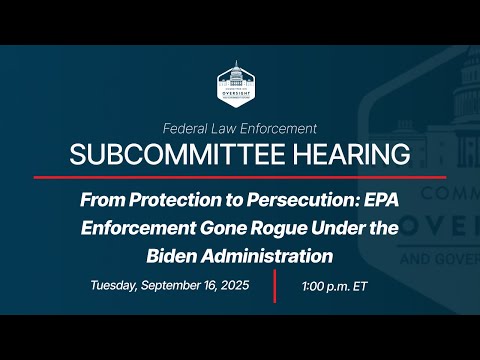
The House Oversight and Reform Subcommittee on Federal Law Enforcement held a hearing examining enforcement actions by the Environmental Protection Agency and the Department of Justice against businesses that sell or install aftermarket diesel emission devices, members and witnesses said.
The House Oversight and Reform Subcommittee on Federal Law Enforcement held a hearing examining enforcement actions by the Environmental Protection Agency and the Department of Justice against businesses that sell or install aftermarket diesel emission devices, members and witnesses said.
The hearing focused on whether EPA and DOJ have relied on criminal prosecutions and armed enforcement tactics against small shops and aftermarket suppliers rather than using civil enforcement or state and local resources, and on the public-health rationale for aggressive action against devices that disable emission controls.
Chairman Higgins opened the hearing by saying the subcommittee was "going to hear about the aggressive enforcement tactics employed by the Environmental Protection Agency and the Department of Justice to intimidate small businesses into consent agreements and other enforcement actions," and later described some tactics as "regulatory terror against everyday American entrepreneurs." Ranking Member Miss Lee said enforcing environmental laws "is critical to protecting public health and ensuring that every person in this country has access to clean air, safe water, and healthy land," and warned that weakening protections would harm communities that already suffer higher rates of asthma and other illnesses.
Corey Willis, owner of Power Performance Enterprises Inc. (PPEI) of Lake Charles, Louisiana, told the subcommittee that his company spent years and millions of dollars responding to EPA investigations and negotiating a consent decree finalized May 26, 2022. Willis said he received his first EPA request for information on Nov. 3, 2015. He told members he paid "in excess of $3,100,000" and estimated lost sales of about $12,000,000 for emissions‑compliant products over the past five years and more than $100,000,000 for racing products; he also said legal fees exceeded $7,000,000. Willis said the consent decree required PPEI to obtain California Air Resources Board (CARB) approvals and a CARB certificate within two years or stop selling certain products, and he told the subcommittee that CARB had not approved any applications his company submitted in more than two years despite independent testing he described as successful.
Justin Savage, a partner at Sidley Austin who said he spent nearly a decade at the Justice Department representing EPA enforcement, framed the issue as a change in enforcement practice. Savage described "the surge of criminal environmental enforcement against small automotive industry players for check engine light violations" and argued that many prosecutions charge conduct that historically was treated as civil. He said that facing federal criminal charges "many have no choice but to take a plea rather than risk their freedom." Savage also said some defendants were subjected to armed searches, and he cited several individuals who, he said, were prosecuted after dawn raids.
Eric Schaeffer, former director of the Office of Civil Enforcement at EPA and former executive director of the Environmental Integrity Project, said products sold to delete or disable diesel emission controls produce large increases in nitrogen oxides and particulate matter and presented public‑health risks. "It is a federal crime to tamper with monitoring devices," Schaeffer said, and he cited court decisions and EPA guidance sustaining criminal liability for some tampering. He told members the pollution from deleted emission controls disproportionately harms people living near highways, ports and industrial sites.
Members of Congress pressed witnesses on several topics. Republicans emphasized the economic consequences for small businesses and whether criminal enforcement and tactical dawn raids were appropriate for regulatory violations; Chairman Higgins said the subcommittee is reviewing agency "badge and gun authority" and called the use of armed agents in regulatory cases "a bridge too far." Democrats, including Ranking Member Miss Lee and Representative Ayanna Pressley, stressed the public‑health harms tied to elevated nitrogen oxides and diesel particulate emissions and highlighted the role of environmental justice, saying cuts to EPA environmental‑justice staffing and canceled grants put frontline communities at risk.
Witnesses and members cited several authorities and documents discussed at the hearing: the Clean Air Act; a 1993 EPA internal memo on criminal enforcement scope; EPA guidance and the national enforcement initiative targeting aftermarket defeat devices; CARB certification requirements; Title VI of the Civil Rights Act regarding civil rights complaints at EPA; and references to the Good Neighbor Rule and court actions challenging EPA implementation. Witnesses differed on whether prosecutions reflect established law or represent novel criminal theories.
The subcommittee accepted several documents into the hearing record by unanimous consent, including a letter and news reports mentioned by members, and Chairman Higgins reminded members they have five legislative days to submit additional materials and questions for the witnesses. The hearing concluded with members agreeing to continue oversight; no committee votes or formal policy actions were taken at the hearing.
The hearing brought into relief two competing priorities: members and witnesses who warned that aggressive criminal enforcement and armed tactics can devastate small businesses and may exceed statutory authority, and witnesses and members who argued aggressive enforcement is justified by public‑health harms from disabled emission controls and by legal authorities under the Clean Air Act. The subcommittee did not issue findings at the hearing and said it would pursue further document production and follow‑up questions.