Get Full Government Meeting Transcripts, Videos, & Alerts Forever!
Get email alerts on the Downtown Campus topic
No spam. Unsubscribe anytime.
Developer revises downtown campus plan after public pushback; residents press to retain Memorial Park
Summary
Developer Tara Frisbie presented a reduced-density revision of the proposed downtown campus, promising more green space, preserved banyan trees, and additional public outreach including a referendum; dozens of residents urged the council to keep Memorial Park public and pressed the city to certify an ordinance petition submitted Aug. 26.
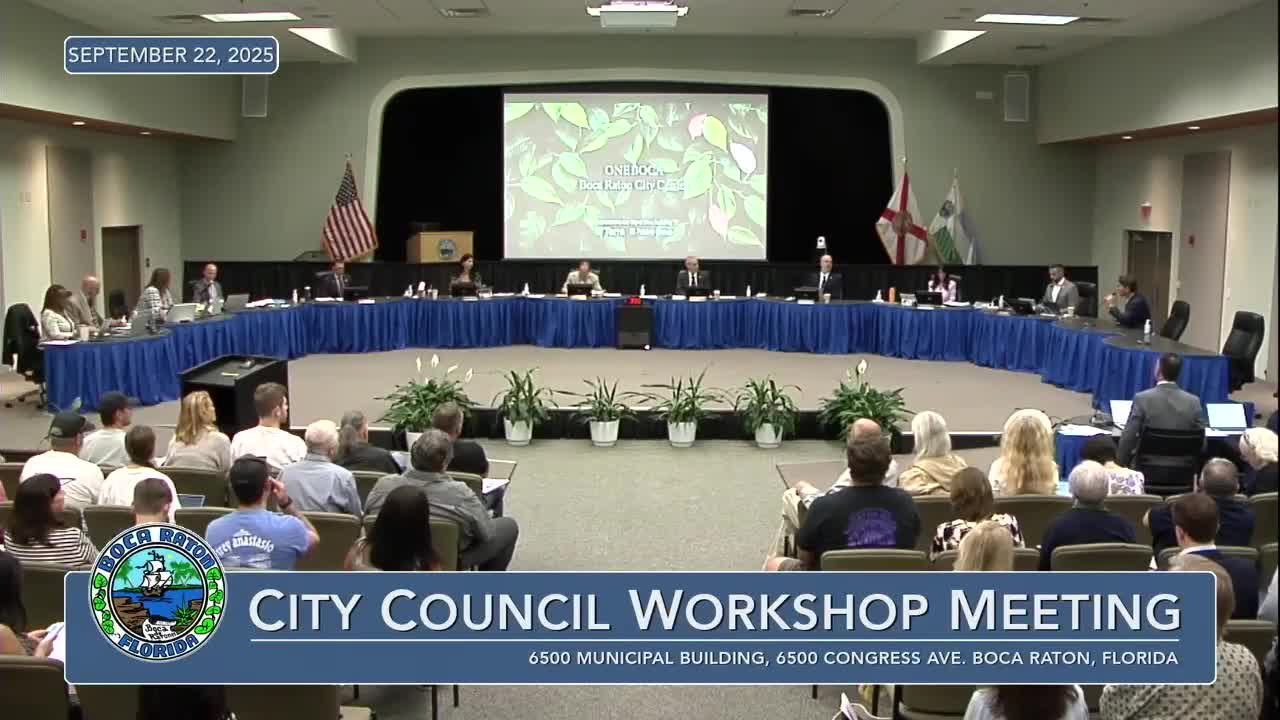
Developer Tara Frisbie used a City Council workshop on Sept. 22 to present a redesigned version of the proposed downtown campus that reduces residential density, removes a planned hotel and some office space, and adds or enlarges civic and recreation elements on the city-owned Memorial Park site.
The developer’s representative, Mr. Frisbie, told the council that the project team is “listening and slowing down this process” and said the team “are fully endorsing the request to send this to a referendum so that at the end of the day, the public has the final say on this project.” He described changes that cut the previous residential count from about 1,100 in an earlier iteration to roughly 740 units in the latest plan and reduced retail and office square footage, saying the revisions increase on-site, usable green and recreation space.
Why it matters: The plan would reshape about the downtown campus area that includes Memorial Park and existing civic facilities. Residents and civic groups told the city the park is a wartime memorial and core public amenity; dozens of speakers at the workshop asked the council to keep public land in public hands and to preserve ball fields, tennis courts and the banyan-tree canopy.
What the revised plan would change: Frisbie said the new design eliminates a hotel, removes at least one office building previously shown on the west side of Second Avenue, preserves five existing banyan trees and expands contiguous recreation areas. He said residential units were cut from earlier figures of roughly 1,100 to just over 900 in a prior update and now down to about 740; office was described as reduced to about 250,000 square feet and retail from roughly 140,000 to under 100,000 square feet. Frisbie described the financial projections he has presented previously: a prior $3 billion long-term total revenue estimate reduced to about $2 billion under the latest density, with a net present value staff discussed in the presentation (Frisbie cited a $344 million and a $228 million net-present-value comparison for earlier and current scenarios).
Resident reaction and petition: Speakers representing Save Boca and other grassroots groups said they oppose leasing or otherwise turning public parkland to a private development partner. John Perlman told the council Save Boca submitted "over 5,000 signatures" on Aug. 26 asking that disposition of city-owned parkland be put to a public vote, and he said the city “still has not certified the ordinance and is in violation of the city charter.” City staff and the city clerk explained the clerk transmitted the petition to the Palm Beach County Supervisor of Elections on Aug. 28 and that the supervisor verifies signatures against the voter rolls; staff said the charter requires that verification and that the city has followed that procedure.
Public concerns: Speakers repeatedly asked that the existing ball fields, skate facilities, tennis courts and children’s programming remain downtown. Students and youth advocates said moving softball fields to Sugar Sand Park would disrupt habitats and existing youth access; environmental speakers said Sugar Sand’s scrub habitat contains protected species such as gopher tortoises and burrowing owl burrows. Some residents who support improvements said they would favor new civic buildings if green space and historic character are protected.
Council and staff response: Council members emphasized the need for more public outreach and said they expect additional charrettes and open houses announced by the developer; Frisbie confirmed open houses for Sept. 29 and Oct. 6 and said the project team will collect feedback and update its designs. Mayor Scott Singer repeated that, whatever the council does, there will be a public vote: “We will have a vote,” he said during the meeting.
Historic structures and programming: Several council members and staff discussed the Singing Pines historic building and the Rickards House on the downtown campus. Staff told council that the small reproduction house (Rickards House) had been built with nonprofit and county funds and that, if removed, county grant terms could require returning some funds. Staff and council members agreed the Singing Pines historic structure should be preserved and considered for relocation within the campus near the banyan trees, but they also said a sustainable plan for programming and operating the building must be developed before reopening it.
Recreation programming and tennis courts: Staff explained the city’s recreation needs analysis and said the downtown tennis center currently has 10 clay courts but overall city demand does not require additional tennis courts citywide. Recreation staff recommended keeping a single cluster of 10 courts in one location; council members and staff discussed two options—leave courts downtown or move them to Meadows Park—and asked the developer to prepare plan variants for public review. City staff said a broader parks-and-recreation master plan will be updated in parallel with the campus planning.
Next steps: The developer promised additional charrettes and modifications and a dedicated website (1boca.com). City staff and counsel stressed that no legally binding transfer of parkland has occurred and any lease or ground-lease terms would require council approval and a public process. The city clerk and city attorney reiterated that signature verification for the petition is the supervisor of elections’ responsibility and that the city has followed the charter procedure for transmitting the petition for verification.