Lifetime Citizen Portal Access — AI Briefings, Alerts & Unlimited Follows
Boca Raton staff, developer and appraiser lay out steps for downtown government campus
Loading...
Summary
City staff outlined regulatory steps and a hybrid form-based code for a proposed downtown government campus; the developer presented a seven-building conceptual master plan and the city's appraiser reported preliminary valuations and options for additional appraisal scenarios.
Boca Raton officials on Monday described the regulatory roadmap, design concepts and valuation work for a proposed government campus on the east side of Northwest 2nd Avenue, a project team said will be considered by the city early next year.
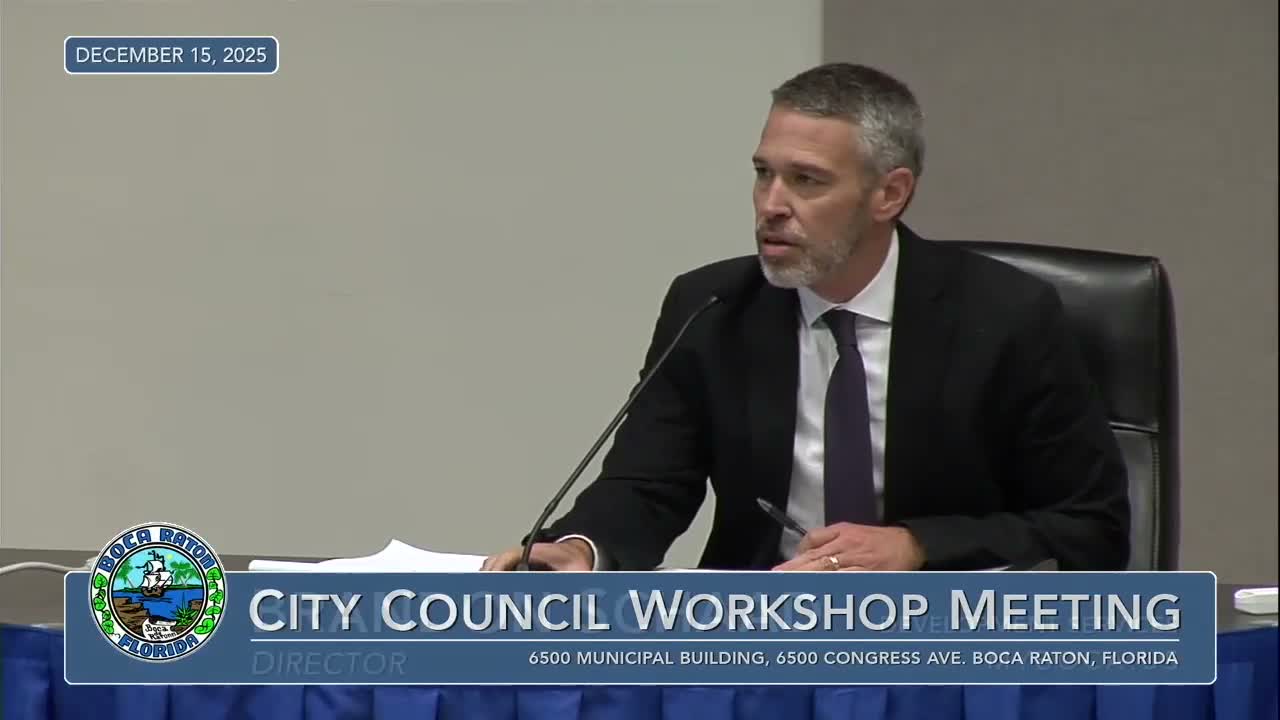
Brandon Shadd, the city's development services director, told the council the process includes comprehensive-plan amendments and a downtown development-of-regional-impact (DDRI) development-order amendment scheduled for council consideration in February 2026, rezoning that could follow a March 10, 2026 ballot question (if voters approve), and site-plan and final development approvals afterward.
The city is drafting a hybrid traditional/form-based code to emphasize building form, massing and street-level activation while requiring standard analyses for traffic, utilities and public works. Shadd said the plan would use the city's alternative traffic concurrency standard (ATCS) for constrained streets such as Palmetto Park Road, favoring multimodal mitigation measures over roadway widening.
Bonnie Miskill, attorney for the Tara Frisbie Group, presented conceptual renderings and a program for the 7.7-acre development parcel east of NW 2nd Avenue. The presentation listed "120,000 square feet of office, a 30,000-square-foot grocer, 79,100 square feet of commercial, a 180-room hotel and 947 dwelling units" across seven buildings, with maximum heights shown at 100 feet (Building 1) and up to 130 feet for other towers.
Miskill said planned street sections prioritize pedestrians and bikes, including a 16-foot median and protected bike path on NW 2nd Avenue, 10-foot pedestrian walkways, and a new pedestrian-only corridor called "Via 1.5." She described a ground-floor retail focus to activate the promenade and a mobility hub and sustainability measures to be required at site-plan review.
The council asked for more detail on traffic-demand-management timing, how phase 2 mitigation could be adjusted after phase 1, and the tradeoffs between angled and parallel parking. Shadd recommended that the council explicitly authorize reevaluation in initial approvals so mitigation can be modified after phase 1 construction if needed.
The city's retained appraiser, Walter Duke of Walter Duke & Partners, and project lead Andrew Rolfe presented the appraisal summary. Rolfe reported three components to the assignment: a component valuation of the proposed 7.7-acre project at roughly $113.9 million; a ground-rent estimate for a 99-year lease (based on a 5% multiplier) of about $5.7 million; and a market "as-is" appraisal for the city's 31-acre holdings at approximately $136.5 million.
Duke emphasized the firm was retained by the city alone and said any additional analyses requested by the council could be provided. Councilmembers asked whether the appraisal should include alternate scenarios such as percentage rent, discounted cash-flow valuation, and explicit treatment of workforce or Live Local units; the appraisers said those options could be added if directed.
The workshop provided no formal votes. Staff said they will continue drafting the LDRs, complete traffic and sustainability studies required for site-plan application, and return to the council with regulatory text and the appraisal revisions the council requests.