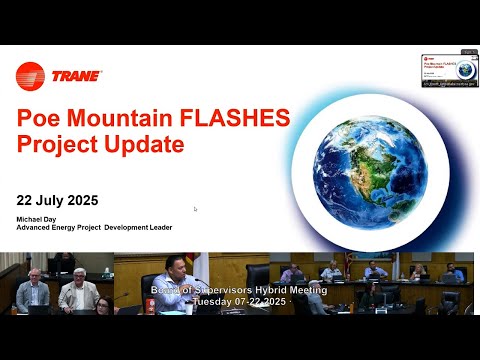
Lake County hears update on Poe Mountain “FLASHES” pumped-hydro microgrid project
Summary
County staff and Trane presented technical and funding progress on the Poe Mountain FLASHES pumped-storage hydro and solar project, which won early placement in PG&E’s Microgrid Incentive Program and aims to provide wildfire-fighting water, multi-day backup power for North Lakeport circuits and revenue to fund feasibility studies.
Ben Rickleman, deputy county administrative officer, told the Lake County Board of Supervisors on an informational item that county staff and Trane are advancing a project known as FLASHES — “fire main linked auxiliary supply hydraulic energy storage” — centered on Poe Mountain.
Michael Day, Advanced Energy Project Development Leader at Trane, described FLASHES as a “super closed loop pump storage hydro” system paired with solar that would generate, store and release electricity and also serve as a firefighting water resource. “FLASHES is fire main linked auxiliary supply hydraulic energy storage,” Day said.
The project design presented to the board includes 30 megawatts of solar photovoltaic sited on county land at the Northwest Wastewater Treatment Plant, three 10-megawatt Pelton-wheel hydro turbines (30 MW total) and roofed upper and lower storage tanks to minimize evaporation and speed federal permitting. Day said the system would be configured to provide roughly 20 megawatts to the Lucerne substation and 10 megawatts to the Hartley substation, enabling microgrid coverage for substantial portions of North Lake County, including Lucerne and parts of North Lakeport.
Day said the FLASHES site could supply about 90,000,000 gallons of water stored roughly 800 feet above Highway 29 for firefighting uses, including sprinkler systems over about one square mile near the wastewater plant, a helicopter dip tank near Poe Mountain and rapid-refill stations for CAL FIRE tanker trucks on a nearby off-ramp.
Why it matters: County officials said the system is intended to reduce risks from wildfire and from public-safety power shutoff events while creating a revenue stream that could fund project costs. Day said the project could be “pretty cash flow positive” because daily generation, storage and dispatch would generate revenue when energy prices are high.
Funding and schedule: Trane said the county applied to Pacific Gas & Electric’s Microgrid Incentive Program (MIP) for tranche 1 funding to cover feasibility work rather than construction. Of about 52 MIP applications, the two Poe Mountain applications (the project routes power to two substations and therefore counted as two applications) scored first and second, the presentation said. Legal issues in grant language prompted follow-up with the California Public Utilities Commission; after county and staff advocacy, the CPUC issued direction to PG&E on June 26 to modify problematic language, enabling the county to proceed toward a grant‑award agreement.
Trane outlined a tranche-by-tranche schedule: a forthcoming amended grant award agreement with PG&E this summer, issuing a county contract to Trane to manage consultants, a tranche 2 application in December with tentative awards in March, interconnection engineering starting in May/June and a projected completion of tranche 1 feasibility work in late 2026. Construction, if the project moves forward, could begin in the fourth quarter of 2026, Trane said.
Outstanding work and investor interest: Day listed major feasibility tasks that remain: formal site control (easement option negotiated but not executed), surveying, civil and mechanical engineering, soils and geotechnical testing, a hydrologic study and CEQA review. He said several large investors, including Brookfield Renewables, reviewed the project but would not advance to construction without completion of the multi‑million‑dollar feasibility study. The MIP tranche 1 award is intended to fund that study.
Ownership options and local benefits: County staff and Trane described two broad paths once feasibility is complete: (1) a third‑party investor (for example, a renewable developer) funds and owns the project, taking tax-equity and other financial benefits while the county receives land-use fees and operational community benefits; or (2) the county pursues public ownership, financed through options such as revenue bonds issued with assistance from the Golden State Finance Authority. Day said either approach would be options for the board when the feasibility work is finished.
Day also emphasized workforce opportunities tied to construction, saying the size of the work would create thousands of skilled-hours and provide a chance to stand up pre-apprenticeship and apprenticeship slots local workers could fill.
In questions, supervisors and staff asked about Inflation Reduction Act timing for tax incentives and whether joining or aligning with a community choice aggregator (CCA) such as Sonoma Clean Power would affect eligibility or long-term procurement. Day said some IRA clean-energy incentives for solar and wind have narrowed by deadline, but pumped-hydro incentives extend through 2033; he also said MIP tranche 1 funding is administered by PG&E under PUC direction and that eligibility for tranche 1 is not affected by CCA decisions. He added that being inside a CCA service area can make it easier for a CCA to procure long-term capacity from the project.
No action requested: The board received the briefing and made no formal decision at the meeting. Staff said they expect to return within weeks after PG&E issues amended grant language and the county advances contracting steps with Trane and PG&E.
Provenance: This article is based on the project presentation and question-and-answer period appearing throughout the meeting’s Poe Mountain FLASHES update, beginning with the agenda item introduction and continuing through the final staff closing remarks.
AI generated
The text on this page is AI generated. Summaries, highlights, analysis, and video transcripts are all produced from the original source material.
AI can make mistakes, so if you spot one, and we will fix it for everyone.
Note: the source content is unaltered by us. Any content source we link to, be it a video, an audio recording, or a document, is presented exactly as its publisher released it. That publisher is usually a government body, sometimes an individual official or another organisation.