Get Full Government Meeting Transcripts, Videos, & Alerts Forever!
Get email alerts on the Climate Integration topic
No spam. Unsubscribe anytime.
Austin staff outline climate-focused scoring for 2026 bond projects; task force debates scope and timeline
Summary
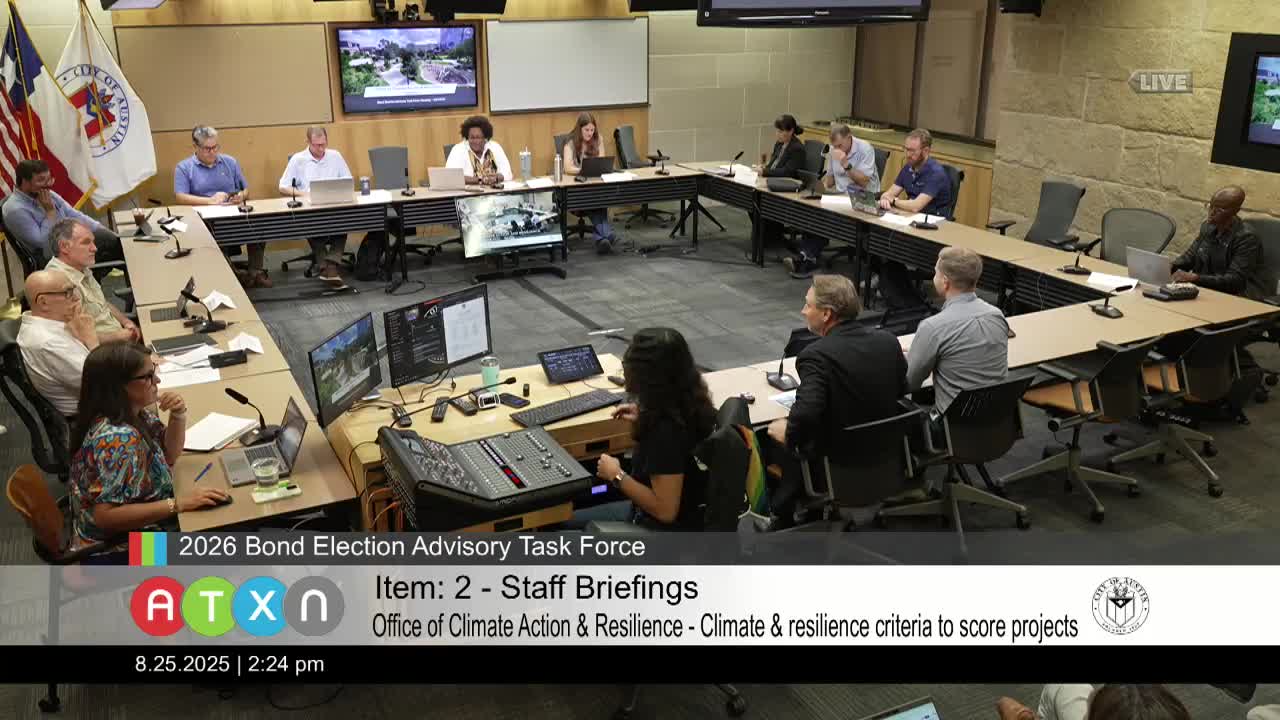
The Office of Climate Action and Resilience presented draft scoring criteria to the Bond Election Advisory Task Force for evaluating projects proposed for the city’s 2026 bond package, and Task Force members debated how broadly the rubric should apply and how soon numeric scores will be available.
The Office of Climate Action and Resilience presented draft scoring criteria to the Bond Election Advisory Task Force for evaluating projects proposed for the city’s 2026 bond package, and Task Force members debated how broadly the rubric should apply and how soon numeric scores will be available.
The office proposed five scoring areas — reduced vulnerability to extreme weather, adaptive capacity, green building policy, life‑cycle carbon assessment and sustainable operations — and said each project would be scored from 0 to 4 in each area. "At the Office of Climate Action and Resilience, we focus on implementing the Austin Climate Equity Plan," Director Zach Ballmer said, and staff framed the rubric as a tool to surface projects that reduce greenhouse‑gas emissions or increase resilience to climate impacts.
The proposed approach is twofold: (1) fund projects that directly address mitigation or adaptation (for example, land purchases for conservation) and (2) integrate climate principles into other departmental projects (for example, building a new library to a higher sustainability standard). Ballmer told the Task Force that the Office and Capital Delivery Services are working to score department proposals and that staff expect an initial set of scores in October.
Why it matters: Task Force members said the climate scoring will influence which projects are prioritized for voters. Several members urged stronger emphasis on mitigation, more explicit treatment of co‑benefits such as water and air quality, and clearer guidance for programmatic requests (sidewalks, bike lanes) and land acquisitions that do not map neatly to an architectural rubric.
What the staff proposed
- Reduces vulnerability to extreme weather: site selection and design that avoid high‑risk locations or use damage‑resistant materials. Projects would receive 0–4 points depending on the level of integration. - Adaptive capacity: features that allow a facility to remain or rapidly become functional after an extreme event (backup power, multiple access points, redundant communications); scored 0–4. - Green building policy: alignment with the city’s green building requirements (minimum LEED Silver/Austin Energy Green Building 3‑star) up to higher verified standards (LEED Platinum, Envision); scored 0–4. - Life‑cycle carbon assessment (LCA): quantifying embodied and operational carbon to find design opportunities to lower total emissions; scored 0–4 depending on commitment and depth. - Sustainable operations: measurable long‑term plans to reduce energy, water and waste over a facility’s life; scored 0–4.
Staff said the five categories are intended to reward projects that both reduce emissions and increase resilience; projects that deliver both would score in multiple categories. Braden Latham Jones, Climate Program Manager, participated in the briefing and the office said it has coordinated the criteria in a cross‑departmental bond development working group.
Key discussion points from Task Force members
- Timeline and deliverables: Luke Metzger, Task Force member, asked staff to aim for an October–November timeframe for delivering scores because "the scores really will matter." Marcus Hammer of Capital Delivery Services told the group staff are aiming to have an initial scoring wrapped by October so the Task Force can use those results when it meets in November.
- Life‑cycle analysis practicality: Members asked whether LCAs can be applied across the hundreds of projects on the city’s list. Ballmer and CDS staff said LCAs are feasible for a limited subset of projects (those with design details or a smaller list), and staff are exploring simplified methods for broader application but cautioned that a full LCA for every project would be resource‑intensive.
- Programmatic projects vs. named capital projects: Task Force members repeatedly asked how the rubric would treat programmatic requests (sidewalks, bike lanes, broad land‑acquisition buckets) that are not single, named construction projects. Marcus Hammer said the rubric works best for named projects; programmatic buckets will require a different lens (past funding levels, readiness, ability to deliver across a six‑year bond program) and additional staff analysis.
- Backup power and fuel sources: Members asked the panel to distinguish fossil‑fuel backup generators (especially diesel) from cleaner options like solar paired with batteries; one Task Force member suggested scoring points for low‑emissions resilience solutions.
- Social vulnerability and equity: Staff said they plan to layer the Social Vulnerability Index in resilience scoring so projects located in higher‑vulnerability areas score higher for serving communities with greater need, but additional analysis would be necessary to determine whether each project’s design directly addresses local social needs.
- Scope and additional environmental criteria: Several Task Force members asked that climate scoring include related environmental outcomes such as water quality and air quality; members suggested broadening the climate/resilience category or adding subcategories to capture those co‑benefits.
Operational notes and next steps
Staff reiterated several calendar items: the city’s open call for project submissions is expected to remain open through October 31; staff aim to return initial rubric scores to the Task Force in October and to present a refined package to the Task Force in November. The Task Force will continue detailed conversations about how to apply the rubric to working‑group recommendations during January–March presentations, with the Task Force scheduled to make its final recommendation to City Council in May 2026.
Ending
Task Force members asked staff to return with clearer guidance for applying the rubric to programmatic requests and with options for simplified carbon analyses that could be applied at scale. Staff agreed to refine scoring guidance (including distinguishing cleaner backup power options) and to continue coordinating with Capital Delivery Services and department staff.