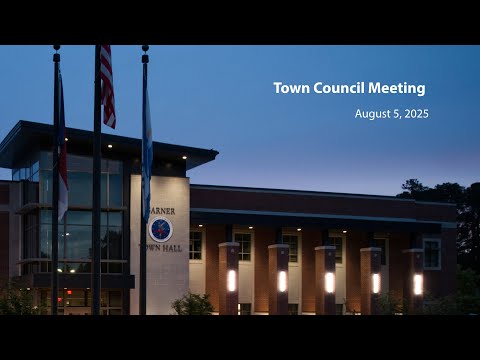
Garner council narrows design-modification threshold, exempts certain large residential projects from special-use permit
Summary
On Aug. 5, 2025 the Garner Town Council adopted ZTA 25‑001, amending the Unified Development Ordinance to exempt certain Tier 2 residential developments from the residential special‑use permit (SUP) requirement and to reduce the design‑modification threshold from 10% to 5%. The vote was 3‑2.
Garner — The Garner Town Council voted 3‑2 on Aug. 5 to adopt zoning text amendment ZTA 25‑001, changing when residential projects must seek a special‑use permit and tightening the threshold for design modifications that trigger a major review.
The amendment, presented by Jeff Triesenberg, the town’s planning director, would remove the SUP requirement for “any residential development site plan or major subdivision involving 200 dwelling units or more, except for those residential developments or major subdivisions located within a tier 2 conditional zoning district,” and would amend the design‑modification standard to reduce the change in total dwelling units that constitutes a major modification from 10% to 5%.
Triesenberg told council that the planning commission reviewed the options and unanimously recommended approval of “option C,” which is the version council adopted. He said the commission found the amendment “not overtly inconsistent” with the town’s adopted land‑use plans and moved to recommend approval.
Supporters on the council said the change is intended to streamline review of large, detailed Tier 2 projects that already undergo an extensive master‑plan process. Mayor Pro Tem Mark Vance, who moved the motion, said the amendment is meant to make the process “more efficient and more effective” for projects that have already been reviewed thoroughly by staff and the planning commission.
Council member Dellinger and Council member Singleton dissented. Dellinger argued the SUP process is a valuable quasi‑judicial tool that allows the town to mitigate adverse impacts and obtain concessions from applicants. “I think we're just removing a tool from our toolbox,” Dellinger said, adding that the SUP process has produced mitigation measures on past projects and encouraged applicants to address neighborhood concerns.
The ordinance adopting ZTA 25‑001 (ordinance no. 20255351) was moved by Mayor Pro Tem Mark Vance and seconded by Council member Behringer. The roll‑call vote was Vance — aye; Behringer — aye; Matthews — aye; Singleton — nay; Dellinger — nay. The motion carried 3‑2.
Planning director Triesenberg said the amendment also tightens review of post‑approval design changes by lowering the numerical threshold for what constitutes a major modification, a change he said narrows the range of revisions that must return to the original approval process.
Council members asked staff questions during the public‑hearing portion of the item; no members of the public signed up to speak on the text amendment at the meeting. The planning commission’s consistency statement and its unanimous recommendation were included in the staff report to council.
Council members who opposed the change said it could reduce public involvement and remove incentives for applicants to negotiate mitigations that protect neighborhoods. Supporters said maintaining careful, early review and strong staff oversight will preserve protections without requiring additional SUP hearings.
The ordinance takes effect according to the town’s standard ordinance timetable and will be applied to future applicable rezoning and development applications.
AI generated
The text on this page is AI generated. Summaries, highlights, analysis, and video transcripts are all produced from the original source material.
AI can make mistakes, so if you spot one, and we will fix it for everyone.
Note: the source content is unaltered by us. Any content source we link to, be it a video, an audio recording, or a document, is presented exactly as its publisher released it. That publisher is usually a government body, sometimes an individual official or another organisation.