Lifetime Citizen Portal Access — AI Briefings, Alerts & Unlimited Follows
D.C. health committee adopts FY26 budget recommendations to soften mayor—s proposed Medicaid and public-health cuts
Loading...
Summary
The Council—s Committee on Health on June 23 approved a report recommending restorations and targeted investments to the mayor—s FY26 health budget, including measures to blunt Medicaid eligibility reductions, shore up HIV prevention funding, expand school health staffing and fund food-access programs.
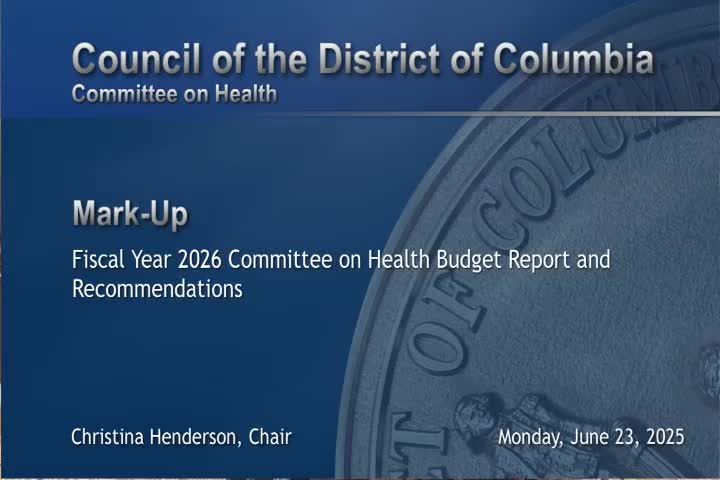
Councilmember Christina Henderson, chair of the Committee on Health, on Monday moved and the committee approved a report of recommendations for the District's fiscal year 2026 health budget that would reverse some of the mayor's proposed cuts and add targeted investments for behavioral health, maternal supports, HIV prevention and food access. The committee approved the report in Room 500 of the John A. Wilson Building and on Zoom; the motion carried unanimously.
The committee said the mayor—s FY26 proposal included sharp reductions to the District—s Medicaid and Alliance programs that would transition roughly 25,500 adults from Medicaid to a Basic Health Program administered by the Health Benefit Exchange Authority and lower adult Medicaid eligibility from 221% of the federal poverty level to 135% of FPL. The report recommends restoring $3.7 million in FY26 and $12.1 million across the financial plan to blunt several proposed reductions, and it directs additional investments across public-health priorities.
Why it matters: The committee—s report would affect thousands of District residents who rely on Medicaid and Alliance benefits and would steer local funding into services that federal cuts or grant expirations have put at risk. Committee members said the changes are aimed at preserving access to care and preventing losses of benefits such as dental, vision and nonemergency medical transportation that the Basic Health Program may not cover.
Key recommendations and restorations - Medicaid/Alliance: The committee recommends rolling back several eligibility and administrative changes proposed by the mayor—s budget, including removing a proposed face-to-face recertification requirement and allowing public-school enrollment to count as proof of residency. The recommendations include a $1.8 million allocation to raise the moratorium age for new Alliance beneficiaries from 21 to 26 for FY26 and restores coverage for durable medical equipment for adults through FY27 and for youth throughout the financial plan.
- Basic Health Program (BHP): The committee noted that BHP enrollees would retain many clinical services but likely would lose benefits currently covered by DC Medicaid, including dental, vision, substance use disorder treatment and nonemergency medical transportation. The report urges the Committee of the Whole to identify the about $5.2 million the committee said is needed to restore dental coverage lost under a BHP transition.
- Dental and provider payments: The committee approved a $7.9 million enhancement for dental rate increases to improve provider participation and parity for managed-care and fee-for-service dental providers.
- Maternal and family supports: The committee approved a $100,000 increase and accepted a $300,000 transfer to bring Nurse-Family Partnership funding to a total of $625,000, and it approved $500,000 in recurring funds for diaper and formula distribution via a grant to the D.C. Diaper Bank.
- HIV and public health services: The report recommends a $1.3 million partial restoration for HIV prevention and surveillance after the committee said the U.S. Centers for Disease Control and Prevention discontinued a roughly $2.4 million federal grant. The committee also recommended $411,000 to expand evening and weekend hours at the DC Health and Wellness Center to improve access to testing and treatment.
- Food access and markets: The committee partially restored $200,000 that had supported local food purchases through a federal program and fully funded Bill 206-109, the Farmers' Market Support Amendment Act, providing $493,829 to DC Health and $225,000 to the Department of Licensing and Consumer Protection to expand farmers markets in low-access areas. The committee also extended a grocery access pilot with $120,000 to enable online grocery purchases for SNAP-Ed participants without extra fees.
- School health and behavioral health: The committee fully funded a transition of the school health services program so DC Health will hire and employ school nursing staff directly rather than operate the program through a grant contract; two school-based health centers at comprehensive high schools will remain contracted with Unity Health. The committee also required the Department of Behavioral Health (DBH) to submit a detailed improvement plan for the school-based behavioral health program by Oct. 15, 2025, and set minimum per-school grant awards of $120,000 to community-based organizations where applicable. The committee said it will retain oversight and may recommend transferring the program to DC Health in FY27 if DBH does not show sufficient progress.
- Substance use and forensic services: The committee recommended $1.7 million in FY26 to continue community outreach teams delivering substance use and behavioral-health services in multiple wards, a $400,000 opioid-abatement fund enhancement to restore OCME—s illicit-drug surveillance program, and restoration of $907,000 from opioid-abatement funds for the court urgent clinic at D.C. Superior Court.
Oversight and next steps Committee members repeatedly emphasized continued oversight. Henderson said the report—s recommendations were developed after six public hearings and months of testimony and engagement. The committee moved the report with leave for staff to make technical changes in consultation with the Office of the General Counsel and the Council Budget Office; the motion passed unanimously.
Councilmember Brianne Nadeau (Ward 1) praised the committee for reversing "devastating cuts" and for securing recurring funds for home-visiting services and substance-use outreach in Ward 1. Councilmember Zachary Parker (Ward 5) said he was "happy to see the restoration of funds for alliance beneficiaries" and welcomed the funding for the child behavioral health services dashboard intended as "a one-stop shop for families." Councilmember Charles Allen (Ward 6) thanked the chair and noted the alliance restorations and local opioid efforts. Councilmember Vincent C. Gray was not a speaker in this hearing; other councilmembers and staff who commented during the meeting thanked committee staff and agency partners.
The committee adopted the report and recommendations and will forward its budget report to the Committee of the Whole for further consideration during the broader Council budget process. Committee members said some items remain contingent on federal developments and additional funding decisions at the Committee of the Whole.
Votes at a glance - Motion to adopt the Committee on Health FY26 budget report and recommendations, with leave for staff to incorporate technical changes made in consultation with the Office of the General Counsel and the Council Budget Office: Passed unanimously (ayes: Christina Henderson, Brianne Nadeau, Charles Allen, Zachary Parker).