Get AI Briefings, Transcripts & Alerts on Local & National Government Meetings — Forever.
Lynnwood adopts new Unified Development Code, defers residential sprinkler rule
Summary
On June 23 the Lynnwood City Council approved a new Unified Development Code (Ordinance 3481) and an Alderwood/City Center subarea plan (Ordinance 3482), and updated the city's emergency operations center location (Ordinance 3480). Council removed the residential sprinkler requirement (LMC 9.18) from the package for further review.
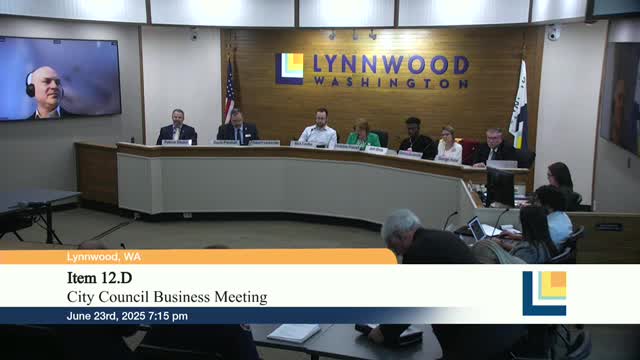
Lynnwood City Council on June 23 approved a package of planning and zoning changes that adopt a new Unified Development Code (UDC) while postponing a separate decision on residential fire sprinklers.
The council voted to adopt Ordinance 3481, which repeals the existing Titles 18, 19 and 21 and adds Title 8 (the UDC). Council also approved Ordinance 3482 (the City Center plus Alderwood subarea plan) and Ordinance 3480 (amending LMC 7.20.080 to update the emergency operations center location). The body removed LMC 9.18 (residential sprinkler requirements) from the motion and directed staff and the planning commission to revisit that chapter later this year.
The UDC changes shift some development regulation to a units-per-lot framework, adjust parking minimums to align with recent state law changes, clarify middle-housing and cottage-housing standards, and simplify bulk and setback rules. Staff said the code is intended to improve clarity and shorten permit review timelines so projects can be built more predictably and at lower overall development cost.
City planning staff told the council the UDC implements policies in the Imagine Lynnwood comprehensive plan and the city's Housing Action Plan. The staff presentation noted the code increases the baseline number of units allowed on many lots (including middle housing) and reduces routine parking requirements while preserving the developer's option to build more parking where market demand exists. The draft also exempts certain housing types (affordable housing and senior housing) from reduced-parking rules.
Council deliberations focused on two persistent trade-offs: safety and cost. Fire officials and staff presented a set of alternative approaches for residential sprinklers. Options ranged from requiring sprinklers in all new residential construction to narrower thresholds (for example, lowering a square-footage threshold or requiring sprinklers for one- and two-family dwellings but exempting ADUs), or delaying any change until coordinated updates are adopted later in the year. Council removed the sprinkler chapter from the primary motion to allow more analysis and public input.
Council members voiced differing priorities in the debate. Some said the council must avoid adding costs that could worsen housing affordability; others emphasized public safety and the prevention benefits fire sprinklers provide. Several council members asked staff for additional analysis of the cost impacts and of the alternatives described by the fire marshal.
The council also approved changes that simplify building bulk standards, establish minimum building separation, and clarify driveway depth and parking stall expectations so parked cars do not overhang sidewalks. Staff noted one objective of the UDC is better predictability for developers and faster permit turnarounds.
Votes at a glance: - Ordinance 3481 (adopt Title 8 Unified Development Code; amend multiple LMC chapters) ' Motion moved by Councilmember Parshall; roll-call vote 7-0 in favor; Council removed LMC 9.18 (fire sprinklers) for later consideration. - Ordinance 3482 (City Center + Alderwood subarea plan) ' Motion moved and seconded; roll-call vote 7-0 in favor. - Ordinance 3480 (amend LMC 7.20.080: emergency operations center location) ' Motion moved by Councilmember Coelho; roll-call vote passed.
What happens next: staff will return with additional, targeted amendments (including a required Critical Areas Ordinance) later in 2025 and will continue public outreach. Council expressed interest in a follow-up evaluation of how the UDC affects parking, tree canopy, public safety and housing cost as projects are built.
Why it matters: the UDC is the principal regulatory document governing how housing and mixed-use development can be built in Lynnwood. The changes are meant to implement the city's 20-year comprehensive plan, increase housing supply options in response to state policy, and reduce permit uncertainty for developers. Deferring the sprinkler requirement leaves a live safety-vs-cost question for later council action.