Get email alerts on the Transportation Planning topic
No spam. Unsubscribe anytime.
Regional Transportation Council update: Transit 2 study, EV charging funds and micro‑transit prospects
Summary
Commissioner Webb reported on the Regional Transportation Council meeting: extensive discussion on Transit 2 recommendations, formation of a subcommittee, approval of the Unified Planning Work Program for 2026–27, and a $15 million call for electric vehicle charging projects limited to public property and 24/7 access.
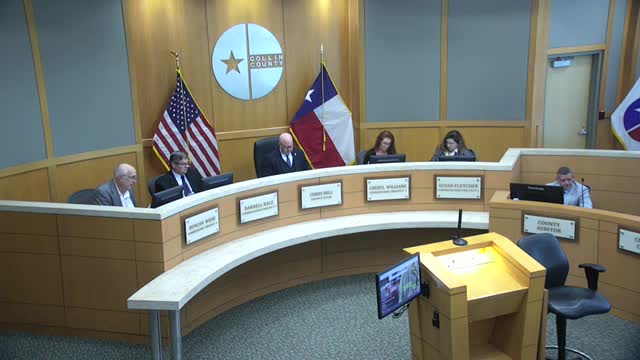
Commissioner Webb briefed Collin County Commissioners Court on the Regional Transportation Council’s recent meeting and the ongoing regional transit conversation.
Webb said discussion of the Transit 2 study dominated the RTC meeting for the second month in a row and that the council rejected a proposal for additional consulting. Instead, the RTC plans to form a subcommittee to pursue “low-hanging fruit” recommendations from Transit 2 and to draft policy incentives designed to encourage more cities and jurisdictions to adopt transit solutions.
Webb said the council approved the Unified Planning Work Program for 2026–27 (a derivative of the Unified Transportation Program) and authorized a call for projects for electric vehicle charging infrastructure totaling $15,000,000. He noted a key restriction on that funding: public charging sites must be on public property and available 24 hours a day, seven days a week.
On expanding transit participation, Webb described options for nonmember cities to contract for services rather than become full DART (Dallas Area Rapid Transit) members. He said DART has eliminated the requirement that a jurisdiction become a member to accept rail service; a nonmember could be a contractual “customer.” Webb observed that the council expects the share of transit funding (the 1¢ sales tax referenced in discussion) could change and that lowering the contribution rate could prompt more jurisdictions to join as members.
Webb said the RTC discussion anticipates significant regional growth and that the council expects some solutions to be smaller-scale “micro transit” services that connect point-to-point trips rather than expanded rail in many suburbs. He indicated he may place a county-level agenda item after budget season (around September or October) to consider Collin County’s role in transit planning and potential leadership with its cities.
The court did not take formal action on the RTC update; Webb presented it as informational and to flag potential future county policy discussion.
AI generated
The text on this page is AI generated. Summaries, highlights, analysis, and video transcripts are all produced from the original source material.
AI can make mistakes, so if you spot one, and we will fix it for everyone.
Note: the source content is unaltered by us. Any content source we link to, be it a video, an audio recording, or a document, is presented exactly as its publisher released it. That publisher is usually a government body, sometimes an individual official or another organisation.