Get Full Government Meeting Transcripts, Videos, & Alerts Forever!
Get email alerts on the Rental Act Topa Evictions topic
No spam. Unsubscribe anytime.
Housing committee advances Rental Act after debate over TOPA exemptions, evictions and buyouts
Summary
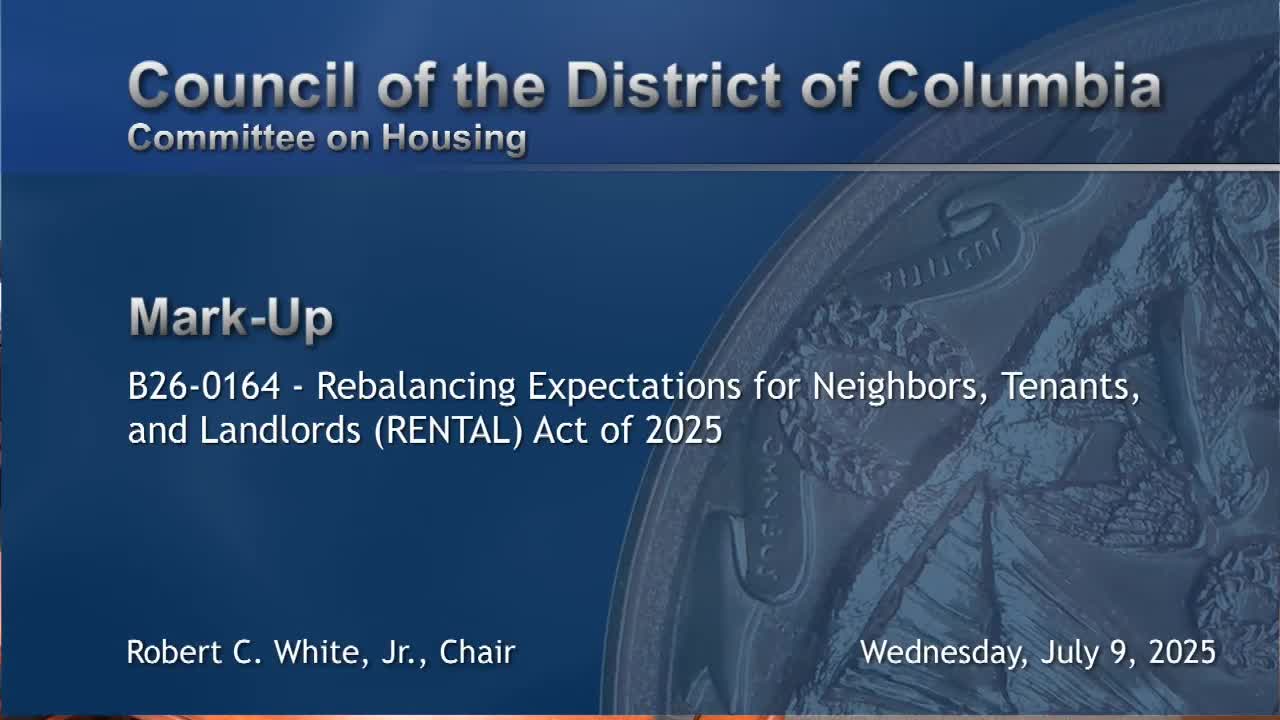
The Committee on Housing voted to advance the Rental Act out of committee (date not specified) after several hours of debate over revisions to the Tenant Opportunity to Purchase Act (TOPA), eviction timelines and limits on cash buyouts.
The Committee on Housing voted to advance the Rental Act out of committee (date not specified) after several hours of debate over revisions to the Tenant Opportunity to Purchase Act (TOPA), eviction timelines and limits on cash buyouts.
Chairman White, Committee on Housing, opened the session by saying the draft Rental Act “was not my bill” but that the committee had a duty to fix provisions that would not work in practice. He emphasized the committee’s focus on preserving long-term affordability and warned against provisions that would simply provide short-term payouts: “We have to prioritize long term affordability over short term payouts,” he said.
The committee’s markup centered on three fault lines: a 15-year TOPA safe-harbor intended to encourage investment in new construction, exemptions tied to affordability covenants, and a narrowed list of benefits allowable in place of tenant consideration — an effort committee members said was aimed at reducing exploitative cash buyouts.
Why it matters
The bill would alter long-standing tenant protections and procedures that affect owners, developers and renters across Washington, D.C. Committee members and staff repeatedly framed the changes as an attempt to balance attracting new multifamily investment while preserving tenant protections that prevent displacement.
What the committee discussed and decided
Safe-harbor from TOPA: Council Member Fruman moved an amendment to limit the proposed 15-year TOPA safe harbor so it would apply only prospectively (to buildings completed after the act’s passage) and not retroactively to buildings constructed in the prior 15 years. Fruman argued the retroactive element would take rights away from tenants who already have them. Chairman White and others said the retroactive element was aimed at freeing capital for repeat investors and preventing recently built properties from being stalled in secondary transactions. The amendment failed on a roll call (tally recorded in the hearing: 2 yes, 3 no). The committee retained the committee print’s retroactive 15-year safe harbor.
Affordability-covenant exemption and buyouts: Council Member Nadeau offered an amendment to strike two provisions from the committee print: (1) a TOPA exemption for properties that include a new income-restricted affordability covenant at the time of sale or transfer, and (2) a narrowing of the list of tenant-considered benefits to five enumerated items (intended to constrain cash buyouts). Nadeau and supporters said the covenant exemption would be administratively difficult to enforce, could be inconsistent with TOPA notice and timing requirements, and could displace tenant negotiating power. Opponents argued the covenant path could add long-term affordability covenants to more buildings. Nadeau’s amendment failed on a roll call (3 no, 2 yes).
Eviction timelines and court capacity: Chairman White repeatedly cautioned against adopting statutory eviction timelines that the Superior Court could not meet because of judicial vacancies. He told the committee that the council’s proposed fixed timelines would not speed evictions unless court vacancies were filled, noting the court’s reported 16% judicial vacancy that he said could rise to 22% by year-end. The committee kept a 20-day hearing requirement for safety-eviction matters in the current print.
Data cited in debate
- The committee presentation cited 7,234 multifamily building permits issued in 2022 and a sharp drop to 1,239 permits in 2024. - The committee cited a 6.1% rental vacancy rate for D.C. and an estimated shortage of 37,429 units affordable to the lowest-income residents. - Committee members said roughly 4% of TOPA transactions involve buildings 15 years old or newer. - Participants referenced a 330-day average sale timeline for properties with tenant associations versus 168 days for other properties. - Committee staff said, on average over the prior eight months, 272 eviction cases were filed per month for 13 judges.
Roll-call votes and motions
- Council Member Fruman’s amendment (strike retroactive 15-year safe harbor) — moved by Council Member Fruman; outcome: failed (tally: 2 yes, 3 no). (Roll-call recorded on the hearing record.)
- Council Member Nadeau’s amendment (strike covenant exemption and narrow allowed tenant consideration) — moved by Council Member Nadeau; outcome: failed (tally: 2 yes, 3 no). (Roll-call recorded on the hearing record.)
- Motion to move the Rental Act out of committee with leave for staff to make technical and conforming changes — moved by Chairman White; outcome: passed on roll call (tally recorded in the hearing: 3 yes, 1 no, 1 present). The committee chair instructed staff to make technical and conforming edits before first reading.
Voices in the meeting
Chairman White repeatedly framed the markup as the result of extensive hearings and outreach: “We listened to the courts, to the tenants, to the small landlords,” he said. Council Member Nadeau said she supported reforms that would preserve tenant rights and noted she had advanced related TOPA legislation earlier in the year. Council Member Fruman said he supported a forward-looking safe harbor but objected to retroactive removal of tenant rights. Council Member Bonds and Chairman Mendelson also addressed the committee during debate and recorded roll-call votes.
Next steps
The committee advanced the Rental Act to the next stages of the Council’s process. Staff will make technical and conforming edits before the bill’s first reading; additional amendments and votes are expected before final passage.
(Reported from Committee on Housing markup; date not specified.)