Get Full Government Meeting Transcripts, Videos, & Alerts Forever!
Get email alerts on the Housing topic
No spam. Unsubscribe anytime.
Planning Commission backs adaptive reuse ordinance with changes to unit size and eligibility
Summary
The Santa Barbara Planning Commission voted to recommend a city ordinance to incentivize converting nonresidential buildings into housing, with commissioners asking staff to shorten the eligibility age to five years and tighten average unit-size limits; the commission also urged faster work on in‑lieu fee options for inclusionary requirements.
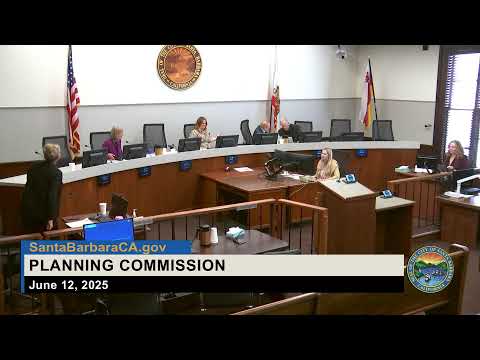
The Santa Barbara Planning Commission voted unanimously June 12 to recommend an amendment to the Santa Barbara Municipal Code to create a citywide adaptive reuse program that would make it easier for existing nonresidential buildings to convert to housing. Vice Chair Boss and five commissioners supported the recommendation after adding changes the commission requested, including reducing the minimum building age for eligibility from 10 years to five years and setting lower average unit‑size limits for projects that use the ordinance’s incentives.
The ordinance would add Section 30.1850.045 to Title 30 of the municipal code and implement Housing Element Program 1, the staff report said. Dana Falk, the city’s long‑range project planner, told the commission the measure is “an incentive zoning program” that gives by‑right development incentives—density, open‑yard, parking and setback relief—if a conversion meets the ordinance’s definition and requirements. Falk said staff recommends the commission: amend the municipal code, find the ordinance exempt from CEQA under CEQA Guidelines §15061(b)(3), and find it consistent with the general plan.
Why it matters: Santa Barbara adopted its housing element in December 2023 and the state certified it in February 2024; the element directs the city to expand tools to create housing. Staff and several housing advocates argued adaptive reuse can convert vacant commercial floor area to housing more quickly and at lower cost than ground‑up construction, particularly in mixed‑use and multiunit zones in the city’s inland area.
Key provisions and limits: Falk summarized several features included in staff materials that applicants would need to meet to use the new streamlined pathway. The ordinance as proposed would: - Apply citywide to inland zones where Title 30 allows multiunit residential uses (the coastal zone would be addressed later in a Coastal Land Use Plan amendment); - Define an adaptive reuse project as a change of use from nonresidential to one or more residential units using the existing building envelope; limited exterior additions are allowed (a 600 square‑foot or 10% cap was included in staff materials for additions outside the envelope); - Offer four development incentives for qualifying projects: no maximum residential density (units allowed up to the building envelope), relief from open‑yard requirements, adjustments to vehicle parking (including allowing no additional parking beyond what exists), and use of existing setbacks for residential space; - Keep existing requirements that still apply, such as the city’s inclusionary housing program, stormwater management, minimum unit sizes and bicycle parking; and - Require a nonresidential ground‑floor use of at least 35 feet depth on State Street (Montecito to Sola) with the intent of activating the streetscape.
Public comment: Supporters from nonprofit and housing groups urged the commission to adopt the ordinance as a tool to add housing. Rob Fredericks of the Housing Authority of the City of Santa Barbara thanked staff and said, “Adaptive reuse is a smart, sustainable strategy. It conserves resources, revitalizes our core districts, and brings housing closer to where people work, shop, and play.” Strong Towns Santa Barbara (submitted comment read by Linda Honickman) cited local housing cost pressures and recommended incentives such as reduced parking and no maximum density.
Developers and some downtown stakeholders warned that requiring onsite affordable units under the city’s inclusionary ordinance could make downtown adaptive reuse projects financially infeasible. Ben Romo, who said he works on downtown projects, told commissioners that inclusionary requirements in the Central Business District “will kill projects” and that many property owners will not accept long‑term deed restrictions. Other commenters suggested allowing in‑lieu fees or exemptions for downtown projects and asked staff to consider smaller average unit sizes or rental‑only limits to avoid luxury conversions.
Commission deliberations and amendments: Commissioners asked staff detailed questions about building code flexibility, the 10‑year building‑age threshold, unit size limits, stormwater and parking implications, and how the ordinance would interact with state laws such as AB 2097 (parking proximity to major transit). Staff (Rosie Dicey and Dana Falk) said the proposed rules reflect precedent research and prior commission feedback; they also confirmed the city is conducting a separate inclusionary‑housing feasibility study (HE‑13) that will evaluate in‑lieu fees and other options.
Motion and outcome: Commissioner Bakke moved to recommend the ordinance to city council with modifications requested by the commission: change the minimum building age for eligibility from 10 years to five years; set the maximum average unit size for rental units at 800 square feet and for ownership units at 1,200 square feet (the commission’s motion text); request that staff report on adaptive‑reuse activity in the Housing Element annual progress report; and strongly recommend that city council prioritize and accelerate study and consideration of in‑lieu fees or other inclusionary flexibilities for adaptive reuse (including possible special treatment for the Central Business District). The motion passed 5–0 (Commissioners Whiskam, Barnwell, Bakke, DiLucio and Vice Chair Boss voting yes; Commissioner Peterson absent).
Implementation steps and schedule: Falk reminded the commission that ordinance amendments require multiple public hearings. Staff said the ordinance would still need hearings before the ordinance committee and then City Council for introduction and adoption; staff also noted concurrent work on a separate water‑meter submetering amendment (Jan 2025 council action already allowed private submetering for 100% affordable adaptive reuse projects) and that coastal‑zone changes must be submitted later to the California Coastal Commission as an implementation package. The city’s housing element sets a calendar goal to complete this program by December 2025.
Unresolved questions and next steps: The commission’s direction included a clear request for staff to return with progress in the city’s annual housing element report and for the inclusionary study to evaluate in‑lieu fees and downtown‑specific options. Staff also flagged that building‑code and fire‑safety flexibility will be handled through existing code‑alternate and existing‑building provisions and a forthcoming triennial code update process.
Ending: With the motion approved, staff will prepare the ordinance package to move to the ordinance committee and then to City Council for consideration; the commission asked that staff highlight the commission’s requested adjustments and the desire for an expedited study of inclusionary in‑lieu mechanisms in subsequent reports.