Lifetime Citizen Portal Access — AI Briefings, Alerts & Unlimited Follows
Sacramento council approves implementation of Railyards term sheet, expands EIFD to finance stadium and central shops
Loading...
Summary
The Sacramento City Council unanimously approved two resolutions Tuesday to implement the November 2024 Railyards term sheet and to expand the city's Enhanced Infrastructure Financing District (EIFD) so private partners can advance and later be reimbursed for major infrastructure that would support a 12,000-seat Sacramento Republic stadium and rehabilitation of the historic Central Shops.
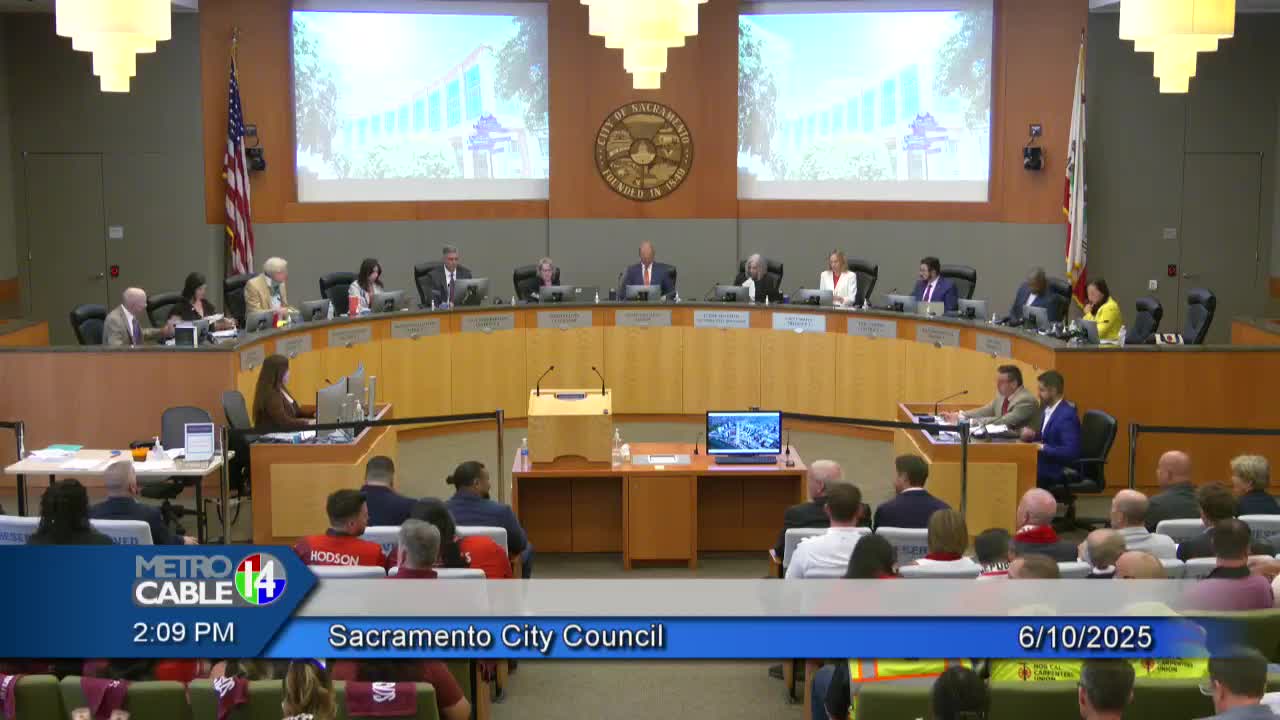
The Sacramento City Council unanimously approved two resolutions Tuesday to implement the city's November 2024 term sheet for the downtown Railyards, expanding an Enhanced Infrastructure Financing District (EIFD) and authorizing the execution of definitive documents to move the project toward construction.
The package the council approved authorizes the city to finalize the master funding agreement and the infrastructure financing plan that will reimburse private parties and the city for certain site infrastructure and land purchases as new development occurs. Mayor McCarty moved the combined motion to approve items 1 and 2; Vice Mayor Talamantes seconded it, and the measure passed 9-0.
Why it matters: The votes advance a multi-decade redevelopment effort that city staff and development partners say is needed to build a commercially viable, mixed-use neighborhood around Sacramento Valley Station. Developers and the Wilton Rancheria have committed private capital to backstop major infrastructure work the city says it cannot fully fund on its own. Council and staff said the action is intended to accelerate construction of a 12,000-seat soccer stadium, the rehabilitation of the Central Shops, and other catalyzing projects that would enable additional housing, retail, health-care and office uses.
City staff framed the financing tool and the near-term effects. Marco Gonzalez of the City Manager's office of innovation and economic development said the 2016 plan for the Railyards and the 2024 term sheet together led to "final steps to implement the term sheet and for the projects to be under construction in earnest." Jamie Gomes of Economic & Planning Systems (EPS) told the council the EIFD amendment creates two project areas, forecasts tax increment revenues over many years and outlines how revenues will reimburse parties that advance infrastructure costs. Gomes emphasized that the EIFD "is not a new tax; it's leveraging incremental property tax revenues." (Jamie Gomes, EPS)
Development partners described anticipated scale and benefits. DRV'representative Denton Kelly and others said the stadium would be an anchor for housing and new commercial uses and would reconnect the central city to adjacent neighborhoods. The development team and Wilton Rancheria leaders described the investment as both economic and symbolic; Wilton Rancheria Chairman Jesus Tarango said reclaiming the Railyards land "is an honor" that acknowledges the tribe's historical ties to the river confluence.
Key figures and commitments included in the council presentations and public record: - Stadium: initial capacity about 12,000 seats, with the ability to expand. - Private investment: staff and partners cited roughly $325 million anticipated for the stadium and Central Shops Phase 1 (presentation figures) and wider estimates of several billion dollars in eventual economic output tied to the full Railyards buildout (EPS projections). - Jobs and economic impact: EPS cited approximately 24,000 total jobs (direct, indirect and induced) and $2.1 billion in annual wage income in the regional economic-impact analysis; other presenters referenced similar multi-thousand job estimates. - Infrastructure needs: staff estimated more than $200 million of remaining public facilities to construct across the site; the EIFD is the mechanism to reimburse advanced funds. - Affordable housing: staff said the EIFD financing plan anticipates about $133 million nominally to support citywide affordable housing over the EIFD's life; separate grant- and project-level affordability requirements (including HCD-linked requirements and the 2016 mixed-income housing strategy) also apply to specific developments on-site. - Land purchase: the city would purchase two parcels to support Sacramento Valley Station work for $14,000,000; those funds are planned for closing in early July per staff comments. - City services waiver: the term sheet allows for waiver of reimbursement for city services on Republic match days up to $300,000 annually for 10 years, adjusted for inflation; amounts above that would be the developer's responsibility.
Council debate and public comment: The council's discussion followed extensive public comment (about 55 speakers recorded). Supporters included business groups, labor unions, tourism and economic-development organizations and numerous residents who said a stadium and associated redevelopment would catalyze jobs and downtown investment. Labor leaders and unions emphasized union hiring, apprenticeships and local job pipelines; multiple labor speakers endorsed the EIFD on that basis. Several community organizations and workforce advocates urged stronger, earlier commitments to affordable housing and pointed to the EIFD's timing for housing revenues, which staff said would not be available in significant amounts until later years of buildout under the financial forecasts.
What the council actually approved (formal actions): The council voted to (a) authorize execution of the definitive documents implementing the November 2024 term sheet and (b) approve the EIFD amendment, infrastructure financing plan and master funding agreement enabling the reimbursement waterfall described in staff materials. Mayor McCarty moved approval of both items and Vice Mayor Talamantes seconded; the motion passed unanimously 9-0.
Next steps and timing: Staff said approval moves the documents to the Public Finance Authority for further action and that the stadium project and Phase 1 work on the Central Shops are targeted to be underway later this year with openings targeted in 2027 for the catalytic projects. Staff and partners noted typical EIFD realities: tax increment revenues accrue only after vertical development and assessed value growth occur, so repayments follow construction and occupancy over time.
Community context and cautions: Council members and speakers stressed that the EIFD structure is a partnership: private parties are advancing funding, the city is contributing tools and limited concessions (for example, the signage and limited service waivers discussed in the term sheet), and the EIFD will funnel revenues in a defined waterfall to reimburse early funders, the city land purchase and, once buckets are filled, to affordable housing and other public facilities. Several council members asked staff for continued reporting and monitoring of milestone performance, and staff said the EIFD will have annual reporting to the Public Finance Authority showing revenues, funded projects and budgets.
The vote closed a long-running effort to redevelop the Railyards that staff traced to planning beginning in the 1980s and formal city approvals in 2016; the council's action Tuesday implements the 2024 term sheet that the city, Wilton Rancheria, Sacramento Republic FC and other partners negotiated and agreed to last year.
Votes at a glance - Motion: "Approve items 1 and 2 as drafted" (execution of definitive documents implementing the 2024 term sheet; EIFD expansion and adoption of infrastructure financing plan and master funding agreement). Mover: Mayor McCarty. Second: Vice Mayor Talamantes. Outcome: approved 9-0.
Ending: Council members and project proponents stressed that the approvals do not by themselves build the project: the next months will involve property closings, permitting and the start of construction activity. Staff and the development team said they expected to return with financing steps and site-level plans and reiterated that the EIFD's revenues will accumulate as vertical development is built and assessed value appears on tax rolls.