Lifetime Citizen Portal Access — AI Briefings, Alerts & Unlimited Follows
Serdar Berdimuhamedov elected president as LLDC3 adopts rules, agenda and launches Awaza Programme of Action
Loading...
Summary
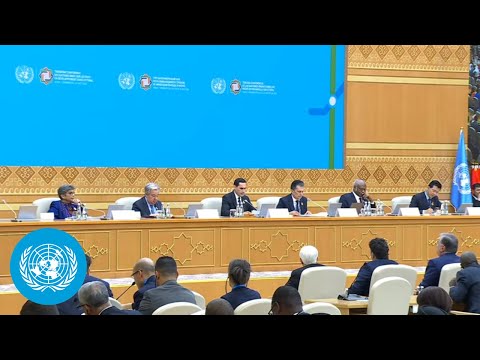
At the opening plenary of the third United Nations Conference on Landlocked Developing Countries (LLDC3) in Awaza, Turkmenistan, delegates elected President Serdar Berdimuhamedov as conference president by acclamation and approved the conference's rules of procedure and agenda.
At the opening plenary of the third United Nations Conference on Landlocked Developing Countries (LLDC3) in Awaza, Turkmenistan, delegates elected President Serdar Berdimuhamedov of Turkmenistan as president of the conference by acclamation and approved the conference's rules of procedure and agenda, officials said.
The adoption of the Awaza Programme of Action and the organization of the conference set the stage for a week of technical sessions and discussions aimed at accelerating infrastructure investment, trade and transit facilitation, digital connectivity, climate resilience and financing for the 32 landlocked developing countries (LLDCs). "Geography should never define destiny," United Nations Secretary-General Antonio Guterres told delegates in his opening statement.
Why it matters: LLDCs represent about 570 million people but account for a small fraction of global trade and face higher transport costs, limited connectivity and climate vulnerability, speakers said. Conference documents and speakers repeatedly emphasized the need for large-scale concessional finance, reforms to transit and trade rules, and targeted investments in physical and digital infrastructure.
Serdar Berdimuhamedov, opening the meeting as the conference's president, framed several Turkmenistan proposals for the global agenda. He proposed an initiative for "global medicine of the future" under United Nations auspices to strengthen medical diplomacy and the delivery of medicines to countries with limited sea access; a "global atlas of sustainable transport connectivity" to integrate LLDCs into logistics networks; a global program for a transition to hydrogen energy with a timeframe beginning in 2030 and extending through 2040; and a proposal for a global framework program on circular economy principles. He also highlighted two General Assembly resolutions his government has put forward concerning environmental cooperation for the Caspian Sea and the Aral Sea basin.
Antonio Guterres urged collective action along four priorities: structural transformation and economic diversification, digital transformation, strengthened trade transit and regional connectivity, and mobilization of funds and partnerships. He cited specific figures that conference speakers used to illustrate the challenges: goods take 42 days on average to enter and 37 days to exit LLDC borders; paved road density stands at roughly 12% of the global average; internet access is approximately 39%; and an estimated infrastructure financing shortfall of about $500 billion for LLDCs was cited in conference remarks.
The conference secretariat reported the start of implementation measures tied to the Awaza Programme of Action, including a UN system-wide roadmap and monitoring framework that organizers said includes more than 320 projects, programs and activities. The conference also established procedural arrangements for the week: five interactive thematic roundtables with named co-chairs, an organization of work (document A/conf225/2025/3) approved with an oral revision, and a credentials committee appointed to examine delegation credentials.
Quotes from plenary participants were limited to formal statements and procedural announcements. In her closing of the opening segment, the conference secretary-general said, "LLDCs may be landlocked, but they are not opportunity locked," summarizing the program's thrust toward partnership and practical deliverables.
Votes at a glance - Election of Serdar Berdimuhamedov (President of Turkmenistan) as President of the Conference: elected by acclamation (approved). - Adoption of the Rules of Procedure (document A/conf225/2025/2): adopted by acclamation (approved). - Adoption of the Provisional Agenda (document A/conf225/2025/1): adopted by acclamation (approved). - Election of Turkmenistan as ex officio Vice-President: elected by acclamation (approved). - Election of 14 Vice-Presidents (listed by region; the first set elected by acclamation included Armenia, Austria, the Plurinational State of Bolivia, Germany, Kyrgyzstan, Latvia, Lesotho, Luxembourg, Paraguay and Zimbabwe): elected by acclamation (approved). - Approval of Organization of Work (document A/conf225/2025/3) with an oral revision concerning timing of two roundtables: approved by acclamation. - Appointment of Credentials Committee (members: Plurinational State of Bolivia, Chile, China, Lao People's Democratic Republic, Lesotho, Liberia, Luxembourg, Russian Federation, United States of America): appointed by acclamation.
Discussion vs. decision: Delegates used the opening plenary for both formal procedural decisions (elections, adoptions, committee appointments) and substantive opening statements that set priorities for the Awaza Programme of Action. Procedural outcomes were recorded by the presiding officer and took effect immediately; substantive items such as Turkmenistan's proposals and the UN system's roadmap were introduced for consideration and implementation during the conference rather than being adopted as binding measures in the opening session.
Clarifying details and figures cited in plenary remarks (as stated in conference statements): the 32 LLDCs encompass roughly 570,000,000 people; LLDCs account for about 0.8% of global services exports and 0.3% of manufactured goods trade in one statement; logistics costs for LLDCs are on average 63% higher than for transit countries; goods transit times cited were 42 days to enter and 37 days to exit borders; internet access cited at 39%; paved road density cited at 12% of the global average; an infrastructure financing shortfall for LLDCs was cited at about $500,000,000,000.
Background: The conference opened with formal adoption of procedural documents so that the plenary and parallel roundtables may proceed. Speakers from host Turkmenistan, the United Nations Secretariat and representatives of member states emphasized a focus on financing, connectivity, climate resilience, digital inclusion and partnerships with transit countries, multilateral development banks and the private sector. Several speaker statements called for specific follow-up mechanisms, including a proposed high-level UN panel on freedom of transit and the creation of an infrastructure investment facility for LLDCs.
Next steps: The conference program moves into general debate and scheduled thematic roundtables and technical sessions during the week to elaborate implementation modalities for the Awaza Programme of Action, launch partnerships, and refine monitoring and financing arrangements.