Get Full Government Meeting Transcripts, Videos, & Alerts Forever!
Get email alerts on the Public Transportation topic
No spam. Unsubscribe anytime.
House transportation panel probes May 14 urban-train power failure; Luma and ATI ordered to share reports
Summary
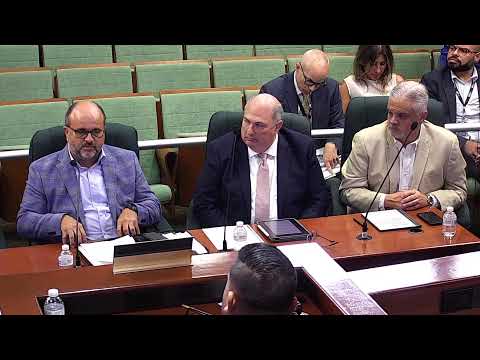
The Commission on Transportation and Infrastructure of the Puerto Rico House of Representatives convened a public hearing at 10:06 a.m. to investigate a May 14, 2025 electrical incident that damaged equipment at the urban train's traction substation and disrupted service. Luma Energy told the commission its records indicate the fault originated inside the train operator's facilities; the Autoridad de Transporte Integrado (ATI) said a preliminary report is ready and a final report is expected by the end of the month.
The Commission on Transportation and Infrastructure of the Puerto Rico House of Representatives convened a public hearing at 10:06 a.m. to investigate a May 14, 2025 electrical incident that damaged equipment at the urban train's traction substation and disrupted service. Luma Energy told the commission its records indicate the fault originated inside the train operator's facilities; the Autoridad de Transporte Integrado (ATI) said a preliminary report is ready and a final report is expected by the end of the month.
Why it matters: the power problem triggered protection failures that left roughly 47,547 customers of Luma without service (Luma’s estimate reported at the hearing) and took several train stations and maintenance facilities temporarily offline. Lawmakers pressed both Luma and ATI for technical logs and maintenance records to determine cause, responsibility and steps to prevent recurrence.
Luma presentation and its conclusion Rebeca Maldonado, representing Luma Energy, told the commission that Luma operates Puerto Rico’s transmission and distribution system “up to the point of delivery to customers” and that customer-owned equipment beyond that point is the customer’s responsibility. In her prepared remarks, Luma stated that the urban-train electrification system is fed by five primary substations, that traction runs on a 750-volt direct-current third rail to 10 stations, and that auxiliaries and other station power are supplied from the same network.
Oscar Bolado, director of protection and control engineering at Luma, described the May 14 event as a fault first reported at about 2:46 a.m. at the Martínez Nadal substation. He said a fault on a 480-volt distribution system propagated to higher-voltage lines and that some of the customer protection schemes did not operate on one side of the system. Luma reported its remote backup operations cleared the fault in 1 minute 27 seconds and said its SCADA and disturbance recorders show the initial fault originated inside the customer’s (ATI’s) installations. “Nuestros registros indican que la falla se originó dentro de las instalaciones del cliente,” Bolado told the commission.
ATI and operator response Josué Menéndez Agosto, executive director of the Autoridad de Transporte Integrado, told the commission ATI already has a preliminary report and expects a final report by the end of the month. He said ATI and the train operator are cooperating with Luma and federal and external technical reviewers (including, ATI said, representatives from the Federal Transit Administration and external consultants) and that further protective-settings tests and documentation remain outstanding.
Manager Luis Villares and operations manager Miguel Ramírez, who identified themselves as part of the train operator and maintenance contractor, said they are performing cable replacements, breaker replacements and other corrective work on affected traction equipment and completing final verification tests on the BPS (point of connection) prior to staged energization. Ramírez said the operator was finishing tests of the BPS‑1 point of connection; once Luma authorizes energization and documentation shows protections are ready, the operator will run verifications and progressively energize traction sections from Bayamón toward Martínez Nadal.
Deadlines and document requests from the commission The commission pressed both parties for documents and set specific deadlines: it granted three business days for a written ponencia (presentation) and asked Luma to provide the disturbance-record exports and system-report evidence cited in its presentation within five days. The commission also requested ATI provide its preliminary report and the operator provide the last month of maintenance logs within three business days; ATI said the final report should be ready by the end of the month. Those directions were recorded on the hearing record and described in questioning by the commission chair and members.
Scope of damage, ridership and service impacts ATI’s representatives told the commission initial damage estimates to the traction substation equipment were a minimum of $5 million; the director later said current estimates already approach $7–8 million and that costs could rise as inspections continue. The operator reported daily ridership normally ranges between roughly 15,000 and 20,000 patrons at peak season; since the incident reported ridership has been about 7,000 daily. ATI confirmed that train fares remain suspended (service is free at present).
Safety and recurrence concerns Lawmakers repeatedly asked whether the event could recur and whether Luma could have caused an overvoltage or overload. Luma engineers told the commission their time-stamped records show voltage at the 38‑kilovolt line feeding the system remained within normal parameters before and during the disturbance and that Luma’s system did not exhibit overvoltage conditions. Luma therefore concluded the event was not attributable to a Luma overvoltage on the 38‑kV system. ATI and the operator said they still need Luma’s detailed disturbance records and protection-test results to complete their root‑cause work.
Next steps ATI, Luma and the operator said they will continue coordination; the commission scheduled a follow-up and said it would review the documents submitted under the deadlines. The companies also confirmed federal reviewers and external consultants are assisting analysis. Commission members emphasized they want clear cause attribution and corrective measures before full restoration of all stations.
Ending The hearing closed after lawmakers and presenters reiterated the deadlines for technical records and the expected timetable for the final ATI report. The commission said it will reconvene or request further briefings if the materials provided do not answer outstanding technical questions.