Lifetime Citizen Portal Access — AI Briefings, Alerts & Unlimited Follows
Reentry advocates urge Council to keep ORCA independent as mayor moves office into EOM
Loading...
Summary
At a June 4 budget oversight hearing, returning citizens, providers and policy groups urged the Council’s Committee on Housing to reject a mayoral plan to fold the Mayor’s Office on Returning Citizens Affairs (MORCA/ORCA) into the Executive Office of the Mayor and to restore or preserve the office’s funding.
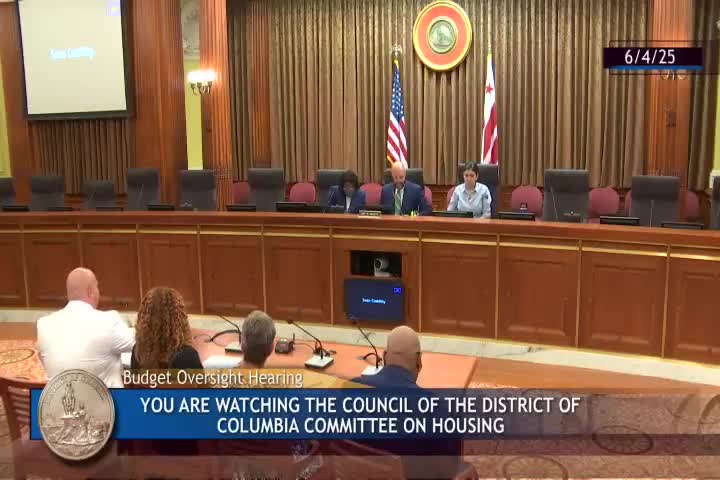
Chairman Robert White called a Committee on Housing budget oversight hearing on June 4 to review the mayor’s FY2026 proposals for the Mayor’s Office on Returning Citizens Affairs (ORCA or MORCA) and related programs. The hearing drew returning citizens, community providers and policy groups who warned that folding MORCA into the Executive Office of the Mayor (EOM) and cutting its funding would erode services for people leaving incarceration.
Advocates said the proposal would weaken a dedicated reentry office. “I urge the council to reject the proposal to absorb the Office of Returning Citizens Affairs into the Executive Office of the Mayor and to restore its full funding,” said Zachary Rigone, policy director at the National Returning Network for Returning Citizens. Rigone said the proposed budget “strips nearly a third of ORCA’s funding” while expecting it to continue the same level of work and that the office’s public identity and trust built with returning residents would be lost if it were buried inside a larger agency.
Residents and community providers described programs that rely on MORCA’s coordination. Samuel Buggs, a Jubilee Housing board member and formerly incarcerated resident, testified that access to affordable housing and wraparound services “allowed me to rebuild my life.” Gabby Smith, program director of Career Shop DC, told the committee her organization placed 11 of 13 participants from recent cohorts into jobs and said community-based job programs rely on referral relationships with MORCA. Tracy Velasquez, Policy Director at the Council for Court Excellence, described MORCA as the first legislatively mandated reentry office in the country and said the mayor’s FY26 proposal “zeros out funding for MORCA” in some documents she reviewed and would amount to shutting down much of the office’s work unless funding is preserved.
Several witnesses asked the Council to preserve MORCA’s public-facing status and funding. “You can’t replace that by sticking people with reentry titles in cubicles in the mayor’s office,” Rigone said. Taylor Castellanos, founder of Who Speaks For Me, asked the Council to create a dedicated grant stream for returning-citizen-led nonprofits and to route that money through the Office of Victim Services and Justice Grants so community organizations with lived experience could receive stable funding.
MORCA’s executive director, Lamont Carey, told the committee the administration plans to move the MORCA budget chapter into the EOM in FY26 to “streamline administrative operations and improve coordination” but said there are no proposed cuts to operating staff or core frontline programs. Carey listed programs that will continue in FY26, including the Georgetown Paralegal Program, the Access to Jobs subsidy, smart trip Metro card distribution and planned Federal Bureau of Prisons institution trips. Carey said the proposed FY26 budget “fully funds MORCA at current levels” and that location, staff and services will remain intact even after the administrative move.
Councilmembers pressed both sides on oversight and funding detail. Chairman White asked Carey to follow up with the Office of the Mayor on line-item transfers the committee’s staff flagged: Carey identified a $597,747 transfer that will move programs (paralegal and smart trip components) into the EOM chapter and acknowledged an apparent $371,772 reduction in non-personnel funds that the mayor’s chief of staff will explain at an upcoming budget hearing. Committee members said the Council needs clear line-item detail to confirm there are no effective cuts to services.
Witnesses also raised operational gaps tied to local housing and support systems: Jubilee Housing and others said the District lacks an in-city halfway house after Hope Village closed, increasing dependence on out-of-state placements; MORCA and partners said growing numbers of people are returning from federal custody; and providers noted rising behavioral-health and Medicaid eligibility pressures that intersect with reentry needs.
The hearing produced no formal action by the committee. Councilmembers and witnesses agreed to follow up: the committee will request detailed budget line-item clarifications from the Mayor’s Office and asked MORCA to provide data the Council can use to judge whether services and staffing remain equivalent after the chapter move. Several advocacy witnesses asked the committee to restore or preserve previous funding levels and to create dedicated grant streams for community-based, returning-citizen-led providers.
Ending: The committee kept the administrative record open for written follow-up and asked agency leadership to provide detailed budget mappings and program performance data before final FY26 decisions.