Get Full Government Meeting Transcripts, Videos, & Alerts Forever!
Get email alerts on the Emergency Medical Services topic
No spam. Unsubscribe anytime.
Austin‑Travis County EMS reports vacancies easing, expands Narcan distribution and plans ambulance automatic‑aid rollout
Summary
At the Public Safety Commission, Austin‑Travis County EMS reported progress on staffing, a large increase in Narcan distribution, new ambulance automatic‑aid planning with Williamson County and ESDs, upcoming academies, and remaining 2018 bond station projects.
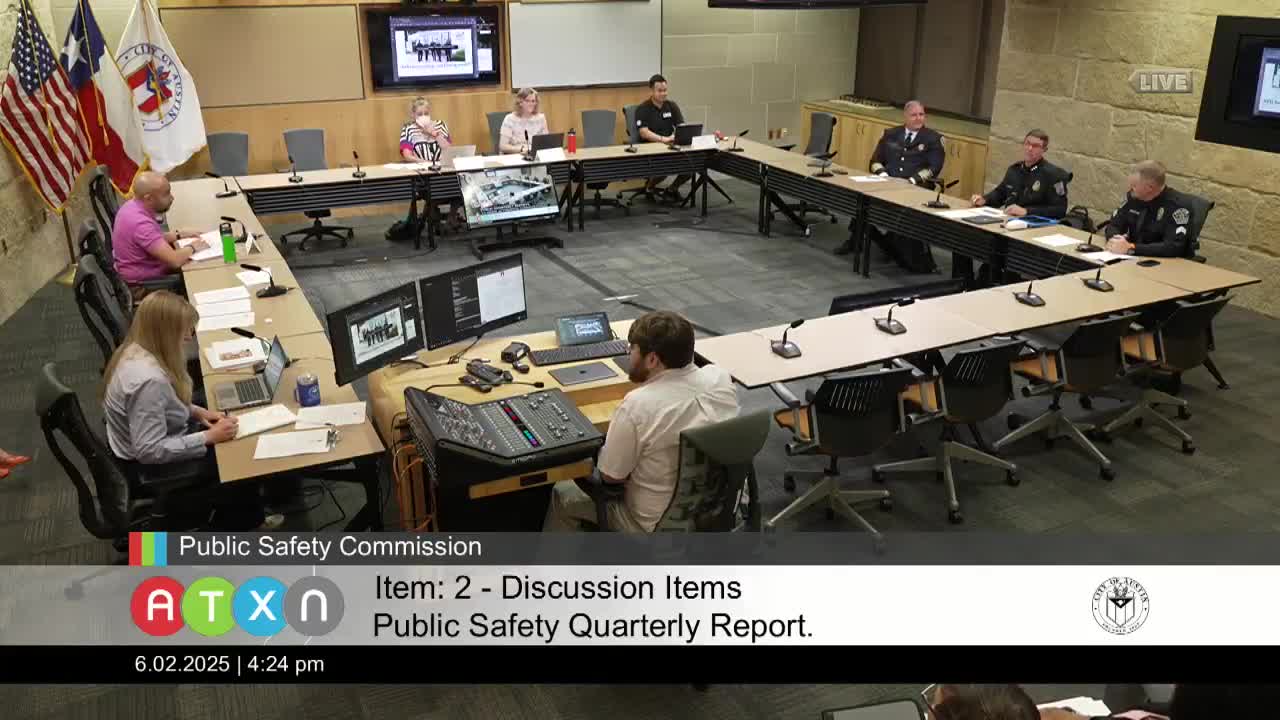
Wes Hopkins, chief of staff for Austin‑Travis County Emergency Medical Services, told the Austin Public Safety Commission that EMS staffing is improving but vacancies remain.
“Current EMS department staffing authorized strength is 714. Field sworn is 626,” Hopkins said during the commission’s quarterly update. He reported sworn vacancies have declined from prior quarters and described retirements concentrated among longer‑tenured employees as well as separations in the one‑to‑five‑year range.
Hopkins said the department distributed 3,227 Narcan rescue kits in fiscal‑year 2025 Q2, up from about 2,000 kits in Q1. The department is tracking opioid alerts and geolocation heat maps to target outreach and harm‑reduction distribution; Hopkins said March 2025 registered the lowest number of opioid alerts since September 2021 but the agency is preparing for a typical summer rise.
Hopkins described a planned ambulance automatic‑aid interlocal agreement to dispatch the closest 911 ambulance across jurisdictions, similar to existing fire automatic aid. The agreement would include Austin‑Travis County EMS, several Emergency Services Districts (ESDs), Pflugerville Fire Department, Lago Vista Fire Department and Williamson County EMS. Hopkins said Williamson County’s recent computer‑aided dispatch migration and other technology upgrades are enabling the project and the department is targeting a go‑live date in March 2026.
On staffing development, Hopkins corrected a slide mislabeling and described recent and upcoming cadet classes: the class graduated March 28; a July academy (class 7/25) will start July 14; and a later academy (class 10/25) is planned. Hopkins said the department’s internal paramedic program has produced medics who recently passed national registry and are moving into clinical‑specialist roles, which will shift vacancy counts in future quarterly reports.
Hopkins also reviewed facilities work tied to the 2018 bond: five new joint fire/EMS stations are complete, several other stations have been replaced or renovated, and three bond projects remain (EMS stations noted in the transcript as Station 1, Station 5 and Station 10). He said one downtown station (EMS Station 3) requires deferred‑maintenance renovation because it is currently located in a parking garage that constrains operations.
Hopkins closed with nonoperational highlights including awards for dispatch staff and an annual EMS awards ceremony. Commissioners asked follow‑up questions about automatic‑aid operations, Williamson County staffing models and invitations for commissioners to attend award or graduation events.