Get Full Government Meeting Transcripts, Videos, & Alerts Forever!
Get email alerts on the School Based Behavioral Health topic
No spam. Unsubscribe anytime.
Parents and providers warn FY26 cuts would destabilize DC school-based behavioral health program
Summary
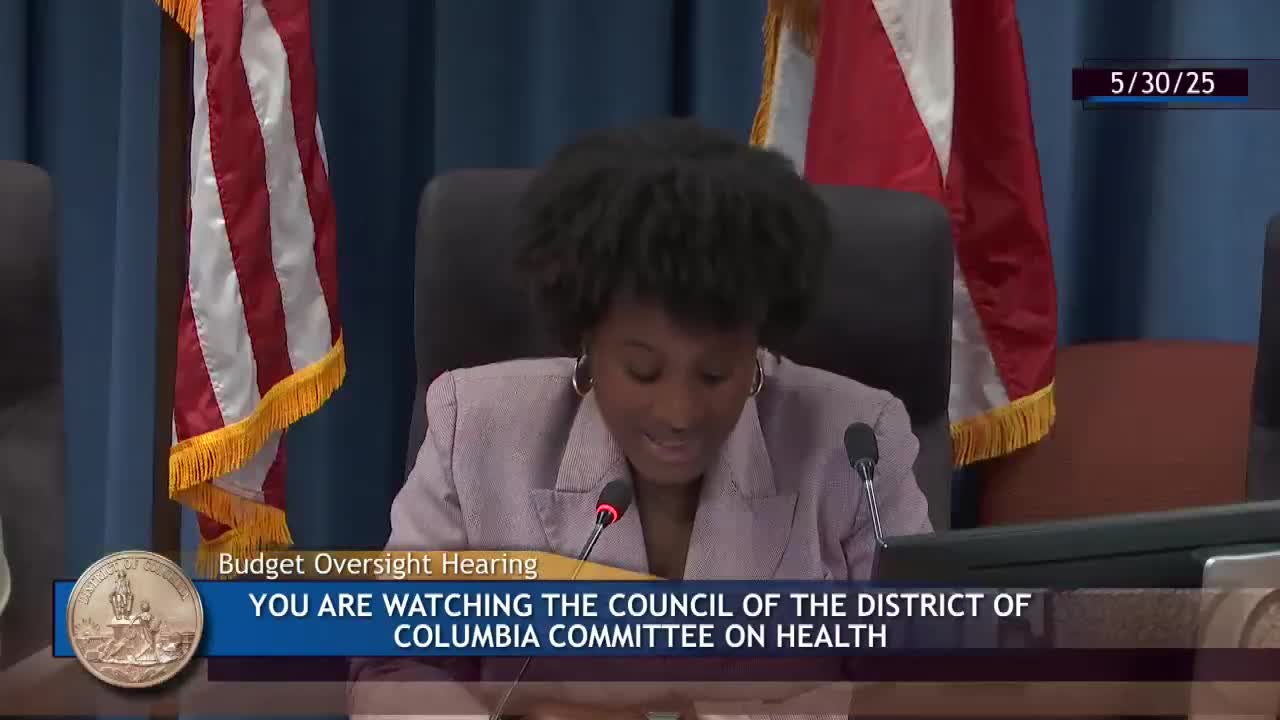
Chair Christina Henderson convened the Committee on Health on May 30 for public testimony on DBH’s FY26 proposal, and parents, clinicians and CBOs warned that proposed reductions to school‑based behavioral health funding would destabilize services and force community providers to operate at a loss or exit the program.
Chair Christina Henderson convened the Committee on Health on May 30 for the first of two oversight hearings on the Department of Behavioral Health's proposed FY26 budget. Public witnesses — including parents, community-based organizations and provider networks — spoke repeatedly about proposed cuts to school-based behavioral health and urged the Council to preserve or stabilize the program.
Leah Kaslaz, senior policy attorney at Children’s Law Center and co‑chair of the Strengthening Families Coalition, told the committee, “The mayor's proposed budget for DBH includes a $3,300,000 cut to the school based behavioral health expansion program.” Kaslaz said that DBH’s budget books do not clearly show how DBH is allocating $25,400,000 for school‑based behavioral health across expansion grants, DBH clinicians, evaluation, and other lines and asked the committee to require DBH to provide a detailed breakdown.
Kaslaz and other witnesses argued that the way the expansion grant is structured creates billing pressures that make community‑based organizations (CBOs) financially unsustainable. “CBOs typically manage to collect only 30% of their billed amounts due to insurance challenges,” said Kristen Ewing, policy counsel at D.C. Appleseed. Ewing recommended establishing a minimum grant amount so CBOs are not forced to “operate at a loss or leave the program.” Several witnesses proposed a $129,000 minimum grant for schools that already have CBO clinicians in place.
Providers and parent leaders described how grant instability and narrow billing targets shift clinicians away from nonbillable but essential work such as classroom consultation, family engagement and prevention services. Laura Patton, clinical supervisor of school‑based mental health at Mary’s Center, described a case in which a student’s acute needs required many nonbillable activities — coordination with teachers, family therapy and psychiatric consultation — and said the clinician’s billable encounters dropped by 5 to 8 sessions per week while the nonbillable workload increased. “When a need for nonbillable support arises, billable services suffer,” she said.
Parents and student advocates said the services translate directly into classroom attendance, behavior and academic progress. Keanu Lamont, a Ward 7 parent, said school‑based clinicians “help students build coping skills” and that proposed reductions would harm students’ ability to learn. Multiple parent leaders and students urged the Council to restore the funding or, at minimum, adopt the proposed minimum grant to retain clinicians.
Several witnesses noted the uneven mix of in‑school supports: schools sometimes have guidance counselors or psychologists focused on special education, but those staff do not consistently provide the tiered, clinical services DBH expansion grants intend to fund. Providers said the variation means a single clinician in a school can be the only licensed mental‑health professional handling both billable therapy and nonbillable prevention and crisis supports.
Council Chair Christina Henderson asked several witnesses for specifics the committee could require from DBH, including a more detailed breakdown of how DBH is currently allocating school‑based funds and whether the proposed reductions reflect unspent funds, staffing vacancies, or intentional program cuts. Several witnesses also asked DBH and the Council to reduce administrative burdens and to make grant payments timely and predictable so CBOs can plan staffing and hiring.
The committee did not vote on funding at the hearing. Witnesses asked the Council to preserve existing expansion funding in FY26, to set a minimum grant of $129,000 for schools with CBO clinicians already placed, and to require DBH to provide clearer budget line detail and program performance data.
Ending: The committee recessed the hearing and scheduled the second part of the DBH budget oversight hearing for Monday, June 2, when agency leaders are set to appear. Witnesses asked the Council to act before finalizing FY26 numbers to avoid clinician attrition and service instability that, they said, would directly reduce students’ access to behavioral health care.