Lifetime Citizen Portal Access — AI Briefings, Alerts & Unlimited Follows
Indian River County planning board recommends denying Florida Gardens rezoning for 44‑lot subdivision
Loading...
Summary
The Planning and Zoning Commission voted to recommend denial of a request to rezone 18.08 acres from AG‑1 to Planned Development for the Florida Gardens project, citing concerns about lot sizes, setbacks, density and traffic near Glendale Elementary School.
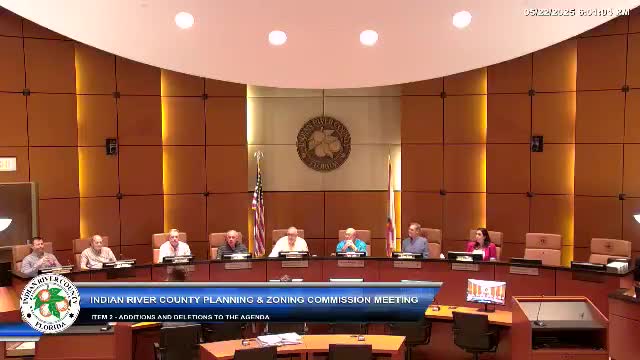
The Indian River County Planning and Zoning Commission voted to recommend denial of a rezoning and concurrent preliminary planned development (PD) plan and plat for the Florida Gardens project, a proposed 44‑lot, single‑family subdivision on approximately 18.08 acres east of 50 Eighth Avenue and west of 40 Third Avenue.
The commission’s recommendation — to deny rezoning from AG‑1 (Agricultural) to PD and to deny the associated conceptual PD plan and preliminary PD plat — was made by a commissioner during the meeting and passed on a roll call vote that split the commission (denial votes recorded for Robert Votel, Calvin Reams, Tom Lowther and John Campbell; opposition recorded from Jonathan Day, Jordan Stewart and Mark Moocher). The denial is a recommendation that will be forwarded to the Board of County Commissioners (BCC) for final action.
Why it matters: Commissioners and nearby residents raised recurring concerns about small lot widths, minimal side setbacks, building coverage, and the capacity and condition of Eighth Street, which sits adjacent to Glendale Elementary School. Commissioners said the plan’s reduced lot and setback standards make the development more like recently constructed PD subdivisions that drew heavy public criticism.
Staff presentation and project details
Brandon (county staff) told the commission the applicant, K. Ponanian Southeast Florida Division LLC with agent MBB Engineering Inc., proposed a PD rezoning and concurrent preliminary PD plan and plat so the full package goes to the BCC together. The site would be developed with a loop road, a stormwater pond on the eastern half of the property and a full‑access driveway onto Eighth Street.
The plan calls for 44 single‑family lots on 18.08 acres (2.43 units per acre). Proposed PD standards include two lot widths (70 feet and 62 feet), side setbacks as small as 6 feet on the 62‑foot lots (12 feet separation between buildings where both lots use the 6‑foot side setback), and a maximum building coverage higher than conventional RS‑3 standards. Staff said the PD would supply public benefits — Eighth Street improvements including a paved segment to better serve Glendale Elementary School, milling and resurfacing on a stretch of Eighth Street, internal sidewalks, street lighting, and expanded landscape buffers and conservation easements.
Public comment and applicant response
Several nearby residents spoke against the rezoning, focusing on traffic and safety for schoolchildren at Glendale Elementary School, drainage and proposed lot proximity to existing homes. Norman Met of Laurel Oaks said during public comment, “Traffic, traffic, traffic, traffic,” and urged a no vote until infrastructure concerns are resolved.
Applicant representatives, identified at the hearing as Angie Bitter (MBB engineer and planner) and Matt Nelson (director of entitlements), said they had worked with county staff for about a year to craft the PD. In a direct comment to the commission, Matt Nelson said the PD process offered buffers and open space that straight RS‑3 zoning would not, adding, “we spent a year working with County staff on what the public benefits will be on the design, on buffering from the neighbors.” The applicant also said a traffic study using county methodology found the nearby roads operating at acceptable levels and that each new home would pay county transportation impact fees.
Commissioner concerns and technical points
Commissioners raised several technical and policy concerns during discussion: small side yard setbacks (particularly 6 feet on 62‑foot lots), tight lot widths paired with large building‑coverage allowances, potential parking over sidewalks given a 20‑foot garage setback from the sidewalk, drainage conveyance between closely spaced homes, emergency access, and the cumulative effect of multiple PD proposals in the area. Staff clarified that the 6‑foot side setback is measured on each lot (resulting in 12 feet between buildings when both lots use the 6‑foot setback) and that building code requires treatments for eaves where separation is narrow.
The commission also discussed nearby developments (including Hampton Park) and a town‑hall for this project held April 29, 2025, attended by about 28 surrounding property owners. Staff pointed to buffers the applicant agreed to: a 31‑foot Type B landscape buffer on the west, upland conservation easements of 50 to 150 feet on part of the south boundary, and 25‑foot buffers along northern and eastern property lines. The applicant also described stormwater design intended to collect and treat on‑site runoff and discharge to the site’s eastern ditch; they said preserve areas would remain undisturbed.
Action and next steps
A commissioner moved to deny the AG‑1 to PD rezoning, conceptual PD plan and preliminary PD plan/plat; another commissioner seconded. The motion to recommend denial passed by roll call (recorded yes for denial: Robert Votel, Calvin Reams, Tom Lowther, John Campbell; recorded no: Jonathan Day, Jordan Stewart, Mark Moocher). Commissioners and staff noted the Planning and Zoning Commission’s decision is a recommendation and will be included in the staff report to the Board of County Commissioners, which will make the final determination.
Commissioners asked staff to present the reasons for denial in the BCC staff report. Several commissioners suggested the board pursue a workshop or formal review of the county’s PD regulations to address recurring community concerns about lot sizes, setbacks and what some called an adoption of “national” PD standards instead of local norms.
Provenance: The transcript of the hearing records the staff presentation, public comments and applicant statements that formed the basis for the commission’s recommendation. The commission’s motion and the roll call vote are recorded on the transcript and will be forwarded in the case file to the BCC.
What to watch next: The BCC will receive the Planning and Zoning Commission’s recommended denial in its staff report; the BCC date for final action was not set at the hearing. Staff indicated the commission may consider a formal item or workshop about PD process changes at a future meeting.