Get email alerts on the Land Use Development topic
No spam. Unsubscribe anytime.
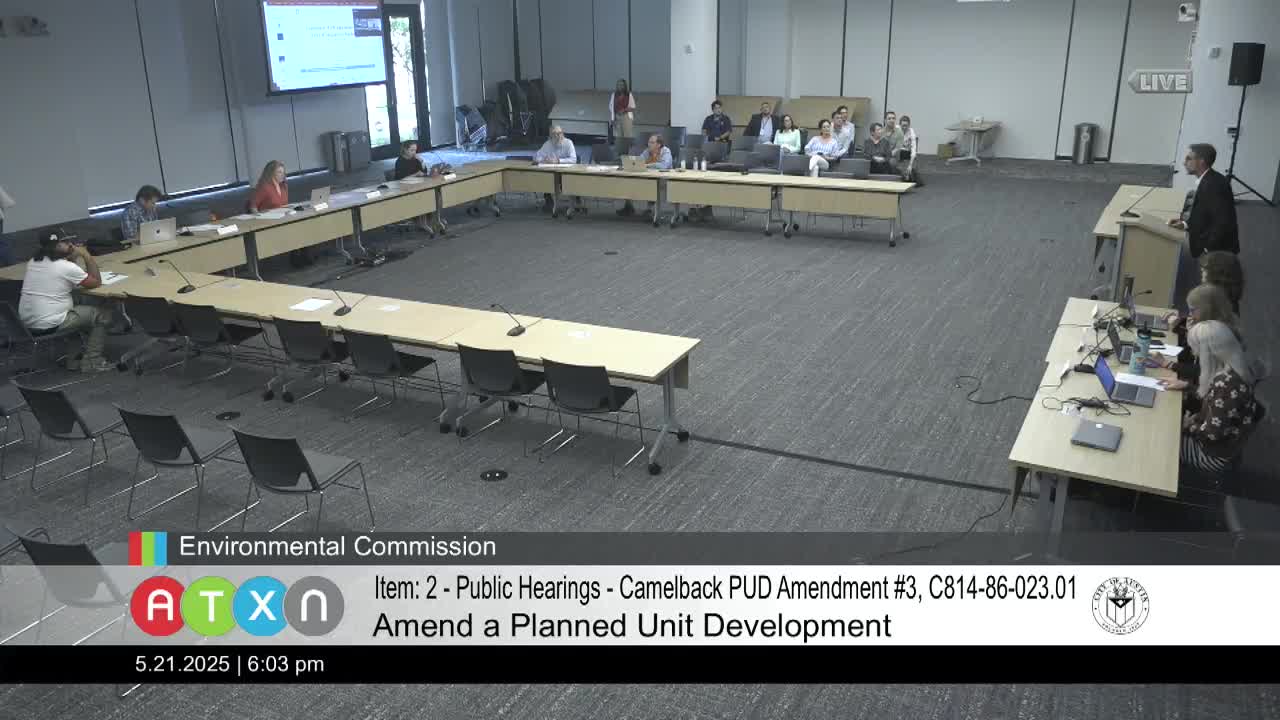
Environmental commission recommends Camelback PUD amendment to replace funicular with cart path
Summary
The Austin Environmental Commission on May 21 recommended approval of Camelback Planned Unit Development Amendment No. 3, allowing a 15‑foot cart path and limited changes to cut‑and‑fill in place of a previously required mechanized access (funicular).
The Austin Environmental Commission on May 21 recommended approval of Camelback Planned Unit Development (PUD) Amendment No. 3, which would allow a 15‑foot cart path and off‑site surface access to the development’s Dock District instead of a previously required mechanized access (funicular). The commission voted unanimously to forward the request to the Zoning and Platting Commission and city council with conditions addressing lighting, revegetation and limits on additional cut and fill.
The recommendation matters because the Camelback site borders Lake Austin and contains multiple critical environmental features, and the amendment trades a large mechanized structure for a smaller, graded cart path while changing allowable fill in a few localized areas. The commission’s action documents staff findings that the cart path would have fewer tree‑clearing and visual impacts than the funicular and attaches explicit environmental mitigation requirements before the amendment advances.
Shawn Watson, environmental program coordinator with the Watershed Protection Department, presented the amendment as project C81486‑023.03. Watson described the site as about 143.1 acres in northwest Austin within the Lake Austin and Cold Creek watersheds and said the 2018 PUD had included a required 800‑foot mechanized access (funicular) from the ridge to a community dock area. Watson summarized the amendment’s two principal changes: (1) allowing a 15‑foot‑wide cart path from the mixed‑residential area to a connector on the adjacent property instead of the funicular, and (2) modest changes to cut‑and‑fill allotments, including a limited increase in allowable fill depth for a short section of fire lane construction.
Applicant comments and neighborhood support
The applicant (identified in the hearing as Jonathan) told commissioners the amendment results from a multiyear effort to negotiate access and avoid the environmental and visual impacts of the funicular. He said the developer reached an agreement to acquire and then lease back a portion of the adjacent property, which would allow the cart path alignment and remove the necessity of the funicular. The applicant said the cart path would be used by small electric vehicles and pedestrians and that emergency and gas‑powered service vehicles would continue to use existing paved roads.
Two neighborhood leaders — Marisa Pareda Lipsher, president of the Shepherd Mountain Neighborhood Association, and Linda Bailey (who also said she represented multiple adjacent neighborhoods) — told the commission they had worked with the applicant for years and supported the amendment, specifically praising the removal of the funicular, added parking commitments and the increased number of residential units in lieu of office uses.
Environmental tradeoffs and technical details
Watson and city staff presented several technical points the commission discussed: the funicular would have required extensive excavation and vegetation removal at the base and up the bluff, including impacts to heritage pecan trees near the proposed base. The cart path, by contrast, would be routed to minimize tree impacts, stay outside a rim‑rock setback in the presentation, and use existing grade variations so fewer trees and less shoreline disturbance are expected. City arborist Naomi Rotramel said staff visited the cart‑path alignment and observed no heritage trees (defined by the City of Austin Heritage Tree Ordinance) in the proposed path across the extraterritorial jurisdiction segment that the city does not regulate; Rotramel said the cart path avoids the three heritage trees that construction for the funicular would have threatened.
The amendment also adjusts cut‑and‑fill allotments. The 2018 PUD allowed limited cut up to 28 feet in certain areas for fire lanes and other infrastructure; the current amendment keeps the 28‑foot cut allowance but proposes up to 30 feet of fill in a roughly 45‑square‑foot area associated with a fire access road. Leslie Lilly of Watershed Protection clarified that the amendment shifts some fill allowances between depth ranges but does not create a blanket unlimited cut‑and‑fill concession; staff said the net disturbed area would not increase and that some grading caused by the funicular’s base would be avoided if the cart path is built.
Parkland, shoreline and docks
The applicant reiterated that the project dedicates parkland along the cliff and that the developer intends to donate improvements and fund long‑term maintenance by a homeowners association. The applicant said the project preserves roughly 90 percent of the 145‑acre property as parkland and preserves about 2,400 feet of shoreline from private docks; instead of multiple private shoreline stairs, the PUD includes a single community dock configuration. The applicant said the lake clubhouse footprint is unchanged and that mechanical equipment originally housed in the funicular base would be relocated into the existing clubhouse without expanding its footprint.
Endangered species and tree protection
Commissioners asked about the Balcones Canyonlands Conservation Plan (BCCP) and karst/endangered species protections. Staff said endangered‑species permitting and BCCP coordination are handled by the appropriate regional programs; Allison (Kimley‑Horn) said the project has a BCCP participation letter for required mitigation for tree clearing. Staff said if karst voids or potential habitat are discovered during excavation, work must stop and the watershed geologists and appropriate specialists will be called to assess and direct next steps.
Commission condition language and vote
After discussion, the commission moved and seconded a recommendation to approve the PUD amendment with the conditions recommended by staff plus two environmental commission conditions: dark‑sky and bird‑friendly lighting throughout the property including the cart path and dock area, and restoration/replanting of all areas disturbed by cart‑path construction with a native‑plant management plan. The vote was unanimous. The commission recorded the recommendation for Amendment No. 3 and noted that parkland details and any additional park‑related alignment work will return to the parks board in a later amendment once park and TxDOT coordination is further developed. The commission recorded its recommendation as a forwarded variance/action; the zoning and planning commission is scheduled June 3 and city council on June 5.
What happens next
The Environmental Commission’s recommendation will be part of the administrative record as the PUD amendment moves to the June zoning and planning hearing and then to City Council. Staff and the applicant told commissioners the cart path option depends on the adjacent property acquisition and that language in the PUD will prohibit construction of both the funicular and the cart path — only one access type can be built.
AI generated
The text on this page is AI generated. Summaries, highlights, analysis, and video transcripts are all produced from the original source material.
AI can make mistakes, so if you spot one, and we will fix it for everyone.
Note: the source content is unaltered by us. Any content source we link to, be it a video, an audio recording, or a document, is presented exactly as its publisher released it. That publisher is usually a government body, sometimes an individual official or another organisation.