Lifetime Citizen Portal Access — AI Briefings, Alerts & Unlimited Follows
Survivor services providers urge restoration of $1M for domestic violence housing and supports
Loading...
Summary
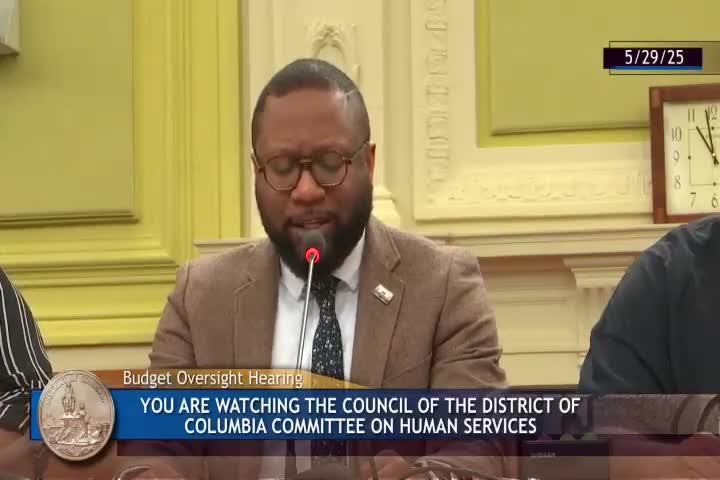
Representatives of DASH, House of Ruth, Calvary Women's Services and coalition partners told the Committee on Human Services that proposed cuts to domestic violence services and related housing lines would deepen risks for survivors and children.
Lede: Representatives of DASH, House of Ruth, Calvary Women's Services and coalition partners told the Committee on Human Services that proposed cuts to domestic violence services and related housing lines would deepen risks for survivors and children.
Nut graf: Witnesses noted that survivors are a large share of the homeless population in DC and that domestic violence services receive a small fraction of DHS family funding. They asked the council to restore $1 million to the domestic violence services line for FY26 and to consider larger recurring increases recommended by the Victim Assistance Network.
Body: Multiple service providers testified that domestic violence is a leading cause of homelessness in the district and that many survivors enter the general homeless services system rather than DV-specific housing. Kashions of testimony included:
- DASH representatives said cuts to ERAP ($22M cut cited by witnesses) and other access to justice funding threaten survivor services and would require eliminating positions and shrinking flexible survivor funds used to avert immediate crises. DASH requested a $1,000,000 restoration to FY25 levels and a longer-range Victim Assistance Network recommendation of $7.8 million for domestic violence services.
- House of Ruth and Calvary Women's Services urged the committee to protect the continuum of gender-specific, trauma-informed housing including transitional and permanent supportive housing, and to restore the $1,000,000 in cuts. Speakers highlighted that nearly half of adults and families in the Point-in-Time Count identified as survivors of domestic or intimate partner violence.
Speakers asked the council to avoid policy/financial changes that produce delays in payments, to fund advance payments or bridge funding to nonprofit contractors, and to restore baseline funds so providers don't need to use credit lines to cover payroll when contracts are late.
Ending: Committee members heard multiple specific restoration requests and were urged to consider an additional $1 million to keep FY25 domestic violence funding levels and to adopt more systematic payment reforms to avoid program disruptions. DASH and coalition leaders signaled readiness to submit written budget platforms and further data for markups.